
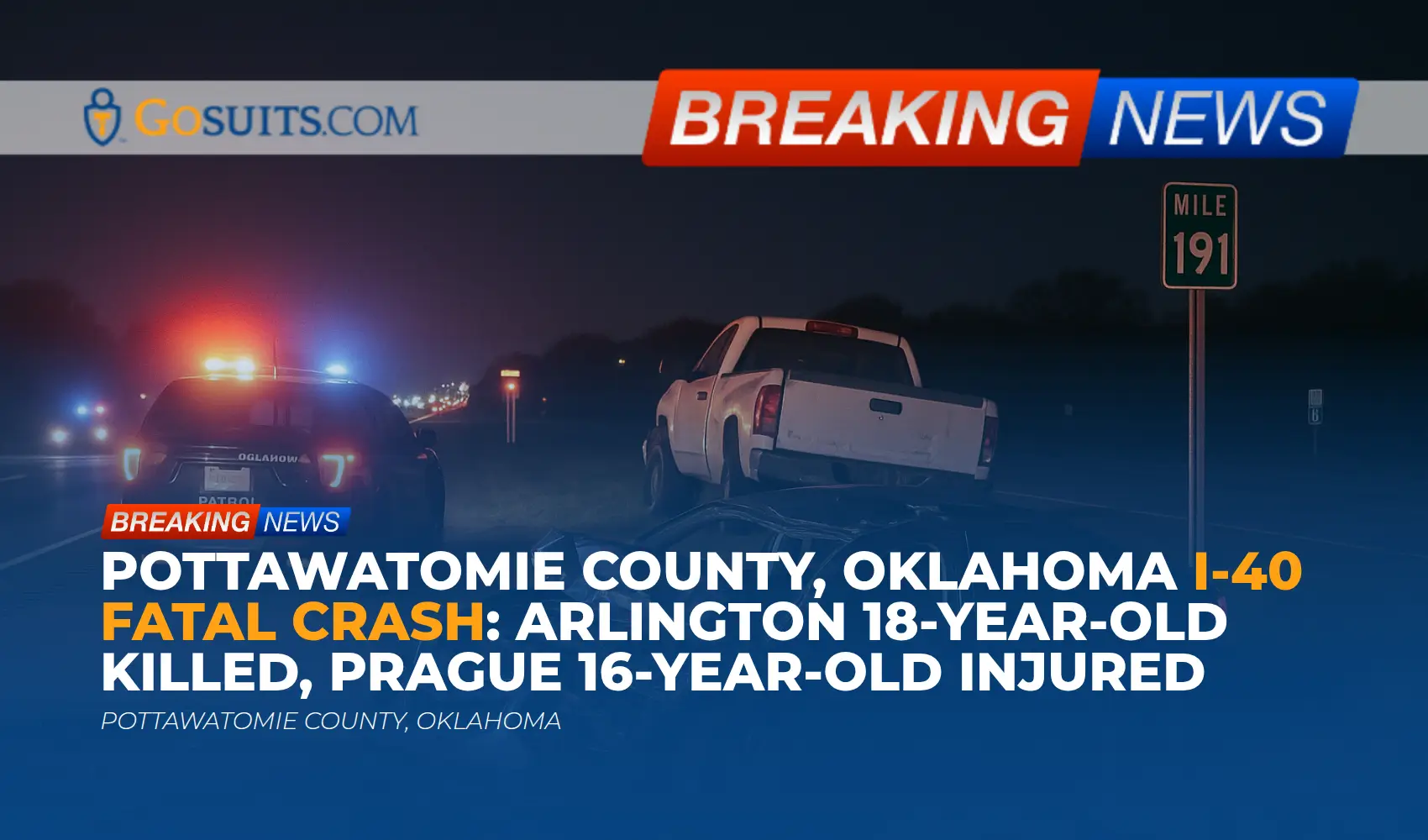
Home » Blog » Blog » Pottawatomie County, Oklahoma I-40 Fatal Crash: Arlington 18-Year-Old Killed, Prague 16-Year-Old Injured
Overview of the reported collision on Interstate 40 in Pottawatomie County
A late evening crash on Interstate 40 in Pottawatomie County has left an 18-year-old from Arlington, Texas deceased, according to the Oklahoma Highway Patrol. Initial reports indicate the teen was in a vehicle that had come to a stop in the left westbound lane near mile marker 191 when it was struck from behind by another vehicle. The impact pushed the stopped vehicle off the roadway and into a ditch. The driver of the second vehicle, a 16-year-old from Prague, sustained injuries. Incidents like this are devastating. High-speed interstates leave very little margin for error, especially when a vehicle becomes disabled or stopped in a travel lane. Families are often left with urgent questions about what happened, what agencies to contact, and how to protect their rights in the days that follow. The information below brings together the publicly reported facts, general safety context, and practical guidance on obtaining official records and understanding the civil legal landscape after a fatal crash.
What we know so far: time, location, and initial OHP account
Based on the initial information attributed to the Oklahoma Highway Patrol: – The collision occurred at approximately 9:20 p.m. on October 16. – The location was Interstate 40 westbound in Pottawatomie County near mile marker 191. – The teen decedent was inside a vehicle that was stopped in the left lane of travel. – A second westbound vehicle struck the rear of the stopped vehicle. – The struck vehicle left the roadway and came to rest in a ditch. – The second vehicle’s driver, reported as a 16-year-old from Prague, was injured. – The teen who died was reported by OHP as being from Arlington, Texas. These are preliminary details. Law enforcement crash investigations often continue for weeks while troopers review scene data, vehicle condition, occupant information, roadway factors, and any available video or witness accounts. If a detailed collision report or reconstruction becomes available, it can provide further clarity on contributing factors.
Who was involved and reported conditions
– Decedent: An 18-year-old male from Arlington, Texas. He was reported to be inside the stopped vehicle at the time of impact. – Other driver: A 16-year-old from Prague who was injured in the crash. – Roadway: Interstate 40 westbound, left lane, near mile marker 191 in Pottawatomie County. – Time: Approximately 9:20 p.m., which indicates nighttime conditions. Visibility, roadway lighting, surrounding traffic, and weather are among the factors typically assessed in investigations. No additional information has been publicly reported here about impairment, distraction, weather, vehicle defects, or other conditions. Absent confirmed findings, it is important not to speculate.
Safety context: risks of stopped vehicles on high-speed interstates
Stopped or disabled vehicles in high-speed lanes pose a serious hazard. At interstate speeds, drivers have limited time and distance to recognize and respond to unexpected obstacles. Rear-end collisions are among the most common crash types nationwide, often linked to speed, following distance, visibility, and distraction. According to analyses published by the National Highway Traffic Safety Administration, rear-end impacts remain a large share of overall crashes, and visibility plus driver response time are critical to avoiding them. For a broad overview of national crash trends and the role of speed and restraint use, see NHTSA’s annual summaries at nhtsa.gov. Teen drivers face elevated crash risk compared with older drivers due to inexperience and other factors. Public health researchers note that collision risk is highest in the first months of licensure. The Centers for Disease Control and Prevention provides national data and prevention insights on young drivers at cdc.gov. These are general risk factors and not findings about this specific crash. For anyone who experiences a vehicle breakdown or sudden stop on an interstate, standard safety guidance stresses getting out of travel lanes if possible, using hazard lights, placing reflective triangles or flares when it is safe to do so, and calling for roadside assistance. Weather, shoulder width, traffic volume, and vehicle condition can affect what is possible in the moment.
Legal context for families after a fatal highway collision in Oklahoma
When a fatal crash occurs, families may consider a civil wrongful death claim. Under Oklahoma law, these claims are brought in the name of the personal representative of the decedent’s estate for the benefit of certain family members. Damages in such cases can include the decedent’s medical and funeral expenses, lost financial support and services, and non-economic harms recognized by Oklahoma law. Courts look at fault in terms of negligence and causation. Multiple parties can share fault based on the facts, such as actions by drivers, maintenance entities, or product manufacturers. Investigations often focus on issues like: – Whether the stopped vehicle’s condition and position in the left lane were unavoidable due to a mechanical failure or crash sequence. – Whether appropriate warnings were activated, such as hazard lights or other visibility measures. – Whether the striking driver was traveling at a safe speed for conditions and maintaining adequate following distance and attentiveness. – Whether roadway conditions contributed to the collision, including lighting, signage, shoulder width, or construction-related factors. – Whether vehicle systems like lighting or brakes were functioning as intended. Civil cases depend on verified facts and technical analysis. Collision reconstruction, electronic data from vehicles, physical evidence at the scene, and witness testimony can all play a role. Families generally benefit when key evidence is preserved promptly.
How to obtain official documents and assistance
Families often need several types of official documents for insurance, probate, and potential civil claims. Oklahoma agencies provide pathways to request these records. Links below go to government sources.
Oklahoma Highway Patrol collision report
– Most law enforcement collision reports in Oklahoma can be requested online through the Oklahoma Department of Public Safety portal at pay.apps.ok.gov/ODPS/CrashReports/. – If an investigating trooper or troop office is known, some families also contact the troop office to confirm the report number and status. General information on DPS services is available at oklahoma.gov/dps.html. – Reports may not be immediately available while investigations are active. It can help to check back periodically or ask about estimated release dates.
Medical Examiner and autopsy records
– In fatal incidents, the Oklahoma Office of the Chief Medical Examiner oversees medicolegal death investigation and issues reports. Families can find information on records requests and family services at oklahoma.gov/ocme.html. – The medical examiner’s file may include autopsy and toxicology findings when applicable. Processing times vary based on caseload and laboratory analysis.
Death certificate and vital records
– Certified death certificates are issued by the Oklahoma State Department of Health Vital Records. Guidance on eligibility, identification requirements, and ordering methods is available at oklahoma.gov/health/services/birth-and-death-certificates.html. – Death certificates are commonly required for life insurance claims, probate filings, and other legal or financial matters.
Towing, impound, and property release
– If a vehicle was towed from an interstate crash scene, the investigating agency or dispatch may have record of the tow provider and storage location. The Oklahoma Highway Patrol or the Department of Public Safety can often confirm which wrecker service responded. See oklahoma.gov/dps.html for agency contact information. – Property release often requires proof of ownership or authorization from the next of kin or the estate’s personal representative. Keeping a log of property retrieved helps later insurance processing.
Victim services and community resources
– Oklahoma’s Department of Mental Health and Substance Abuse Services lists statewide behavioral health services and crisis supports that can assist grieving families at oklahoma.gov/odmhsas.html. – For roadway and traffic updates that sometimes aid in reconstructing travel conditions, the Oklahoma Department of Transportation provides public information at oklahoma.gov/odot.html.
Potential civil liability and insurance issues
Every crash has unique facts, but there are common liability questions in a rear-end collision involving a stopped vehicle in a travel lane on an interstate. Civil liability often turns on whether drivers used reasonable care under the circumstances. Key considerations can include: – Stopped vehicle in a live lane: Investigators will look at why the vehicle stopped in the left lane and whether there was time or space to move to the shoulder. Mechanical failures, flat tires, or prior impacts can leave a vehicle immobile. If a vehicle is disabled, the reason and the steps taken to warn approaching traffic may be examined. – Visibility and lighting: At approximately 9:20 p.m., lighting conditions and conspicuity of the stopped vehicle are critical. Functioning tail lamps, hazard flashers, reflective markers, and ambient lighting could affect approach-time recognition. – Speed, attention, and following distance: The striking vehicle’s speed and attentiveness are core issues in rear-end collisions. Even with a stopped vehicle ahead, legal responsibility depends on whether a reasonable driver could have avoided the collision under the conditions. – Multiple potential contributors: Responsibility can be shared. Examples include a negligent driver, a defective component that led to a sudden breakdown, or a roadway hazard. Product and roadway claims require technical proof and are fact intensive. – Insurance layers: Potential insurance coverage can involve the striking driver’s liability policy, the vehicle owner’s policy, and in some cases uninsured or underinsured motorist coverage. For out-of-state decedents and vehicles, coverage coordination can be complex. Insurance companies investigate swiftly. Statements, signed authorizations, and early releases can affect claims. It is generally prudent to consult a personal injury attorney before engaging substantively with any insurer after a serious crash. What is said to an insurance company can be used later in ways that may limit recovery.
Preserving evidence and documenting losses
Evidence can fade quickly after a highway collision. Preserving it can make a meaningful difference in understanding what happened. The following measures are commonly recommended in serious crash cases: – **Secure official reports**: Obtain the OHP collision report when available and request any supplemental or reconstruction reports. – **Scene documentation**: If safe and available after the fact, request or preserve photos, dashcam footage, traffic camera footage, and 911 audio. Agencies often have retention limits. – **Vehicle preservation**: If there are questions about vehicle function or lighting, preserving the vehicles for inspection can be important. Electronic data modules may contain speed, braking, and other pre-impact data. – **Witness identification**: Identify and contact witnesses who stopped to help or observed the incident. Names and contact details are time sensitive. – **Medical and funeral records**: Organize hospital records, itemized bills, and funeral or memorial invoices. These documents support the calculation of economic losses. – **Employment and financial documentation**: Gather records showing wages, benefits, and financial contributions for loss of support analyses where applicable. When multiple jurisdictions or out-of-state families are involved, coordinating records and evidence can require consistent follow-up. Documenting all requests and communications helps maintain a clear timeline.
Compassionate guidance on speaking with insurance companies
Insurance representatives may contact families soon after a crash. They often request recorded statements, medical authorizations, or quick settlements. These interactions can have long-term consequences. – **Consider speaking with an attorney first**: Before making any recorded statement or signing documents, consider consulting a personal injury attorney. Initial consultations are commonly free. This helps ensure a clear understanding of rights and obligations. – **Be cautious with recorded statements**: Answers given early, before all facts are known, can be used to dispute liability or minimize losses later. – **Limit authorizations**: Broad medical or records authorizations can open sensitive information unrelated to the crash. Narrowly tailored releases are preferable when appropriate. – **Beware of quick settlements**: Early settlement offers can be made before a full assessment of economic and non-economic harms. Once a release is signed, additional claims are typically barred. – **Coordinate benefits**: Health insurance, medical payments coverage, and other benefits may interact in complex ways. Understanding coordination of benefits helps avoid avoidable denials or reimbursements.
Practical next steps: time-sensitive actions
Time matters after a fatal interstate collision. The actions below are designed to preserve information, reduce uncertainty, and keep options open while investigations continue. – **Request the official collision report**: Monitor availability of the Oklahoma Highway Patrol report through the DPS portal at pay.apps.ok.gov/ODPS/CrashReports/. Obtain the report number from OHP if possible. – **Obtain Medical Examiner records**: Follow the Oklahoma Office of the Chief Medical Examiner’s guidance for family records requests at oklahoma.gov/ocme.html. – **Secure certified death certificates**: Order these from the Oklahoma State Department of Health Vital Records at oklahoma.gov/health/services/birth-and-death-certificates.html. Multiple certified copies are often needed. – **Preserve vehicles and data**: If feasible, ensure vehicles are not destroyed or released for salvage before inspection. Electronic data and lighting components can be critical. – **Collect photos and contact information**: Store scene photos, vehicle photos, and any witness details. If others shared images or video, keep originals with metadata intact. – **Organize expenses and benefits**: Keep a ledger of medical costs, funeral expenses, travel, counseling, and other crash-related costs. Track interactions with all insurers. – **Consult an attorney before contacting insurers**: A legal consultation can clarify rights and reduce the risk that statements or signatures will be used to limit claims later. – **Be mindful of deadlines**: Civil claims have filing deadlines. Early legal guidance helps ensure all time limits are identified and met.
Supporting data and public resources
Commentary from Gosuits Pottawatomie County, Oklahoma Personal Injury Attorney
First, our hearts go out to everyone affected by this tragic crash on Interstate 40. Losing a loved one in a sudden collision is deeply painful, and the process of getting answers can feel overwhelming. This article is intended for educational purposes and general information, and it reflects common issues that arise after fatal highway collisions. In our view, the early information from the Oklahoma Highway Patrol raises important questions that are typical in rear-end impacts involving a stopped vehicle in a travel lane. Investigators will seek to understand why the vehicle was stopped in the left lane, what visibility measures were in place, and whether the striking driver had a reasonable opportunity to perceive and avoid the hazard. Nighttime conditions on interstates magnify the importance of visibility and attention. It will also be important to review whether any mechanical failure, lighting or electrical issues, or roadway features contributed to the event. Careful evidence preservation and a thorough review of official records are essential before drawing conclusions. Insurance companies and large corporate stakeholders often move quickly after serious crashes. They may prioritize rapid statements, broad records authorizations, and early settlement offers. Many people do not realize that what they say in those early days can be recorded, parsed, and later used to dispute fault or reduce the value of claims. Complex coverage issues can also arise, including coordination between liability policies, potential uninsured or underinsured motorist coverage, and health insurance reimbursement rights. Without guidance, it is easy to sign paperwork or provide information that limits options. A free consultation with a seasoned personal injury attorney can help clarify the path forward. It allows families to understand the types of claims that may exist, what evidence should be preserved, and how to approach insurance communications with care. This type of consultation does not obligate anyone to take further action. It is simply an opportunity to learn about rights, timelines, and next steps before making decisions that could have lasting consequences.
This article is provided solely for general informational and educational purposes. It is not intended as legal advice and should not be relied upon as such, particularly by individuals affected by the incident discussed. Reading this article does not create, nor is it intended to create, an attorney–client relationship.
An attorney–client relationship with our firm can only be established through the execution of a written contingency fee agreement signed by both the client and the law firm. If you are a victim of this incident, you should not interpret the information herein as legal advice. Instead, we strongly encourage you to contact an attorney of your choice to obtain a proper consultation tailored to your specific situation.
Some or all of the information found on this site maybe generated by AI. Images of the scene of the incident are not real images and are created by AI. We do not guarantee the accuracy of the research and infromation found here. You agree to indemnify, defend, and hold Gosuits and the affliated companies harmless for damages or losses caused by you or another party due to any access to or use of the Services on this website or any information contained therein whether authorized or unauthorized. We will not be liable for any information or access caused by unauthorized disclosure of your information by any third party. You agree to notify us in writing immediately if you suspect any unauthorized use of or access of your information from this website by a third party.
We rely on the information found on the net and do not always have first hand knowledge of the matters. If you find any information here inaccurate or offensive contact us and we will have it immediately removed.
By using this website you are agreeing to these terms and conditions along with our terms and conditions on our disclaimer page. https://gosuits.com/terms-use-disclaimer/
If you would like this article removed, please call 800-972-4355 and ask for Sean Chalaki, who will assist you with your request.