
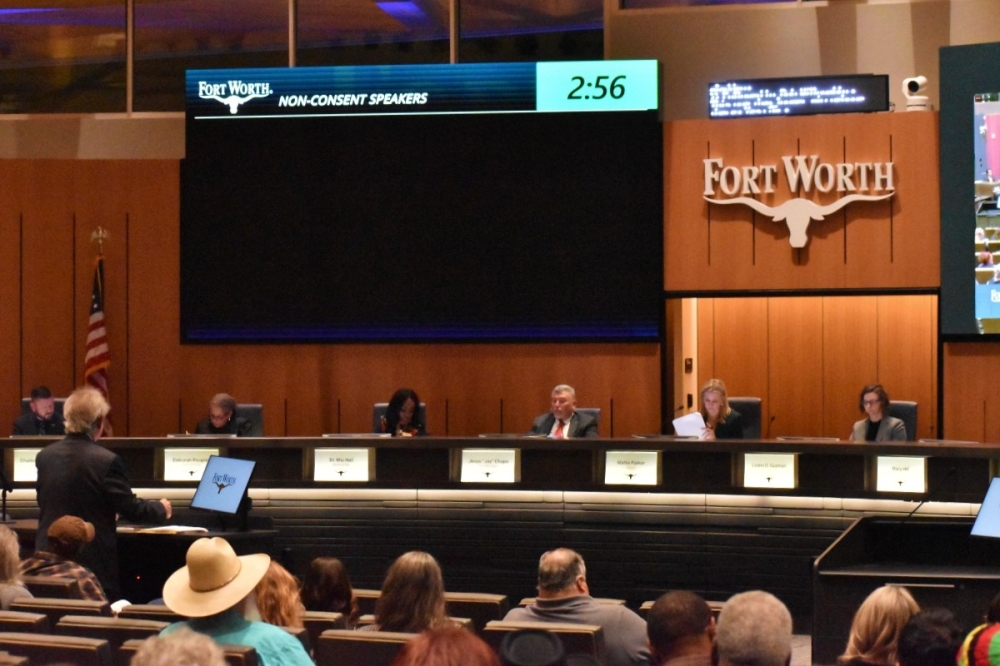
The city of Fort Worth increased residency restrictions aimed to reduce opportunities for contact between registered sex offenders and children by restricting where such offenders may reside in relation to areas where children commonly gather.
The motion passed during the Feb. 24 council meeting after being tabled at the Feb. 10 meeting.
Current situation
Council voted 9-0 to pass the registry distance from 1,000 feet to 2,000 feet, with Chris Nettles and Elizabeth Beck absent from the meeting.
“The fact there’s any opposition to this is quite surprising,” District 4 council member Charlie Lauersdorf said. “I’m glad the city of Fort Worth is moving forward on this. I’m glad we changed it to 2,000 feet. I think this is about protecting our kids. … If it protects even one child [in] the next 30 or 40 years, it is completely worth it.”
According to data presented at a Dec. 2 council meeting, there are 3,201 registered sex offenders in Fort Worth. Of that number, 2,454 of those had a victim who was 17 years old or younger.
Of the 3,201 offenders, 877 are on supervised release, either probation or parole, and have restrictions prohibiting residence in child safety zones. These zones include schools, day cares, public parks and playgrounds, pools, community centers and libraries.
The presentation in December stated that 1,577 registered sex offenders with child victims have no residency requirements.
The state Legislature addressed the law with a 1,000-foot requirement in 2017.
From Jan. 1-Dec. 2, 2025, the city made 140 arrests and filed 178 cases against registered sex offenders, according to the December presentation.
What you need to know
The Fort Worth changes make it unlawful for a sex offender to establish permanent or temporary residence within 2,000 feet of any premises where children commonly gather.
The ordinance also makes it unlawful to let or rent any place or structure, manufactured home, trailer or any other conveyance with the knowledge that it will be used as a permanent or temporary residence by any person prohibited from living within 2,000 feet of any premises where children commonly gather, according to city documents.
The 2,000-foot buffer map for residential land use would have an impact in Fort Worth in terms of options for housing for sex offenders.
With the change, available land use for residency in council District 4 goes from 6.7% to 0.1%. In District 10, the number drops from 11.9% to 1.1%, according to city documents.
Put in perspective
Many nearby cities adopted residency restrictions that are greater than the state requirement. According to data provided to the council, Lewisville (1,500 feet), Richardson (2,000 feet) and Keller (2,000 feet) all passed stricter restrictions.
City documents list the restrictions in surrounding cities may shift offenders into Fort Worth’s jurisdiction.
The Texas average for sex offenders per number of residents is 1 in 417 residents. Fort Worth is fourth among major cities in the state, with 1 sex offender for every 315 residents. Other notable Texas towns:
Houston 1-231San Antonio 1-299Dallas 1-305Lubbock 1-331El Paso 1-345Austin 1-427Plano 1-1,286Arlington 1-1,490Keller 1-2,028The outlook
According to the presentation, if someone is currently in a lease in an area that would violate the city ordinance, those residents would be grandfathered in.
However, if a sexual offender moves, they would have to abide by the new 2,000-feet requirement, said Laetitia Coleman-Brown, Fort Worth deputy city attorney.
Any person, firm or corporation that violates, disobeys, omits, neglects or refuses to comply with or who resists the enforcement this ordinance will be fined up to $500 for each offense. Each day that a violation exists will be a separate offense, according to the city documents.