
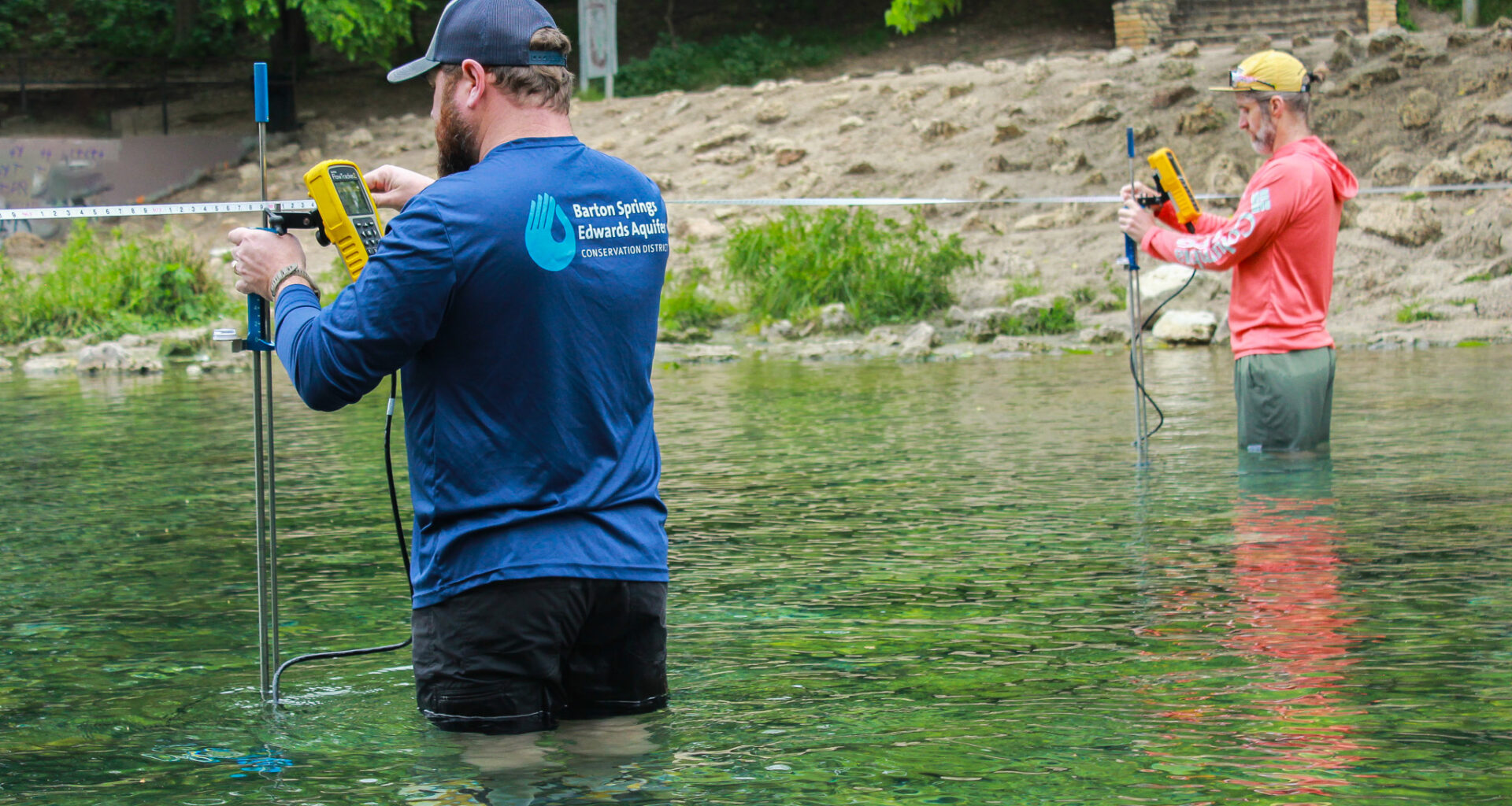
Austinites who have been around at least a decade may remember that back in the summers of 2015 and 2016, Barton Creek flowed from Barton Springs into South Austin, pocketed with deep green, swimmable water holes. That’s because in both years, Central Texas had over 20 inches above average rainfall as measured at the airport and Camp Mabry, recharging the Edwards Aquifer after the 2008-2011 drought years.
But in 2022, annual rainfall in Austin plunged to 10 inches below average. Our annual rainfall levels have hovered in the red ever since, with 2025 getting about 11 inches less than a normal year.
“We’re basically missing an entire year’s worth of rainfall at this point,” said Shay Hlavaty, communications and outreach manager at the Barton Springs-Edwards Aquifer Conservation District. “What we need is long-term, sustained, above-average rainfall, ideally for years.”
As of October 2025, the district declared its territory to be in Stage 3 Exceptional Drought, which includes portions of the Edwards and Trinity aquifers that supply drinking water to nearly 100,000 residents. Exceptional Drought was only declared for the first time ever in December 2023.
Now, the district says the Austin area is close to another first-of-its-kind declaration: a Stage 4 Emergency Response Period, with Edwards Aquifer levels and springflow at Barton Springs dipping closer to historic lows.
“This is unprecedented. These are crazy times, and so our rules and bylaws say that our board of directors can take action as they see fit to help protect flow in the aquifer,” Hlavaty said, noting that such plans are in the works ahead of the declaration.
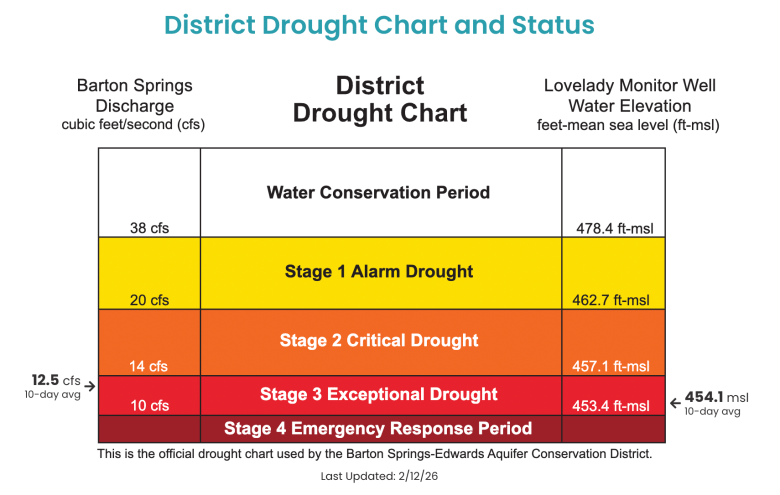
A Stage 4 declaration would mean even tighter pumping curtailments for those who have well permits to pump water out of the Edwards and Trinity aquifers through the district – depending on the permit type, monthly pumping out of the aquifer must reduce by 30%, 50%, or 100%, according to the District’s User Drought Contingency Plan.
Who uses the Edwards and Trinity aquifers as their water source? The district’s territory encompasses Austin south of Lady Bird Lake and stretches down into Hays County. The cities of Buda, Hays, Sunset Valley, Kyle, Mountain City, Creedmoor, and Mustang Ridge all have permits with the district, using the aquifers to supply water to their communities, Hlavaty said.
Under a Stage 4 declaration, those municipalities, along with utility companies, businesses, churches, and other non-domestic water users would be subject to tighter water pumping restrictions and need to lean on their alternative water sources, according to Hlavaty.
“Having a diverse portfolio of water supplies is probably more important than ever these days for service supply providers, because there’s so much uncertainty,” said Natalie Ballew, the Texas Water Development Board’s Groundwater Division director. “But groundwater is typically the cheapest option of water supply just in the nature of how groundwater law is set up: It’s often cheap to drill a well and get some shallow groundwater.”
While most Austinites get their water from the Highland Lakes (which includes lakes Austin, Travis, and Buchanan), thousands of Austin-area homeowners have a well on their property, pumping water from the aquifer for their own homes, according to Hlavaty. While domestic permittees are not subject to pumping restrictions by the district, water levels have gotten so low that many wells may no longer actually reach the groundwater, she added.
“What we actually see for most of those domestic wells is not necessarily that their well is going to go dry right now, but it’s more that their pump isn’t low enough,” Hlavaty said. “So they’d have to pay money for somebody to come in and lower it even further.”
March could bring healthy rainfall over the Edwards Aquifer recharge zone, delaying a Stage 4 drought declaration, Hlavaty said. “But based on the climatic conditions right now, it’s not looking great. We’ve been having below average rainfall the last several months,” Hlavaty continued. “Even getting average [in March] would be great, but that’s not going to put a huge dent in the drought.”
“We’re basically missing an entire year’s worth of rainfall at this point.”
Shay Hlavaty, communications and outreach manager at the Barton Springs-Edwards Aquifer Conservation District
Drought particularly strains aquifers, Ballew explained. During drought periods, there’s usually less water available from lakes and rivers, prompting folks to lean on groundwater supplies even as aquifer levels are also dropping. “That can compound the water level declines that we see in those aquifers: There’s less rainfall coming in and there’s increased pumping coming out of them,” Ballew continued.
As severe drought and mounting demand from population growth, data centers, and development across the state strains Central Texas water resources, groundwater conservation districts like Barton Springs-Edwards Aquifer are exploring ways to conserve aquifer health.
One avenue is aquifer storage and recovery, where treated Edwards Aquifer water is stored in the Middle Trinity Aquifer and recovered later when supplies are tight. Buda is one of the earliest Austin-area municipalities to implement ASR as part of its long-term water strategy.
Many think of the Edwards Aquifer as a spring of fresh water, but the aquifer contains saline water as well. Another strategy currently being explored is the purification of that saline groundwater, the “saline Edwards,” into drinkable water quality.
“Most of the Edwards has really high-quality water. We’ve all been in Barton Springs, the water is incredible,” Hlavaty explained. “But then the saline Edwards is a separate portion that has super high salination and high total dissolved solids in it, meaning it’s not drinkable as it is.”
The Barton Springs-Edwards Aquifer district is currently coordinating the first-ever permit to pump water from the saline Edwards for desalination efforts, Hlavaty said. Beyond large-scale water supply projects, Austinites can also conserve water in small ways, like establishing a Watering Day, using pool covers, and monitoring their homes for leaky pipes.
“Every gallon of water that you waste or use on your lawn is one less gallon that somebody can drink or recreate in,” Hlavaty emphasized. “We want to save our drinking water and wells as long as we can, and also conserve Barton Springs and make sure it keeps flowing.”
This article appears in March 6 • 2026.
A note to readers: Bold and uncensored, The Austin Chronicle has been Austin’s independent news source for over 40 years, expressing the community’s political and environmental concerns and supporting its active cultural scene. Now more than ever, we need your support to continue supplying Austin with independent, free press. If real news is important to you, please consider making a donation of $5, $10 or whatever you can afford, to help keep our journalism on stands.