
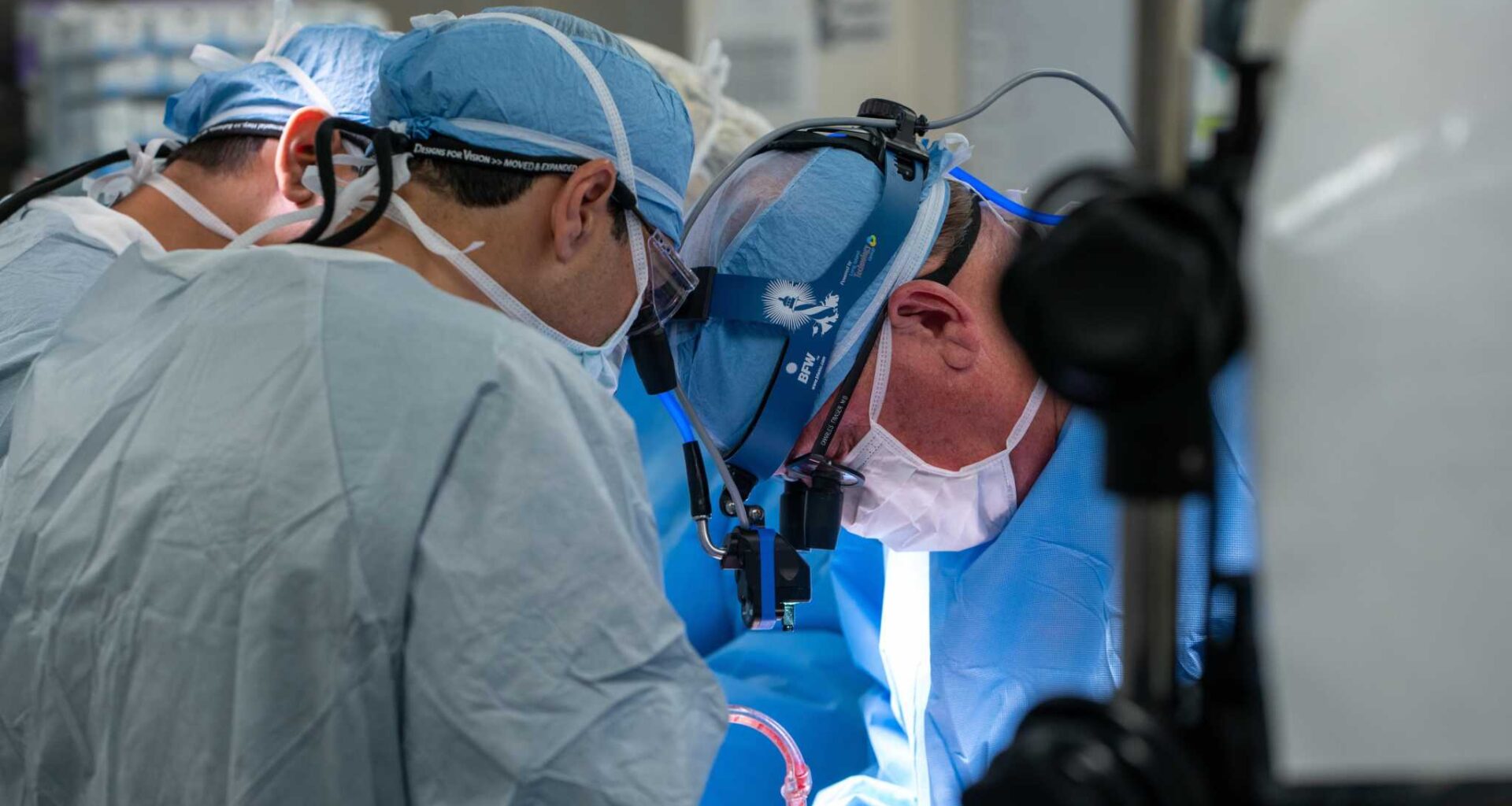
Dr. Charles Fraser checks on Morgan Adams’ surgery scar in 2025. She was one of the youngest patients to get a heart transplant at Dell Children’s Medical Center.
Mikala Compton/American-Statesman
As Christmas Eve turned to Christmas Day last year, a quiet milestone was happening at Dell Children’s Medical Center in East Austin.

For the 50th time, doctors were transplanting a heart into a patient whose family had waited anxiously about a year for the miracle.
Article continues below this ad
From its first transplant on Oct. 3, 2020, to Dec. 25, 2025, the hospital achieved the mark at a speed no one at the program believed it could.
For transplant coordinator Dr. Chesney Castleberry, “50 in 5” was a lofty private goal when she arrived from St. Louis in 2019. Early projections at Dell Children’s showed 10 to 15 Texas patients each year lacked access to a heart transplant even with programs at Texas Children’s Hospital in Houston and Children’s Medical Center of Dallas.
“That has been our patients’ stories: They’ve either not gone to get help, not traveled for care, or they were turned down by other centers,” Castleberry said.
Dr. Charles Fraser Jr. never set a target like 50 in five years when he came to Austin in 2018 to start the Texas Center for Pediatric and Congenital Heart Disease at Dell Children’s and UT Health Austin — the clinical practice of the Dell Medical School at the University of Texas.
Article continues below this ad
Dr. Charles Fraser, right, and Dr. Carlos Mery, left, work toward getting a patient onto the bypass machine so they can remove his heart and put a new one in during the first heart transplant at Dell Children’s Medical Center on Oct. 3, 2020.
Jeshua Mauldin/UT Health Austin
“We are certainly busier than I thought,” he said. “We’re filling a role here in Austin that was missing.”
Providing more access, “that’s what health care is about,” he said.
The 50 transplants “is enormously meaningful to me and my team,” Fraser said. “It’s affirmation that we’re doing the right thing for the region and the patients and the families.”
Article continues below this ad
Those 50 patients, ranging from infants to people in their 20s, previously would have had to move to Dallas or Houston or farther for care. That’s agonizing for families who have to split up while waiting for the heart and during the weeks and months after the transplant. For many, that is not practical and not financially possible.
Pediatric cardiologist Dr. Chesney Castleberry listens to Elias Robinson-Rodriguez’s heart during a checkup after receiving a partial heart transplant at Dell Children’s Medical Center in 2023. He now has a strong heart, with just a tiny murmur, Castleberry said. Dell Children’s was the third program in the country to do a partial heart transplant.
Kara Hawley / American-Statesman
Growing a large cardiac program
Fraser said it’s not just heart transplants the program has brought to the region. The program did more than 2,000 heart surgeries in the first five years of the center. Many of these were firsts for the Austin area:
Article continues below this ad
“We are a big program now, from a scope-of-services standpoint,” Fraser said.
Gerardo Ramirez Jr., 18, is greeted by Austin firefighter M. Reese outside of Dell Children’s Medical Center on Dec. 23, 2020, as he leaves the hospital. Ramirez became the hospital’s first heart transplant patient that October.
Ricardo B. Brazziell/American-Statesman
In October, Dell Children’s was named the No. 10 pediatric heart program in the country by U.S. News & World Report, something Castleberry never thought the program would reach. “I thought maybe top 20,” she said.
Article continues below this ad
None of this would have been possible without the start of Dell Medical School in 2016, Fraser said, because it attracted doctors who want to teach the next generation as well as do research. It also attracted the type of doctor who wanted the chance to build a program and a medical school from the ground up. A new cardiac fellowship is starting in July, and medical students and residents are often observing in the cardiac operating room at Dell Children’s.
Galilea Rodriguez, right, watches her husband Leonardo Rodriguez, left, as he combs their son Leo’s hair. Leo was born at Dell Children’s in July 2022 and lived in the hospital until he had his heart transplant in March 2023.
Aaron E. Martinez / American-Statesman
Being comfortable with risks
Dell Children’s has become known as a program that will take calculated risks and accept patients that have been turned away by larger, more established programs.
Article continues below this ad
“We’ve been a very risk-liberal transplant program,” Fraser said. “We wouldn’t want to be accused of being irresponsible about donor profiles given the precious nature of donor hearts, but we also don’t want to deny a transplant opportunity for someone that could have benefited.”
Of the 50 transplant patients, 37 were people born with single ventricles, meaning their anatomy is more complex than people with two heart ventricles. Many have had multiple surgeries before transplant, and that can complicate the operation. Some also have complicated antibodies that can make finding a compatible heart more difficult.
Richard Owens, the director of mechanical circulatory support and a perfusionist, takes Grace Jennings’ blood pressure during a weekly checkup in 2020. Grace was the first patient to get a left ventricular assist device at Dell Children’s in 2019. She had the second heart transplant in 2021.
Ana Ramirez/American-Statesman
Since starting the transplant program, Dell Children’s has not reached the same success rates as Children’s in Dallas or Texas Children’s in Houston.
Article continues below this ad
Dell Children’s success rate is 89% in the first five years, with a goal of 90% or higher. Some centers will not accept the most critical patients because they don’t want their success rates to be effected, Castleberry said.
“That’s not how Fraser or I want to play these odds,” she said. “For better or worse, I come from a place of ‘yes.’ … I love the tough ones. That’s my jam.”
Many Dell Children’s patients only have an 80% chance of survival with a transplant, she said. To be close to 90%, “we’re beating the odds.”
Because the program is only five years old, its smaller volume means each case has a larger impact on the percentages. For patients to show up in the statistics, they typically are almost two years post-transplant.
Article continues below this ad
For the period between July 1, 2023, and June 30, 2024, Dell Children’s performed 12 transplants and had one patient die. Dallas performed 28 transplants and had no patient die and Texas Children’s performed 34 transplants and had one patient die, according to the metrics reported to the Scientific Registry of Transplant Patients.
Castleberry said she is also focused on post-transplant care. Using patients’ genetics and blood tests, tailors anti-rejection medications to them. She sees artificial intelligence as a way to improve patient care because it can help her synthesize the data to better predict which regimens will work.
Olivia Guthrie cuddles with her 6-month-old daughter, Zaria Grace Jackson, in 2021 outside Dell Children’s Medical Center of Central Texas. Zaria was the first child to get a Berlin mechanical heart at Dell Children’s. Months later, she received a heart transplant.
Jay Janner/American-Statesman
Limited by organ donation numbers
The biggest challenge for all transplant programs is finding an available organ. Dell Children’s currently has 10 patients waiting for a heart. Some are so sick they have been hospitalized and many are babies, who often wait longer because they need a smaller heart.
Article continues below this ad
The need for more organ donors needs to be elevated, both Fraser and Castleberry said. While there is progress in mechanical hearts and the possibility of using animal hearts, Fraser said, “There’s a lot of magic to the human heart that we haven’t been able to replicate.”
“It’s got to be in the back in our minds that a tragedy could in some way be a gift for someone else,” he said, whether through an organ transplant or the use of tissue or a heart valve.
“We deal with a lot of really desperate patients and families,” he said.
Azariah Abdallah is pushed into an event room at Dell Children’s Medical Center on Dec. 22. Azariah received the 49th heart transplant at Dell Children’s.
Aaron E. Martinez/Austin American-Statesman
The next five years
Castleberry wants the program to grow to 15 to 20 transplants a year, reaching 150 by its 10th year.
Article continues below this ad
Fraser doesn’t want to predict when the program will hit 100 transplants or 150 transplants.
“Growth will come if you do the right thing,” he said.