
As Glasstire celebrates our 25th anniversary, each month we’ll be publishing thematic content by our editors and contributing writers. Over the course of the year, our themes will touch on our early years, art schools and places of nontraditional learning, creativity in times of crisis, and more.
In addition to newly written content, we are also mining our archives. Over the past 25 years, Glasstire has published more than 18,000 articles. This month, our theme — Texas Topographies: Examining Place & Practice — provides a lens to look back at writings about Texas as a place and how the state’s unique cultures and geographies shape the arts. For your reading pleasure, we’ve gathered some of these articles below, including opinion pieces, reviews, and more.
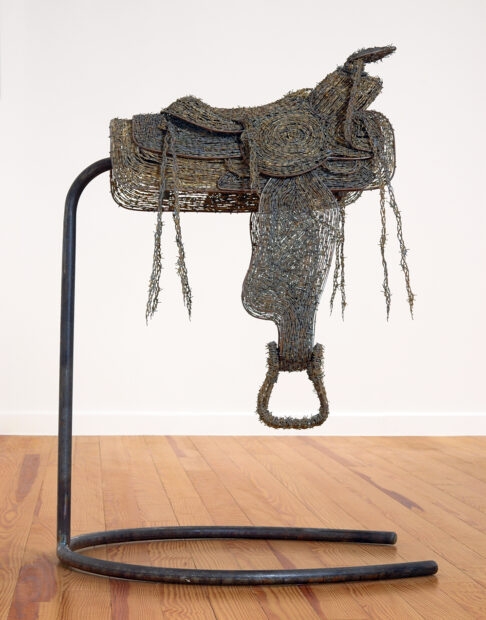 Mel Chin, “Rough Rider,” 2002, barbed wire and steel, 38 x 29 x 23 inches. Photo: John Lucas
Texas Culture: Reflections from a Fort Worth Curator by Maggie Adler
Last summer, Fort Worth-based independent curator Maggie Adler penned a reflective piece about how her perspective of arts and culture in Texas has shifted over a decade of living here. She wrote about once being an “ardent Texas apologist,” attempting to dispel the stereotypes outsiders held about the state, and noted that over time her understanding of Fort Worth and Texas has changed.
“In this age of divisive politics, I am beginning to own my hard-won Texas ennui. Like the proverbial boyfriend that I have been crazy about but of whom my friends disapprove, I’m starting to see that I might have been overcompensating. I am coming to the realization that no matter how much I try to dress Fort Worth up to represent the best aspects of what it is, the naked truth of it without the dressing is not what I’ve promoted it to be.”
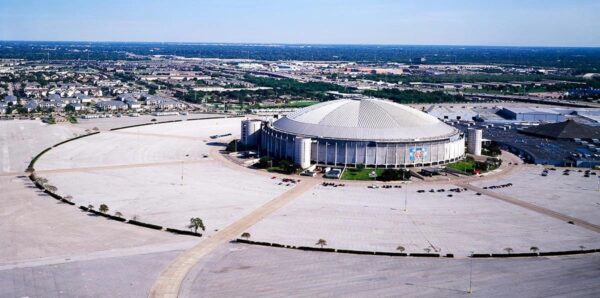 An aerial photograph of the Astrodome
Concrete Loops: Brutalism and the Weather of Houston by Joseph Staley
Also in 2025, Joseph Staley poetically mused on how the interplay between architecture and climate in Houston shapes the city.
“In a city where heat kills, storms redraw coastlines, and booms vanish midsentence, adaptable buildings outlast declarative ones. Houston’s brutalism demonstrates rather than declares: stains that map a storm, patches that confess care, an overhang that saves a passerby at three. Value gathers in behavior, not silhouette — mass that damps the thermal pulse, shade that scripts congregation, thickness that practices civic care.”
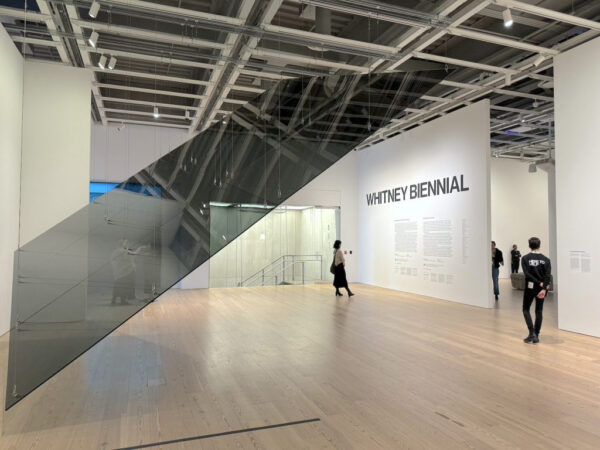 Charisse Pearlina Weston, “un- (anterior ellipse[s] as mangled container; or where edges meet to wedge and [un]moor,” installation view in the 2024 Whitney Biennial. Photo: Ben Davis/Artnet News
Why are there No Texas Artists in this Year’s Whitney Biennial? by Brandon Zech
In 2024, Glasstire’s Publisher Brandon Zech questioned the lack of representation of Texas artists in the Whitney Biennial. Throughout the essay, he lays out a case for the significance of the state’s artists and outlines why Texas art is often overlooked. Zech’s arguments echo those of Glasstire’s founder Rainey Knudson in her 2016 essay decrying the lack of Texas artists in Texas museums and recognizing the Contemporary Arts Museum Houston and the Galveston Arts Center, which were notably showcasing art from Texas.
“It is a travesty for a show that describes itself as a “‘dissonant chorus,’ unharmonious in its collectivity,” as the 2024 Biennial does, to omit representation from Texas, which as both an ideology and a place is as dissonant as they come.”
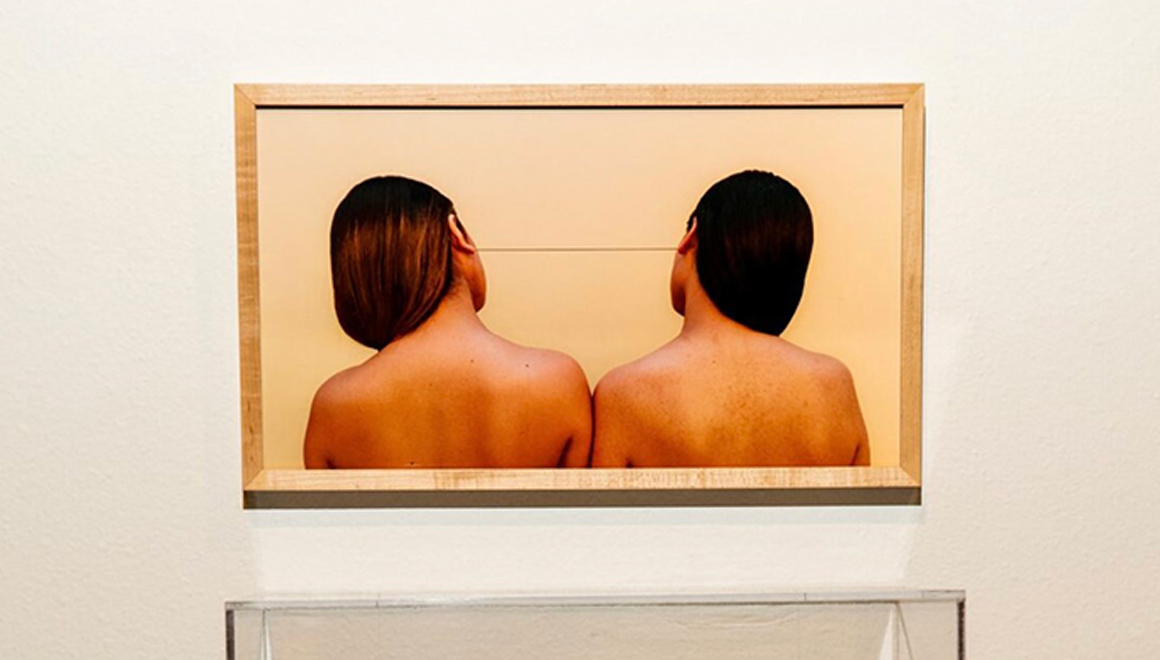
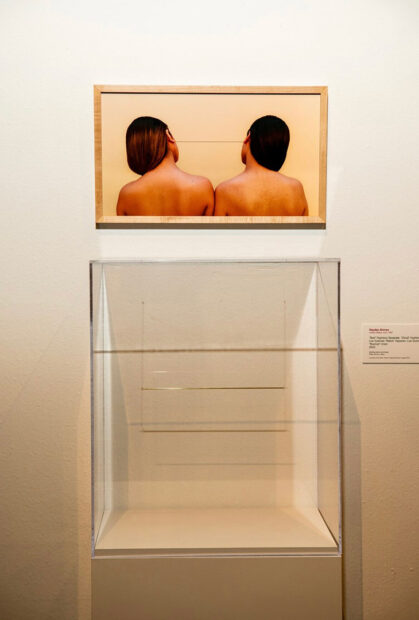 Haydee Alonso, “‘Bad’ Hyphens Separate; ‘Good’ Hyphens Attach.”
Redefining the U.S./Mexico Border: Works from the “2024 Border Biennial” by Jessica Fuentes
Following a trip to El Paso and Ciudad Juárez, Jessica Fuentes wrote about the 2024 Border Biennial / Bienal Fronteriza 2024, hosted at institutions in each of the cities. Like the cross-institutional exhibition, the review spoke to the diversity and connectivity in the region. The following year, Fuentes returned to the area and wrote about community art spaces and cross-border support of the arts.
“The border region is many things to many people, most of whom would prefer that the defining line of the border itself be as invisible to the world as it is in their minds and hearts.”
 Women artists from New York at the Durr Ranch near Dumas, Texas,
Spring 1960. (Photographer unknown.) From the collection of Carolyn Fitz.
Third from left, Elaine de Kooning; third from right, Louise Nevelson; seated
to the left of Nevelson is Martha Jackson
When New York Visits the High Plains: Louise Nevelson in Amarillo by Leslie Thompson
In 2023, Leslie Thompson spoke with author and professor Amy Von Lintel about how New York artist Louise Nevelson’s visits to the Texas High Plains influenced her work.
“We don’t have her saying that directly. What we have is that both of her biographers note that Nevelson’s sister discloses that she talked about her gold pieces as being inspired by the faucets in Texas ranch houses. Because they were gilded.”
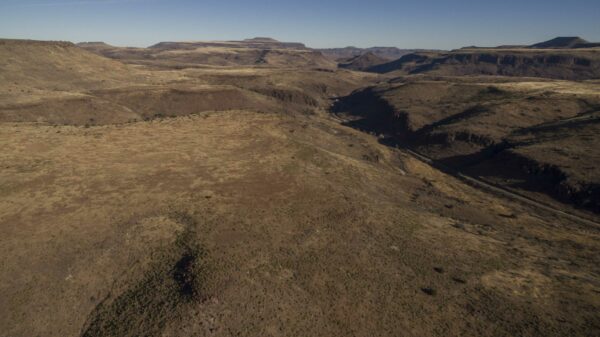 Photo: Alex Boeschenstein
TEXAS MESSIAHS / ACT 02 / JUDD MERIDIAN by Sean J. Patrick Carney
In 2022, Sean J. Patrick Carney wrote a two-act narrative essay on the history of Texas’ Messiahs, tying the phenomenon to the life, work, and ethos of Donald Judd.
“The creative self, Judd believed, eclipsed art for social good. And through abstracted formalism, by fabricating specific objects, Judd sought communion between the individual and the divine — a very Protestant, and Texan, attitude. No doubt, the paradoxical aura of West Texas — rugged individualism and ambient paranoia; wide open ranges sewn into private tracts by barbed wire — had infected the artist.”
 Leighton McWilliams & David Keens, “Duel,” 2008
All of Our Guns, Part 2: An All-Texas Edition by Christina Rees
In 2016, on the heels of Texas’ “open carry” handgun law going into effect, Glasstire’s then Editor-in-Chief, Christina Rees, shared a crowdsourced grouping of Texas artists who have made works featuring guns.
“A couple of weeks ago, we ran a piece titled ‘All of Our Guns, Part 1,’ which due to the current political conversation ruminated, through images, on the depiction of guns and gun references in art… This kind of image mining takes one down a rabbit hole in the sense that it can almost feel easier (or more limited) to name contemporary artists who haven’t used gun imagery in their work than it is to name all the ones who have. This isn’t true, of course — not even in Texas — but it shouldn’t surprise readers to know that Texas-based artists might well confront and pull from this aspect of our culture.”
 Terrestrial Arcs – Plan B Gallery
Land Arts of the American West by Eric Zimmerman
In 2005, Eric Zimmerman reviewed Terrestrial Arcs, an exhibition at Plan B Gallery in Austin that was curated by Bill Gilbert and Chris Taylor, founders of the Land Arts of the American West program at Texas Tech University. Though the program and the exhibition reach beyond the geographic borders of Texas, the review captures a moment in the history of the renowned Land Arts program.
“Gilbert and Taylor … define Land Arts practices as ‘including everything from constructing a road, to taking a walk, to building a monument, to leaving a mark in the sand.’ Combining studio artists from the University of New Mexico and design students at The University of Texas at Austin, Land Arts immerses its participants within a travel experience based on ancient and contemporary land art sites. Living in tents and traveling throughout the southwest, nomadic Land Arts students must not only create their work, but also engage with a variety of sites, guest scholars and artists from fields as diverse as their destinations.”