Welcome to From the Archive, a look back at stories from Dwell’s past. This story previously appeared in the October 2002 issue.
In the Dallas/Fort Worth Metroplex, there is no shortage of three-bedroom, two-car-garage homes for sale on newly created streets with names like Running Brook Drive and Brittany Place. It’s almost a given that young couples in search of their first home go straight to developments by companies like Centex, Dissmore, History Maker Homes, or any one of the many builders in the area. These homes are all spacious, well-appointed, and reasonably priced, to be sure—but each seems nearly indistinguishable from the next.
“People don’t want to make choices or take chances,” Gayla LaBry observes. “That’s why they buy those developer homes.”
Gayla and her husband, Michael Young, who describes himself to me as “a strong, aggressive personality” (as Gayla nods her head vigorously in agreement), wanted something different. “I think outside the box,” says Mike who works as a project engineer for Acme Brick in Fort Worth. “You see that at work and in the way our home turned out.”
Mike and Gayla, who works in finance, met during college in Lafayette, Louisiana, and in 1996, after a year in Germany, moved to Fort Worth. In a town where football and church are the primary cultural activities, this couple has made more treks through Europe than PBS’s Rick Steves. When they accumulated $1,000 worth of books and magazines to research ideas for their new home, the stack included not only Southern Living but Abitare and Domus. And while their peers were happily handing over down payments for 3,000 square feet of brass-fixtured, shag-carpeted colonials, Mike and Gayla presented an architect with their idea of a dream home, hired him, and paid for the whole thing in cash.
When they made the decision to build rather than buy, Mike and Gayla chose a lot in Burleson, about 20 minutes south of Fort Worth. In contrast to the brick-veneered homes in the unabated sprawl of “affordable luxury” housing developments clustered off I-35, their little neighborhood is a refreshing pocket of individuality. “I wish I’d been born here,” says Gayla. “I feel like I was.” The houses in this working-class community are unremarkable but unique. As you turn off the main drag just past Wal-Mart, there’s a newly minted colonial, a ’70s-era bunker with grass growing on the roof, and a modest ranch house featuring an artful if puzzling pattern of undulating bricks. It’s a libertarian’s dream here—people just let each other be. So when the couple began work on their 950-square-foot house-as-loft project on Pecan Drive, the only thing anyone asked was, “You’re not putting a trailer on the lot, are you?”
Mike was working at that time for a glass company, where he had supervised the construction of a steel-frame addition to the factory. He was fascinated by the technique, and for a variety of reasons ranging from aesthetics to termite-resistance, he was intent on using a steel frame for his own house. All he needed was an architect.
The Fort Worth AIA put the adventurous couple in touch with architect Richard Wintersole. It was a perfect match, and since Rick’s idea of marketing himself is “sitting by the phone and waiting for it to ring,” the Young/LaBry commission came as a pleasant surprise. Architecture is a second career for the mild-mannered and wry-humored Texan, who was originally trained as a microbiologist. The determination and resolve that comes with starting out in a new field later in life has no doubt aided his efforts to work in a modernist vernacular in a community reared to desire gabled roofs. His own home in the suburb of Aledo, Texas, which he shares with wife, Margaret, a journalist, and son Colin, 17, is an elegant corrugated-metal-and-glass structure with a barrel-vaulted ceiling that takes its inspiration from Louis Kahn’s Kimbell Art Museum. “We’re probably considered to be communists or something out where we are,” says Rick, who is just completing construction on a house for a client in Keller, Texas, that has industrial stairs and a camouflage roof. “Margaret has to hide her subscription to Mother Jones.”
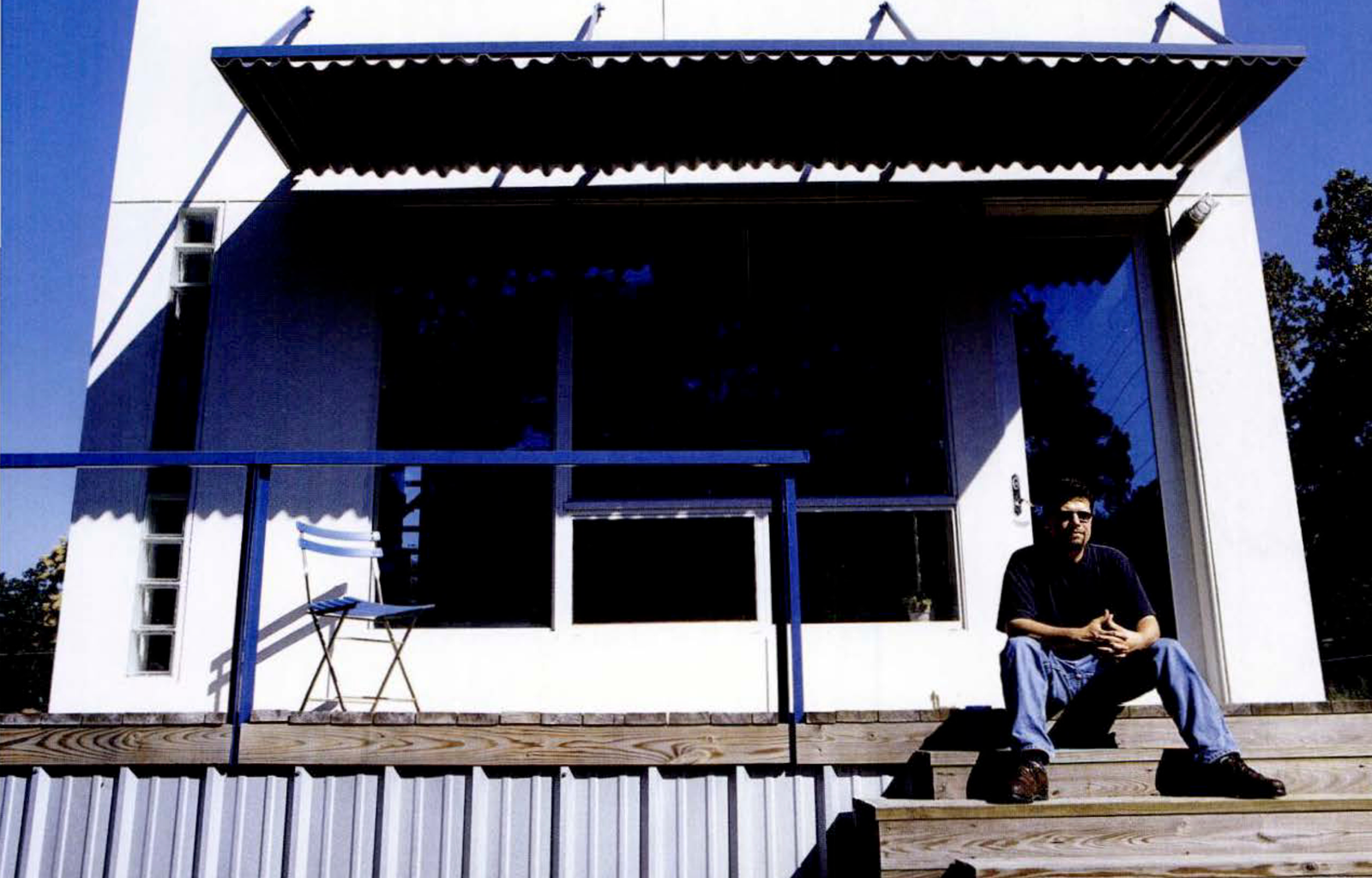
Mike and Gayla were clear about what they wanted—something clean, modern, and minimalist—and knew what they could afford. “We wanted something unique,” says Mike. “We didn’t want to copy someone’s design, but we also weren’t interested in something so different that it didn’t look right.” At $120,000, the budget was small, but because the site was located in an unincorporated part of town, the codes and restrictions that normally dictate home construction were not in place, so Rick knew he could have more freedom with his design.
Mike enthusiastically marketed the steel-frame option to Rick, who at first wasn’t convinced. “I don’t think the day that I sat down with a blank piece of paper I was thinking it was going to be a metal building,” he explains. But when contractors’ bids started coming in, the steel framing turned out to be not only the clients’ preference but also the most cost-effective option.
Rick’s initial reticence had been based on his prior experience with steel companies. “When I’d dealt with them before,” he explains, “they basically just wanted to sell steel. The closest thing these companies have to an architect is the guy who does the CAD work for them. And once the house is complete, it’s like you’re not supposed to know that it’s steel anymore. It’s supposed to look like everybody else’s house.”
Houston’s Classic Steel Frame Homes was willing to transform Rick’s working drawings into a steel frame for the house, though the company—which manufactures a line of Tudorish homes with names like the Palace and the Oxford I0Plex—wondered why the client didn’t want to just pick an existing design from their brochure. Once the fabrication was complete, the company loaded up everything from the floor joists to the roof purlins, trucked it from Houston to Burleson, and laid it out in the yard like an outsize set of Tinkertoys. The frame was assembled in a day and a half. The house was completed in about six months.
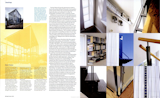
The house is refreshingly different from the developer homes down the road. Essentially, Rick created a distinctive urban loft space within the confines of a Fort Worth suburb. Its industrial roots are exalted rather than hidden: The exterior is expressed in Galvalume siding and simple white stucco. Interior details include sandblasted steel and maple railings, galvanized diamond-plate stair treads, exposed ducts, and a bridge of steel and plywood decking upstairs. An uncomplicated palette—white, blue, light wood (mostly maple), and metal—used inside and out maximizes the square footage and natural light.
The absence of code restrictions allowed Rick to get away with a few more space-enhancing features. There are no egregious safety infractions—though walking across the open catwalk that leads from the top of the stairs to the bedroom, one is hit with a heady dose of vertigo. The ability to fudge things like stair depth and handrail heights allowed the architect to place the stairway parallel to the house’s front façade, creating a fluid line from one end of the house to the other. Had the grade been to code, the stair would have been the first thing you saw when you entered through the front door.
Most of the fixtures and furnishings came from stores like Ikea, Pottery Barn, and The Container Store, but Mike and Gayla splurged at Smink, Inc., in Dallas, on a B&B Italia sleeper sofa (Mike was so entranced with the way it opens out and closes, he dropped to the floor to show me how the internal mechanism works) and two sleek side chairs by Artelano. “We deliberately chose furniture with no arms,” Mike told me. “Everything we chose had to do with creating visual space.”
Another clever space-saver was the configuration of the main bath upstairs. Rick wasn’t sure how he could fit both a shower and a tub in the space allotted; Mike suggested putting the bath in one half of the room and creating an open shower area by installing two shower heads on the wall that faces the tub. It was also Mike’s idea to install a stacking washer/dryer unit right between the bathroom and the closet. This arrangement, Mike explains enthusiastically, “completely eliminates clothes migration!”
Whether they’re raving about the guest bathroom (“a perfect expression of minimalism!”) or the ceiling fixtures they got from Lowe’s for $12 a pop, the couple’s eyes light up when they talk about their home. “People say it’s too small,” says Gayla. “‘You’ll never be able to sell it.’ But we’re not worried. We’re not going anywhere for a while and when we do, there will be someone else just like us, a couple with a cat, who will want to move in.”
For now, Mike can’t wait to make an addition outback—from a shipping container.