
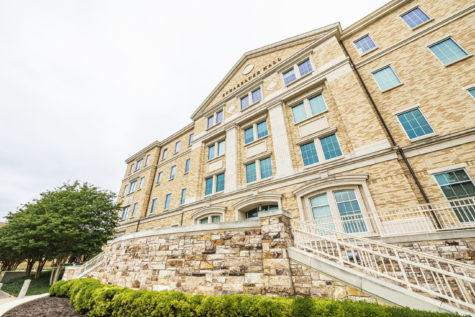
 Scharbauer Hall, home to the AddRan department (Heesoo Yang/Staff Photographer)
Small majors at TCU are tucked between the university’s powerhouse programs, like business, nursing and communications.
Behind small enrollment numbers are students and faculty with passions for an academic path less traveled.
Ella Thessen, a sophomore astronomy and physics double major, described her physics class of eight students as a tight coalition that studies together and bonds over being part of a smaller major.
“Since our classes are so small, the professors get to know each student pretty quickly,” said Thessen. “Which is very nice because they want every student to succeed in the class, especially since they know us personally.”
According to the TCU Office of Institutional Research, Thessen is one of 11 students to enroll in the astronomy and physics majors between the 2022 and 2025 fall semesters.
For students in small majors, the academic experience isn’t just shaped by curriculum, but rather by small class sizes, close faculty relationships and an overall niche community.
At the same time, these majors face unique challenges, from limited course offerings to long-term sustainability.
Thessen said that despite having close-knit relationships with her professors and classmates, she runs into limited class availability when it comes to enrollment.
“Only one class time is available for some of my classes, so I have scheduling conflicts for my core requirements because of the awkward times of my major classes,” said Thessen.
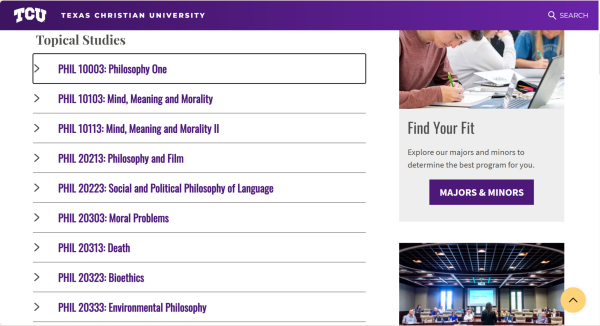 The course listings display available classes for different academic programs. (Courtesy of Texas Christian University philosophy department website)
“There’s a ton of class options on the philosophy website,” said Aiden Morris, a sophomore clarinet performance and philosophy double major. “A lot of those classes aren’t actually available to take.”
Morris said that, on top of small class sizes, “It feels like we really have certain holes in our course offerings, but because there’s not enough professors to cover it, we can’t get into those classes.”
For Morris, small class sizes and class scheduling conflicts are not the only challenges of being a part of a small major.
Philosophy majors make up less than 0.5 % of the student body, according to the TCU Office of Institutional Research, with only one person choosing philosophy out of the 2,754 students who enrolled in fall 2025.
“Because of how small the department is, we don’t feel like as much of a priority,” said Morris. “Most of my job search stuff comes from my other degree, but there’s not a lot of opportunity for philosophy majors at TCU looking for internships.”
Morris mentioned that he has attended meetings within the philosophy department, where they discuss how to expand the program and boost enrollment. With the recent dissolution of TCU’s Comparative Race and Ethnic Studies degree because of low enrollment numbers, Morris said he feels vulnerable being one of a handful of philosophy majors.
Professor Stacie McCormick, the department chair of Comparative Race and Ethnic Studies and Women and Gender Studies, detailed her experience being a small major professor and facing the tides of its dissolution.
“In so many ways, it makes the work even more important for me because students have selected this major in spite of perceived barriers to career and social capital,” McCormick said.
“Numbers are used to quantify the value of something, but that is not the only metric,” said McCormick. “We remind students that being in a major with a small number of students doesn’t correlate to the impact our students will have in the world.”
McCormick expressed a tension that many small majors at TCU quietly navigate: the pressure to justify their existence in an environment where enrollment numbers often drive institutional priorities.
“A challenge is making sure students don’t feel alienated or devalued,” said McCormick, pointing to an invisible labor that professors in small programs often shoulder.
Small majors at TCU continue to balance close-knit academic communities with the pressure to defend their place in an enrollment-driven institution. For students and faculty who choose these majors, their value lies not in numbers but in the depth of connection and impact they cultivate.