
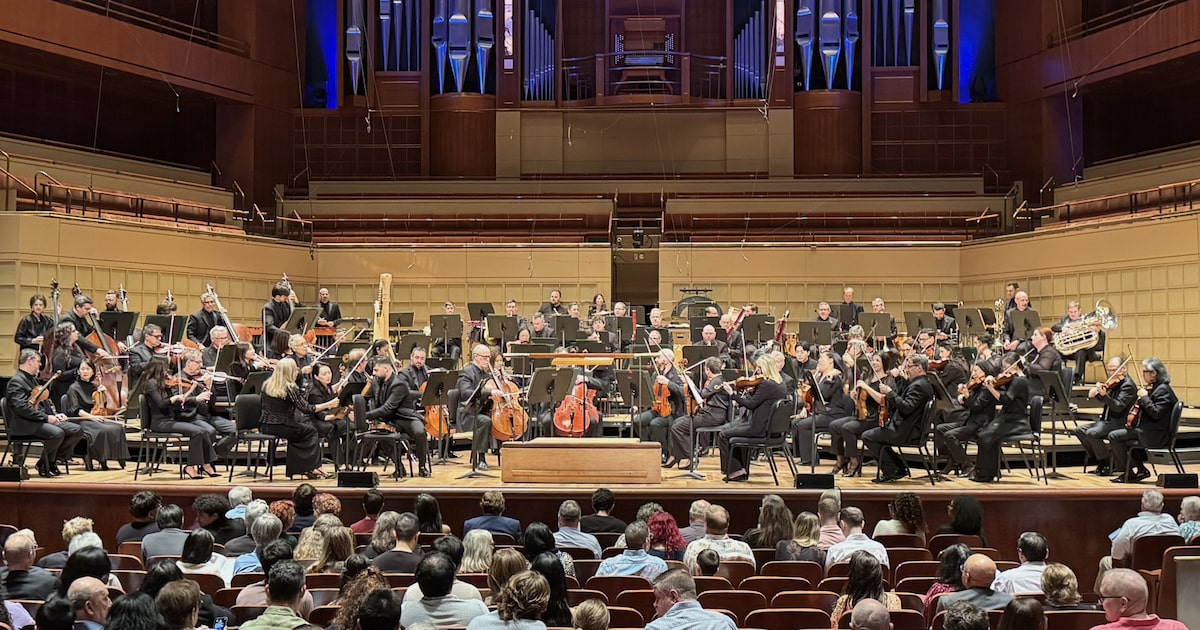
The Dallas Symphony Orchestra’s classical concerts this month will open with surprises. At music director Fabio Luisi’s behest, the first piece on each program will be unidentified, encouraging audiences to listen without any preconceptions.
Identities will be announced before each concert’s second half. For the benefit of audiences at repeat performances, I’m pledged not to reveal Thursday night’s opener.
With former assistant conductor Maurice Cohn back on the Meyerson Symphony Center podium, each of the announced works was its composer’s final purely orchestral opus. Brahms’ Concerto for violin and cello, not that often performed, featured violinist Chad Hoopes and cellist Jan Vogler. The 92-year-old Second Symphony of German-American composer Kurt Weill was getting its first DSO performance.
In the early 1930s, Weill made quite a splash with his Rise and Fall of the City of Mahagonny and Threepenny Opera, but their edgy social commentary and tart music annoyed the Nazis. Having begun his Second Symphony early in 1933, the Jewish composer fled Berlin two months after Hitler became German chancellor, completing the work in Paris. (He subsequently immigrated to the U.S. and became a citizen.)
News Roundups
In three movements, the 28-minute symphony is mostly built out of simple motifs, although strands of melody surface here and there. Then-current neoclassicism is evident in bright scorings — for double winds and brass, strings and timpani — and patches of contrapuntal business.
There are also tunes one can imagine wafting in from a smoky Weimar Republic bar. The restless first movement does quite a variety of things with an underlying waltz rhythm.
Is there also a whiff of nostalgia in the slow movement, for a world disintegrating in brutality? Anxieties repeatedly surge in volume and dissonance. The finale is an ambiguous mix of jollity and agitation, with a piccolo shrieking above a militant march. Even the rowdy coda leaves things unsettled.
Is it great music or a period curiosity? I’m not sure, but Cohn led a crack performance, with eloquent solos from Gregory Raden (clarinet), Mark Debski (oboe), Barry Hearn (trombone) and Christopher Adkins (cello).
The Brahms started with promise, Vogler’s cello projecting a big but gorgeously creamy tone. When playing together, the two soloists — both expert — never slipped out of rhythmic and generously expressive sync, but Hoopes’ violin sounded steely when pressed. The encore was a Prelude for violin and cello by Reinhold Glière.
As with recent DSO performances of Brahms symphonies, the orchestra’s playing here kept getting too loud and blaring for the music at hand. Brahms, of all composers, benefits from a certain reserve, especially in a hall so acoustically responsive — indeed, reinforcing — as the Meyerson.
A Fort Worth symphony review once noting the orchestra that evening played better than the DSO the night before drew some flak. But anyone who attended both concerts would have compared them.
This time, I kept wishing the DSO’s Brahms had more of the clarity and finesse I’ve been hearing lately from the Houston Symphony under Juraj Valčuha. I’m now ducking.
Details
Repeats at 7:30 p.m. Saturday and 2 p.m. Sunday (no Friday performance) at the Meyerson Symphony Center, 2301 Flora St. $31 to $190. 214-849-4376, dallassymphony.org.