
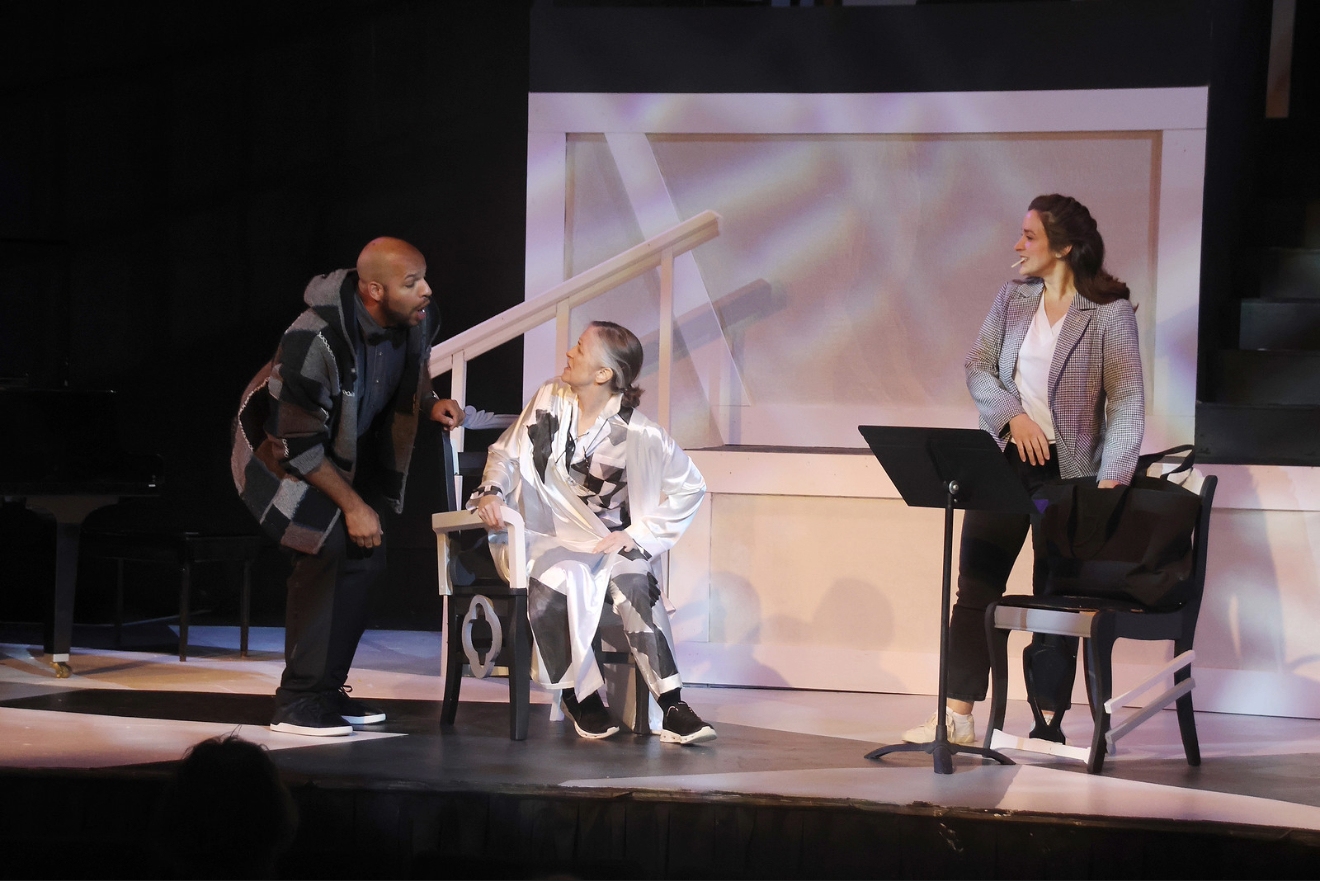
After listening to Laura Kaminsky and David Cote’s “music-is-healing” chamber opera, Lucidity (2024), I dare you to hum one bar from the score. One bar is all I ask. You won’t be able to, because this most modern music, though rhythmically throbbing with percussion, is disjointed, dissonant, skittery, choppy, and not at all pleasing to the ear.
I could argue that this deliberate atonal technique – the bane of most contemporary work – is a fitting way to musically describe the onslaught of dementia. Memory slips away in bits and pieces, there’s no coherence to it, and spurts of anger and disassociation are natural, if hated, consequences. The darkness comes with agonizing certitude. So spiky music might be apt for Lili (soprano Cynthia Clayton, striking and dramatic), the former concert singer/composer who is afflicted by the slowing spread of Alzheimer’s. But the other characters are swathed under this jarring music also.
They suffer under their own haunting problems, but their music sounds just like Lili’s. Everybody sings from the same hymnal. There’s no difference in mood or style. Adopted son Dante (baritone Geoffrey Peterson, solid) has given up his languishing piano career to care for Mom; psychologist Dr. Klugman (mezzo Abby Powell, passionate), writing a book on the power of music to delay the onset of dementia, suffers from writer’s block; young clarinetist Sunny (soprano Cristina Maria Castro, emotionally affecting), plays for Lili as an experiment in Klugman’s research and is estranged from her devout parents for choosing music over motherhood. They are all conflicted, with music at the core of their troubles, but Kaminsky gives them the same ragged sound she gives Lili. What contrasts Lili’s awful illness from the others?
Lyricism’s balm appears when Lili slowly remembers Schubert’s classic song, “The Shepherd on the Rock,” a former concert favorite in her repertoire. At first she fumbles with the lyrics, but the second try transforms her. You can see the clarity in Clayton’s delivery, her pallor vanishes, her eyes clear. The radiant number overtakes her, as it does Lili. Schubert overtakes us, too. At last, beauty of line and form. The pleasure is fleeting. Bedlam soon returns.
Cote’s original libretto is direct but conventional. There’s some fragrance inside his lyrics, but in this 90-minute work, there’s no time to explore these people in depth, so the characters’ dilemmas are easily resolved just like a Hallmark television movie of the week. When Klugman discovers that “science and music are one,” her writer’s block vanishes. Dante’s love/hate commitment to his mother softens when he’s seated at the piano, once again accompanying her. Through her remembrance of the circus carousel’s music from her youth, Sunny’s passionate appeal to her parents solidifies her choice to be a musician (the opera’s most dramatic aria and performed lovingly by Castro).
Lili’s happy ending is transitory, of course. She finishes her incomplete song to her son, “I Have No Lullaby,” and stands center stage. “There’s so much to hear.” She stretches out her arm, reaching for memories out of her grasp. “Listen.” The clarinet’s lone note fades to nothingness, as do the lights. A most effective ending.
The orchestra’s quintet is first-rate, led by maestro Gregory McDaniel, who evokes all the brutal screeching that Kaminsky throws into the score. Maiko Sasaki’s clarinet soars with lush phrasing; Dominika Dancewicz’s violin flutters in arpeggios and achingly melts with plush velvet tone; Jeanette Stenson’s cello adds plummy timbre; Eric Andries’ sparkling piano sounds as if Gershwin were at the keys; and Andrew Keller’s stylish percussion work covers marimba, xylophone, gong, blocks, drums with easy brilliance. The score softens under their playing.
Although it’s receiving many current productions, I doubt if Lucidity will ever become a staple in the rep. The music is disjointed and full of angst, more angry than clarifying, hard and edgy. In her work for the theater, Kaminsky prefers intimate, personal stories that speak to contemporary social issues. Alzheimer’s is certainly on the front burner these days, but no matter the subject, no matter how timely, is melody anathema to modern ears?
Lucidity continues at 2 p.m. Sunday, March 8. Opera in the Heights, 1703 Heights Boulevard. For more information, call 713-861-5303 or visit operaintheheights.org. $35-$85.
Related