
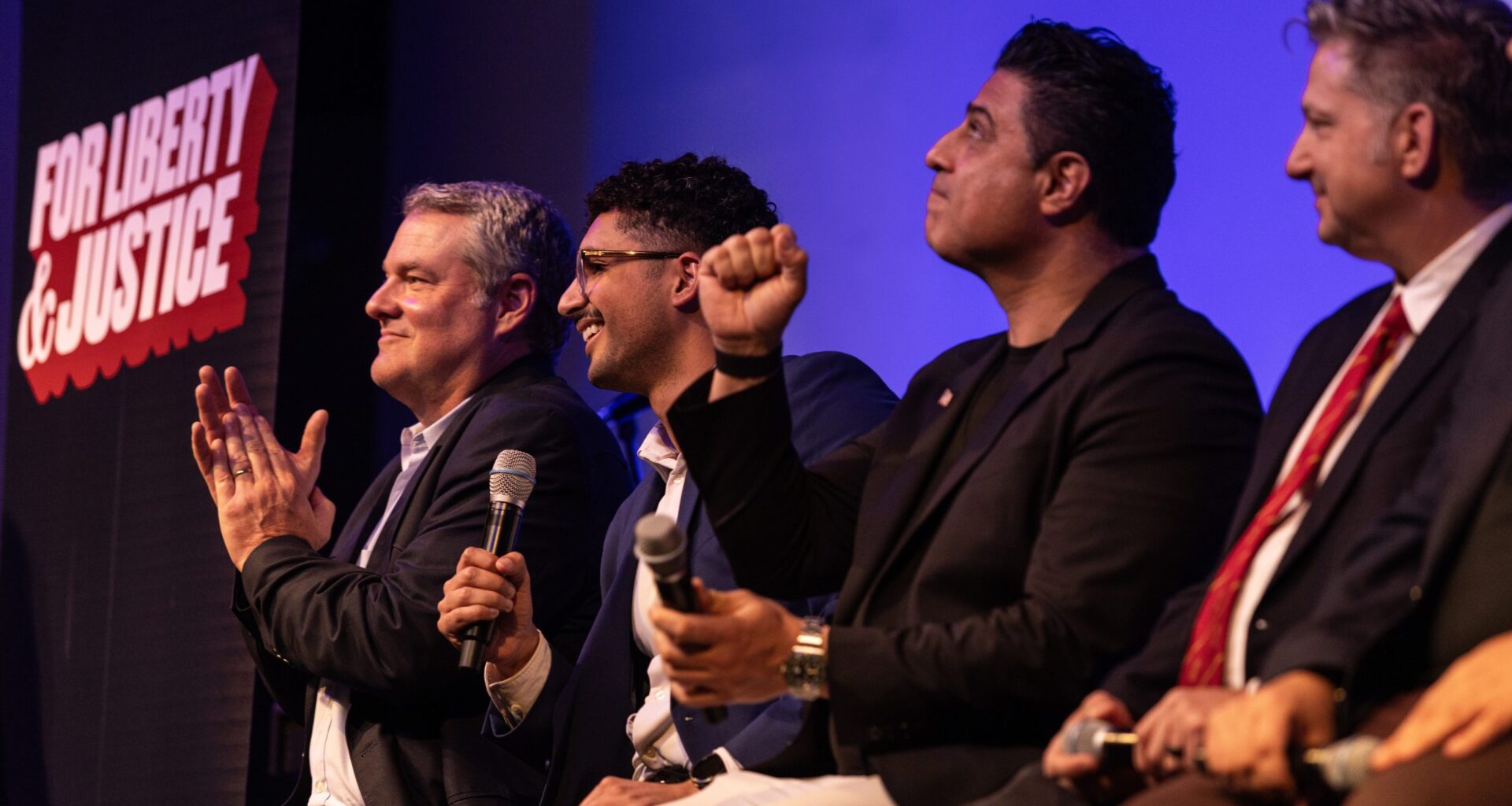
Political and religious leaders suggested deporting, jailing or converting all Muslim people to eradicate what they perceive to be the “threat of Islam” in Tarrant County and Texas.
The ideas were debated in a panel discussion Thursday night, during which a Republican legislator suggested state lawmakers remove federal protections for the practice of Islam by classifying the faith as a political system rather than a religion.
“We could basically say, ‘In the state of Texas, we get to define what a religion is, and Islam is not a religion protected under the First Amendment of the U.S. Constitution,” said state Rep. Andy Hopper, who represents Wise County northwest of Tarrant.
Hopper joined four other panelists at Light of the World Church for the event hosted by For Liberty & Justice, the political arm of Fort Worth’s Mercy Culture Church. The event came just two days after primary elections — in which many Republican candidates in local, state and national races campaigned on anti-Islamic rhetoric — and during Ramadan, which is the holiest month in the Islamic faith.
The other speakers were Shahriq Khan, a self-described “ex-Muslim” turned Christian social media influencer; Benji Gershon, founder of the Dallas-based grassroots group American Jewish Conservatives; Abteen Vaziri, who lost his primary bid for the GOP nomination for northeast Dallas County’s U.S. House District 32; and John Guandolo, a former FBI agent and author of the 2019 book “Islam’s Deception: The Truth About Sharia.”
Combatting “Islamic extremism” is a long-held concern in fringe Republican circles, but the ideas discussed March 5 signal a “big step” from traditional talking points, said Matthew Wilson, a political science professor at Southern Methodist University who studies the intersection of religion and politics.
“Some of the stridency of the rhetoric, that is even the suggestion that you could outright ban or criminalize the practice of the world’s second-largest religion, is noteworthy because that is a real escalation of the rhetoric,” Wilson said Friday.
More than 31,000 people practice Islam in Tarrant County, according to 2020 data from the Association of Religious Data Archives. Muslims make up 1% of the Dallas-Fort Worth population, according to Pew Research Center’s 2023-2024 Religious Landscape Study.
Concerns about the so-called “Islamization” of Texas regained traction among Tarrant County’s GOP circles during the primaries, with elected officials or candidates seeking to crack down on “sharia law” through government policy.
Convening such a panel so soon after the elections indicates that some religious leaders within the evangelical Christian community perceive the topic of Islam to be “a genuine threat and a genuine issue going forward,” Wilson said.
“They don’t want to see it cynically used to garner primary votes and then discarded,” Wilson said. “They want to see concern about Islam continue as a live issue in Texas Republican politics.”
Carlos Turcios, who leads For Liberty & Justice’s Tarrant County operations, organized the event in response to The Meadow, a planned Muslim-centric residential development in the city of Josephine more than 70 miles northeast of Fort Worth. The project, formerly called EPIC City, faced months of backlash and legal challenges from residents and state officials.
Turcios described growing concern in Tarrant County around Muslim residents creating “their own segregated communities.” The discussion was a “healthy debate,” he told the Fort Worth Report following the event that drew about 100 attendees.
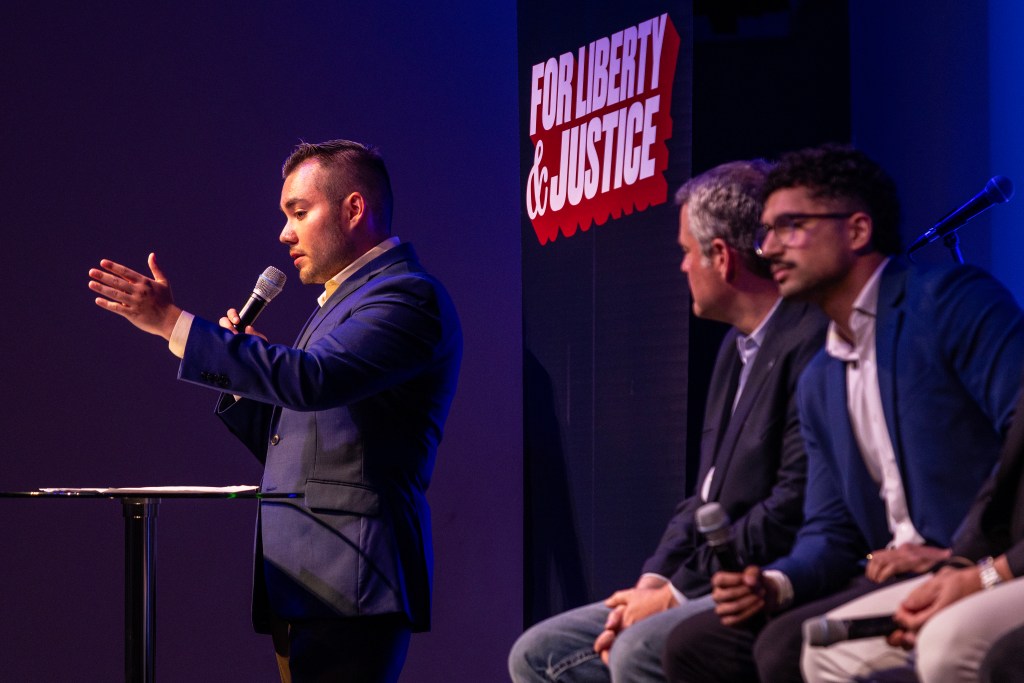 Carlos Turcios, For Liberty & Justice’s Tarrant County director, introduces panelists before a discussion on the “threat of Islam” at Light of the World Church in Fort Worth on March 5, 2026. (Maria Crane | Fort Worth Report/CatchLight Local/Report for America)
Khalid Hamideh, spokesperson for the Islamic Association of North Texas, said he was “taken aback” after discussing Thursday’s event with Report journalists. A 40-year advocate and spokesperson for Islamic organizations, Hamideh said he has never heard talking points such as essentially banning the religion in Texas, especially from an elected official.
“This is very extreme. They’ve really pushed it to the outer limits,” Hamideh said.
The campaign rhetoric in recent weeks included Vaziri, an Iranian-American political refugee, explaining that he was running for Congress “to ensure the Islamic ideology he escaped never takes root here — in Texas or the United States,” according to his campaign website.
Bo French, former chair of the Tarrant County GOP, promised to “stop the Islamic invasion, and defeat the left,” in his campaign for Texas Railroad Commissioner, which oversees the state’s oil and gas industry. French faces Jim Wright in a runoff election in May.
Last year, French refused calls from within the Republican Party to resign from his leadership position after he posted a social media poll asking whether Jews or Muslims pose a “bigger threat to America.”
In January, Keller Mayor Armin Mizani — who successfully sought the GOP’s nomination in a Texas House race — championed a resolution initially drafted to outlaw sharia, the moral code that guides those who practice Islam. City Council members unanimously approved it after removing explicit mentions of sharia in response to community concern that banning sharia would violate the federally protected right to freedom of religion.
Thursday’s panelists discussed a desire to ban sharia but acknowledged the difficulty in doing so because of the First Amendment.
Wilson, who is Catholic, noted the Texas and U.S. constitutions prevent lawmakers from banning sharia law, much like it prevents banning handguns. They also prevent Muslims from using so-called “sharia courts” to enforce their own legal system, he added, comparing sharia to any other moral code or belief system.
“If I choose to buck the dictates of my faith and have a steak tonight for dinner, my Catholic friends and family may look askance at me, but I can’t be put in jail for it,” Wilson said, referencing the Catholic tradition of abstaining from eating meat on Fridays during Lent. “Texas would never enforce Catholic religious expectation in that sense, and sharia law is largely the same thing.”
Every Muslim practices sharia, Hamideh said, comparing the moral code to Christians’ Ten Commandments.
“These people are hate-mongers. … They all know we pray to the same God,” Hamideh said. “We’re climbing the mountain from different directions, but we’re all going in the same direction. We’re all trying to get to heaven.”
As the panel took place Thursday evening, Hamideh broke bread with other faith leaders in Richardson at the Islamic Association of North Texas’ annual interfaith iftar. During Ramadan, Muslims abstain from eating or drinking from sunrise to sunset, breaking their fast after sunset.
Hamideh described the dichotomy between the two events as “ironic,” adding he was surprised to hear such a topic discussed in a “holy place of worship.” During the interfaith iftar, he told the congregation, “Muslims are on the menu, and we’re on the ballot.”
He attributed growing anti-Muslim sentiment to election season, adding that Tarrant County residents are susceptible to such campaign talking points because they’re “so kind” and “so pure.” He urged people unfamiliar with Islam to visit a mosque and learn for themselves.
“We’ve got to go the extra mile to reach out to these folks,” he said, urging Muslims not to shy away from the controversy.
The panel’s impact will carry far beyond the church’s doors, Hamideh said. When elected officials or political leaders “hate-monger” Islam, they inspire followers to leave bomb threats at local mosques and Muslim schools, make death threats to Muslim families and bully Muslim girls who wear hijabs at school, he said.
“The consequences are real,” Hamideh said. “Their words carry weight with the general public, because people believe what they say.”
Panelists offered different approaches to combatting what Hopper described as a “political ideology masking as a religion.” Hopper told attendees he became a founding member of the Sharia Free Caucus in the Texas House that day.
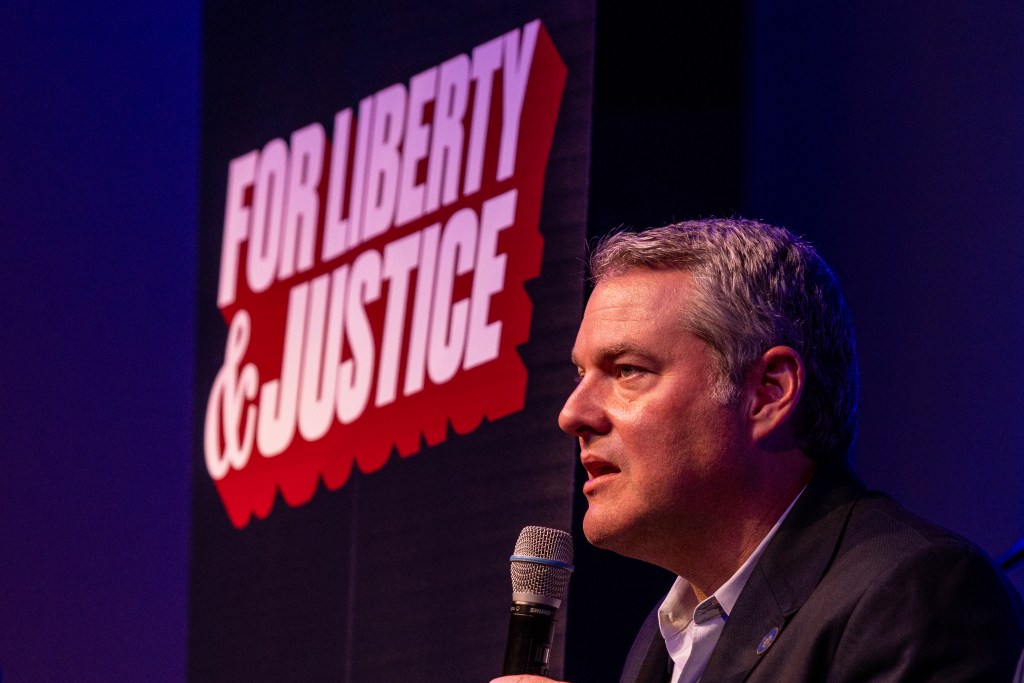 State Rep. Andy Hopper, R-Decatur, speaks during a panel on the “threat of Islam” at Light of the World Church in Fort Worth on March 5, 2026. (Maria Crane | Fort Worth Report/CatchLight Local/Report for America)
Hopper was not initially scheduled to be on the panel but took the place of Mercy Culture pastor Nate Schatzline, Fort Worth’s state lawmaker who is stepping down at the end of the year after accepting a position on President Donald Trump’s national faith advisory board. Schatzline was in D.C. Thursday afternoon to pray over Trump, he wrote on social media.
Schatzline and other Mercy Culture pastors developed Campaign University, an online course that trains Christian conservatives to seek public office or get engaged in local politics through school boards and city councils.
Campaign University’s lessons emphasize the idea that there is no separation between what happens within the church and what happens in government. Schatzline and other instructors say the First Amendment’s establishment clause on the separation of church and state is meant to protect against government involvement in religion, rather than vice versa.
https://www.instagram.com/p/DVi8TVrjtUy/
Turcios didn’t shy away from the suggestion that Campaign University’s goal of mobilizing “conservative warriors” mirrors the panel’s concerns about Islam.
“It’s very simple: America is a Christian country,” Turcios said. “There are countries where their identity is tied to their Islamic faith, and I wouldn’t want to change their identity in those countries.”
Throughout the night Thursday, panelists pushed the idea that Islam mandates that Muslims wage war on other religions and impose sharia on non-Muslims.
Hopper shared the idea of ending public contracts with companies that have an H-1B visa program, prohibiting halal foods in Texas schools and deporting those associated with the Muslim Brotherhood or the Council on American-Islamic Relations, or CAIR, which Gov. Greg Abbott declared in November as “foreign terrorist organizations and transnational criminal organizations.” CAIR denies those claims.
“Without a shadow of a doubt, there is no opportunity for co-existence with civilization,” Hopper said.
Khan veered away from what he called the “violent” language of his co-panelists, instead saying Christians should focus on converting Muslims to Christianity. He discouraged attendees from “attacking” or villainizing those of the Islamic faith, emphasizing “respectful” evangelization.
He advised reading and learning the Quran, and suggested that Christian parents teach their children how to stand up for their faith and debunk Islam.
“It’s our job as a church to disciple our kids five times harder than the Muslims are discipling theirs,” Khan said.
Guandolo is the founder of Understanding the Threat, an online organization that offers county-level training programs for citizens to “defeat the jihadi threat.”
“We need to draw a line and say, ‘I will risk everything from this moment forward, to defend liberty, to defend freedom of thought, to defend the right to express myself and the right to live freely as an American and as a Texan,’” Guandolo told attendees Thursday night.
Marissa Greene is a Report for America corps member, covering faith for the Fort Worth Report. You can contact her at marissa.greene@fortworthreport.org.
Cecilia Lenzen is a government accountability reporter for the Fort Worth Report. Contact her at cecilia.lenzen@fortworthreport.org.
At the Fort Worth Report, news decisions are made independently of our board members and financial supporters. Read more about our editorial independence policy here.
This <a target=”_blank” href=”https://fortworthreport.org/2026/03/07/banning-islam-deporting-muslims-discussed-at-fort-worth-church-after-primary-elections/”>article</a> first appeared on <a target=”_blank” href=”https://fortworthreport.org”>Fort Worth Report</a> and is republished here under a <a target=”_blank” href=”https://creativecommons.org/licenses/by-nd/4.0/”>Creative Commons Attribution-NoDerivatives 4.0 International License</a>.<img src=”https://i0.wp.com/fortworthreport.org/wp-content/uploads/2021/04/cropped-favicon.png?resize=150%2C150&quality=80&ssl=1″ style=”width:1em;height:1em;margin-left:10px;”>
<img id=”republication-tracker-tool-source” src=”https://fortworthreport.org/?republication-pixel=true&post=436901&ga4=2820184429″ style=”width:1px;height:1px;”><script> PARSELY = { autotrack: false, onload: function() { PARSELY.beacon.trackPageView({ url: “https://fortworthreport.org/2026/03/07/banning-islam-deporting-muslims-discussed-at-fort-worth-church-after-primary-elections/”, urlref: window.location.href }); } } </script> <script id=”parsely-cfg” src=”//cdn.parsely.com/keys/fortworthreport.org/p.js”></script>