
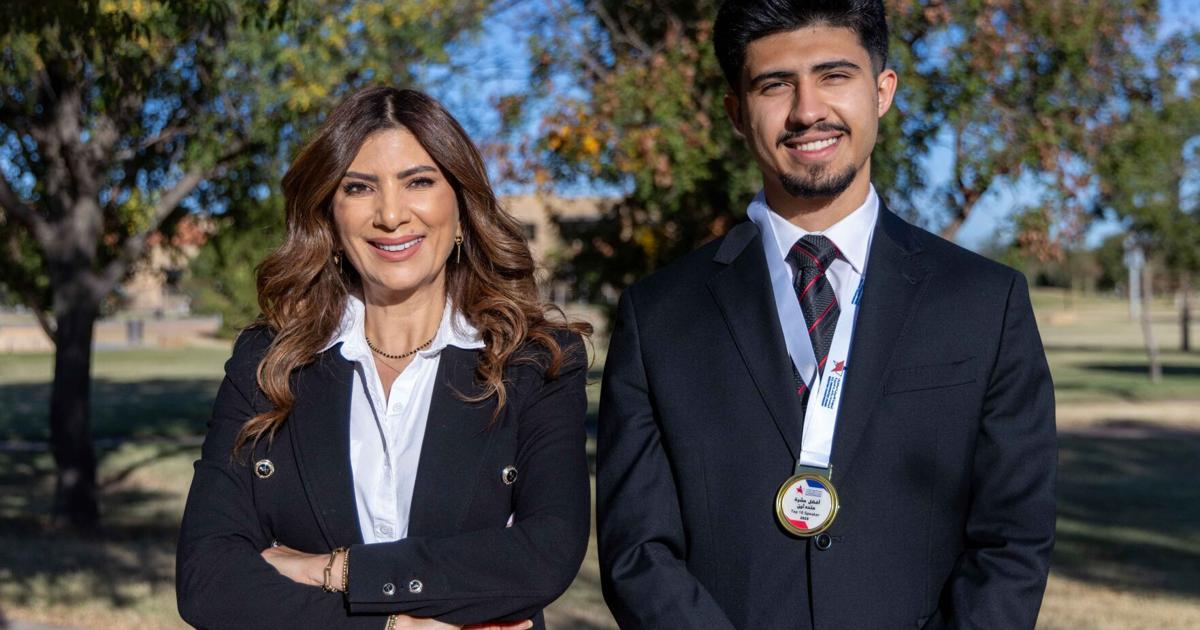
For the first time in program history, Texas Tech’s Arabic Debate Team achieved fourth place in the semifinals of this year’s U.S. Universities Arabic Debating Championship in New York.
Before the competition began on Sept. 26, Mohammed Ali Alabdali, the team’s second speaker, knew for a fact they were making history.
“I told Rula since even before the first round, ‘Listen, I promise you, you have my word, we’re gonna make it to the semifinal,’” Alabdali said. “She said we’ve never done that in the history of the school.”
This marks the fifth time Tech’s Arabic Debate Team has competed in the USADC. However, this was the first time Tech has made a semifinals placement, achieving fourth place behind the Massachusetts Institute of Technology, Stanford University and Harvard University.
Alabdali, a fourth-year mechanical engineering major from Baghdad, Iraq, said his confidence in their chances came from his faith in the team’s ability to stand alongside their prestigious opponents.
“I didn’t feel like I was competing against Ivy Leagues because I never thought I was an underdog in that situation,” Alabdali said. “I always thought I was just as good as they are, I’m just as smart as they are.”

Texas Tech Arabic debate team member Mohammed Ali Alabdali holds his medal from the U.S. Universities Arabic Debating Championship in Urbanovsky Park Oct. 22, 2025.
Jake Cooper
Hosting over 34 institutions, the USADC invites college teams to debate numerous topics affecting the U.S. including artificial intelligence, economics and education. Teams are judged round by round on their ability to effectively convey their arguments in the Arabic language.
After competing against colleges such as Duke University and the University of Chicago, Abdulkader Almosa, a Tech alumnus who graduated in May but remained involved with the team as the first speaker, said hearing their names nominated for semifinals was a surreal moment.
“In all of Texas Tech history, they never made it past the second round,” Almosa said. “So, us making the third round was a big deal in itself, but then making it to semifinals was an even crazier thing to me.”
Rula Al-Hmoud, a senior lecturer in Arabic and leader of the Arabic Debate Program, coached the team alongside her assistant, Sanaa Naciri.
Hearing Tech’s semifinal nomination, Al-Hmoud said she was simultaneously ecstatic and in disbelief.
“I lost my voice. That’s how loud (I was) screaming,” Al-Hmoud said. “I was like, ‘What? I cannot believe it.’”
Almosa said many other public universities competed along with their private counterparts. It was this sheer number that made Tech’s nomination even more impactful.
“It was just really amazing to see how Texas Tech, of all the public universities in the United States that competed, we’re the only one that made it to the semifinal,” Almosa said. “I’m just really proud to be able to represent the university through this.”
The competition pits teams of three against each other, with a first, second and third speaker each arguing different points during the debate. With this in mind, the trio rigorously trained their skills and knowledge in a variety of subjects to decide who and when someone would speak.
Tech Arabic Debate Team members Abdulkader Almosa, left, Mohammed Ali Alabdali, middle, and Hussam Al-Haj, right, sit at their table preparing for a rebuttal against their opponents during the U.S. Universities Arabic Debating Championship on Sept. 26.
Courtesy of Rula Al-Hmoud
Almosa said their practices revealed each member’s individual advantages and disadvantages. Once they understood their strong suits, they came up with a strategy that elevated their abilities, leading to the placement.
“Once we figured out the pros and cons and each of our strengths and weaknesses, we were able to put a good game plan together,” Almosa said.
He also said each member brought unique perspectives and strengths, giving the team a diverse repertoire to rely on during the championship.
“Alabdali is crazy good at providing evidence, whether it’s historical or economical evidence. Since I have a background in health sciences, I would provide a medical and social perspective,” Almosa said. “ … Hussam, who’s our third speaker, is very good with politics and engineering, so he was able to bring those perspectives, and at the same time he’s really good at rebuttals.”
Hussam Al-Haj, a third-year architecture major from Sanaa, Yemen, and the third speaker in the debate, said the team’s placement among private Ivy League universities represents a shift in quality across Tech, not just in Arabic or debate.
“We are getting better,” Al-Haj said. “ … Football, basketball, academic-wise, research. I feel like that did affect us in a way that made us (want to) go there. Texas Tech as a community has been thriving, and we just went on that wave with Texas Tech.”
After returning to Lubbock, Alabdali said the team’s historic placement came not just from their individual skills, but from their ability to work as a cohesive team, no matter the circumstances.
“We’re all working together and we’re all humble and just like working together and being supportive of each other,” Alabdali said. “If somebody does good, we support them. If somebody does not so good, we support them.”