
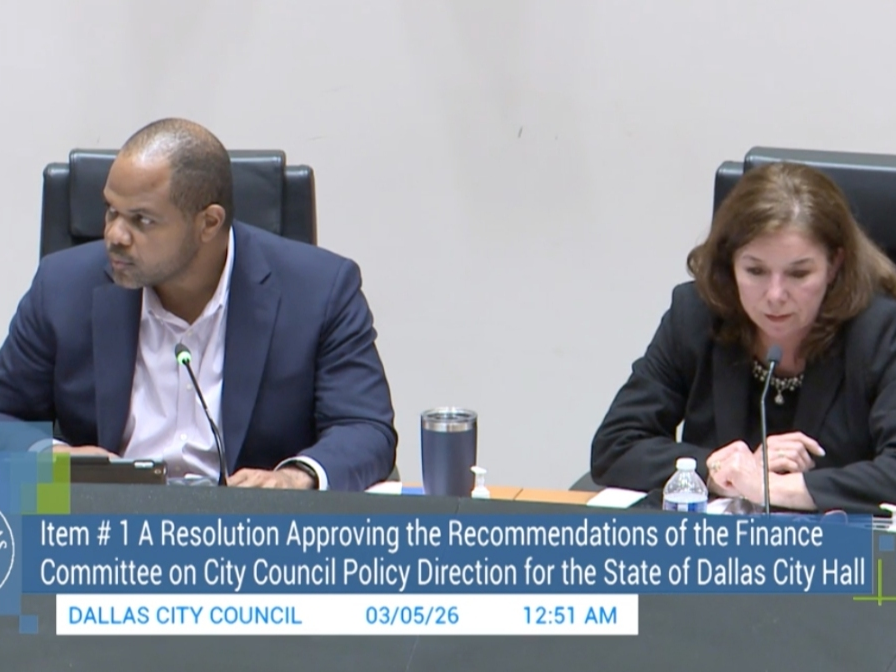
It was 1:18 in the morning when the Dallas City Council finally voted on the future of I.M. Pei’s City Hall. The special session had begun sixteen hours earlier with 76 speakers and a chamber so full they were staged in groups. The resolution to explore leaving the building passed 9-6, the word “pursuing” amended to “exploring.” “I’ve never seen such vehement opposition to gathering more information,” Mayor Eric Johnson said in closing, “when we’re not even being asked to decide a thing.”
What the sixteen hours produced was a civic reckoning, voice by voice. Michael Amonette, third-generation Oak Cliff native and Bishop Arts investor, called the plaza something developers always misread. “A plaza is not an empty space,” he said. “It is a civic space. It’s where a city sees itself.” Architect Jessica Stewart recalled marching to this building during the 2017 mega march for immigrant families. “This plaza received us,” she said. “It gave us context for our power as citizens.”
Council Member Paula Blackmon bemoaned the fact that the city spent two years debating trash pickup and five years on a police training center. “It took five months to change that broken clock in our break room,” she said. “But this decision, we are expecting to make in six months.”
At hour fifteen, Council Member Adam Bazaldua held up a crayon drawing from a four-and-a-half-year-old boy whose mother, father, and grandfather all worked at City Hall. It read: “Dear Bas, don’t destroy City Hall. I’m sure going to miss it.” Over 90% of constituents he’d heard from, Bazaldua said, shared the sentiment. “This process has been very telling,” he said. “And it’s far from over.”