
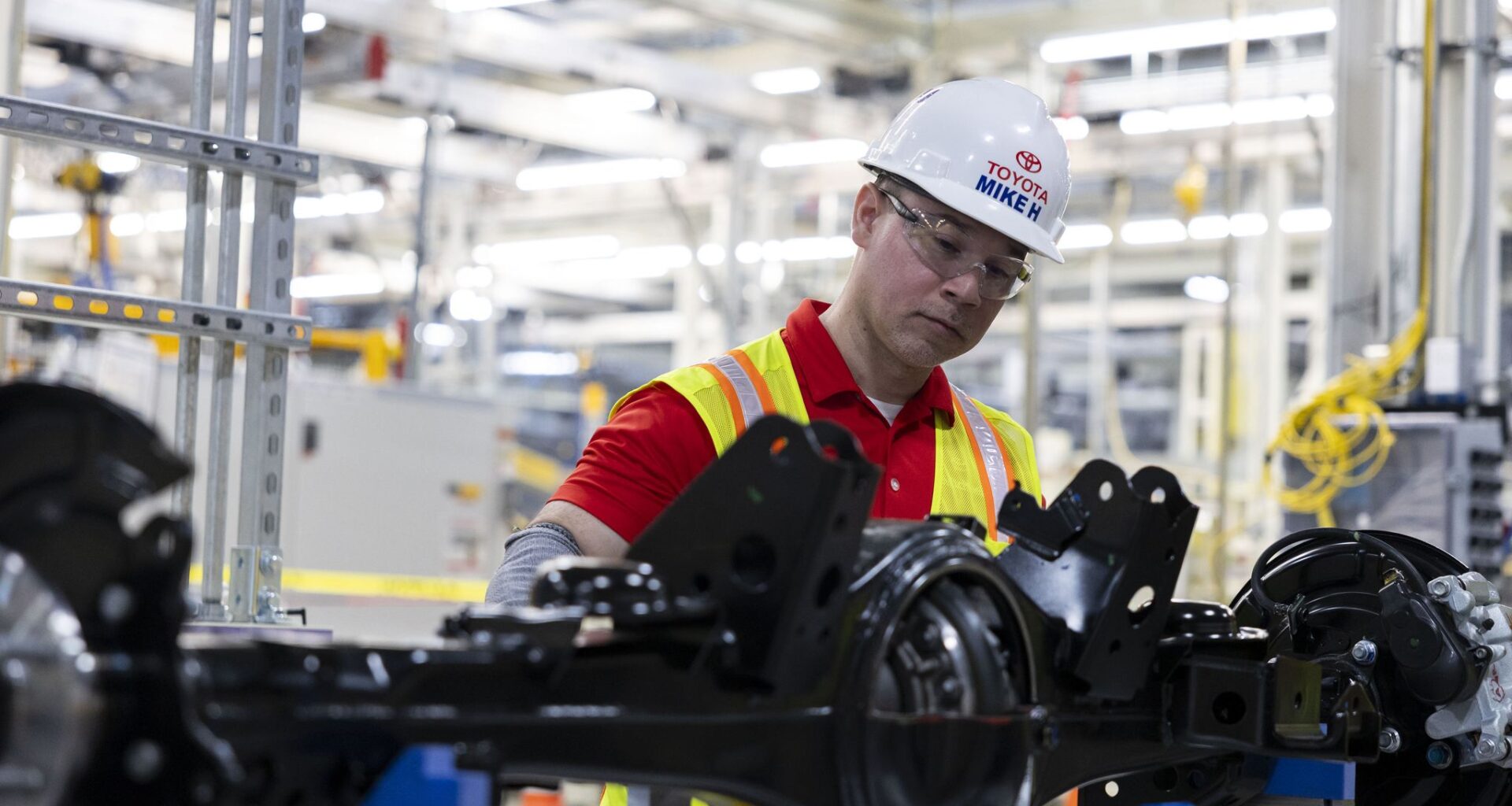
Michael Hernandez, a manager of assembly production, gives a demonstration at the new rear axle plant at Toyota Texas in San Antonio on Monday, March 2, 2026.
Katina Zentz/San Antonio Express-News
Toyota’s new plant on the South Side is still months from opening, but the automaker is gearing up for a shift from the construction phase to prepping the factory for production.

Once it’s up and running at full speed in 2027, the $531 million plant will be pumping out half a million rear axles a year.
Article continues below this ad
Hiring is underway, with managerial and skilled maintenance roles filled. Construction on the sprawling 2,000-acre campus on the South Side is expected to wrap up in May.
After the construction crews clear out, Toyota will be ready to put the plant through its paces — running the assembly lines to make sure everything is operating properly before starting production in November.
Elected officials recently donned neon vests and hard hats to get a sneak peak at Toyota Motor Manufacturing Texas’ newest operation.
Toyota decided to bring production of rear axles in-house after its previous supplier stopped producing rear axles. The critical part transfers power from the engine to the rear wheels.
Article continues below this ad
“It is very important for us to continue to focus on improving our cost efficiency, streamlining our production and managing overall quality,” Toyota Texas President Frank Voss said. “That’s what this facility here will allow us to do.”
Toyota is now working to fill its production positions, which account for more than 80% of the 411 new jobs being added by the plant.
So far, many of the positions at the factory have been filled by promotions and transfers from the vehicle plant. Those vacancies will be filled by new hires.
READ MORE: Toyota begins hiring at new San Antonio plant; will add 400+ employees this year
Article continues below this ad
Hiring for the production positions will occur over the next 16 months as production ramps up. Wages start at $22.50 an hour and rotation premium, just above the median hourly wage of $22.29 for production workers in the San Antonio metro area in May 2024, the most recent data available.
San Antonio Mayor Gina Ortiz Jones tours Toyota’s new rear axle plant in San Antonio on March 2.
Katina Zentz/San Antonio Express-News
San Antonio Mayor Gina Ortiz Jones, left, and Bexar County Judge Peter Sakai applaud during a presentation at the Toyota Texas Experience Center on March 2.
Katina Zentz/San Antonio Express-News
Mayor Gina Ortiz Jones pointed to Toyota’s pay structure as a plus for San Antonio.
Article continues below this ad
“At the end of the day, that’s what I care about,” Jones said. “We can’t be the third-poorest city in the country and then not demand that our employers pay people a living wage — not just a living wage but a wage where they can enjoy their lives.”
The workers will be operating five machining and working lines, with three reserved for the Tacoma and two lines producing the same axle for the Tundra and Sequoia.
The plant will start off by producing rear axles for the Tundra and Sequoia. In December, it expects to be making rear axles for the Tacoma. It expects to reach full capacity — producing 500,000 rear axles each year — by May 2027.
Workers will be assigned to one of the plant’s three zones: welding, painting and assembly.
Article continues below this ad
Production on the rear axles will start in the welding zone, where much of the system is automated. Each welding station will have one to two automated welding robots.
Some of the work — such as heavy arc welding — will still be handled by humans. Arc welding is a process to join two pieces of metal together by using the heat produced by an electric arc.
Toyota is tapping into virtual reality tech to train its employees in heavy arc welding.
More than 20 team members already have been taught the skill using a new “virtual reality welding dojo,” said Sam Wegehaupt, general manager for the rear axle plant.
Article continues below this ad
RELATED: Toyota president gearing up for ‘biggest challenge’ — opening new plant at San Antonio site
“This virtual welding process is very similar to a video game, but it teaches our members how to actually weld,” Wegehaupt said. “It’s a very exciting technique and it’s very efficient. We don’t have to actually burn steel or welding wire in order to get a lot of repetitions for welding.”
Once the welding work is complete, the parts are sent off to the painting zone. This phase requires 13 different dip tanks — nine for cleaning and preparing, while the other four coat the product in paint.
Next up is the assembly zone, which operates three lines: two for the Tacoma and one for the Tundra and Sequoia. The coated products are installed with components like differential gears and drive shafts that come from Toyota’s Alabama plant. Toyota operates 14 manufacturing plants in North America.
Article continues below this ad
After the rear axle is assembled, it undergoes two final inspections to ensure there are no issues, such as leaks. The plant will produce 17 variations of the rear axles, depending on factors like the vehicle being two-wheel or four-wheel drive.
Once the plant is operating at full capacity, it will be shipping out 25 trailers of axles daily, with 300,000 of them going out to Toyota Motor Manufacturing Baja California, Guanajuato for the Tacoma. The remaining 200,000 will be sent to the manufacturing plant across the street to be installed in the Tundras and Sequoias being built there.
Workers stand by the assembly line at the new rear axle plant at Toyota Texas in San Antonio.
Katina Zentz/San Antonio Express-News
Greg Rexroat, a senior manager over the rear axle unit plant, leads a recent tour at Toyota’s new rear axle plant.
Katina Zentz/San Antonio Express-News
READ MORE: Sales of San Antonio-made Toyota electrified vehicles surge, continue outperforming their peers
Article continues below this ad
Those shipments will add to the traffic on Toyota’s South Side campus.
Currently, about 1,250 supply trucks drive through the site every day, according to Carla Underwood, Toyota Motor Manufacturing Texas vice president of manufacturing business operations and general manager of production control. Another 500 trucks will be added to the daily traffic flow once the new plant is fully operational, she said.
To handle that additional traffic, Toyota is putting in new roads, and the city is adding an entrance to the rear axle plant off Applewhite Road.
In addition, Toyota and the city are pushing for South Texas Parkway to be built. The proposed 15-mile freeway would run south of Loop 410 — near the Toyota campus — and connect Interstates 35 and 37.
Article continues below this ad
The city of San Antonio has argued that the freeway would help alleviate freight traffic from industrial operations.
“We need the South Texas Parkway,” Jones said, calling it a “key part” of the city’s legislative agenda.
RELATED: What you need to know about a proposed new freeway on South Side
The proposed parkway would help handle the additional traffic coming from the South Side campus to Toyota’s plants in Mexico, where the Tundra is manufactured.
Article continues below this ad
Toyota Texas President Frank Voss also will be keeping an eye on the U.S.-Mexico-Canada-Agreement review this July and how President Donald Trump’s tariff policies could end up affecting it. Voss is also is Toyota Motor North America’s group vice president of Region 4 — a North American supply chain that stretches from Mexico through Canada that includes Toyota Motor Manufacturing Baja California, Guanajuato and Toyota Auto Body California.
It’s also a consideration for Jones, who said trade is one of the issues she aims to bring up during the SA to DC trip later this month.
“When these things are pumped out, they’re going to go straight to Mexico,” Jones said. “We’ve got to do everything possible to keep barriers low so that we can continue producing at the highest amount.”
Article continues below this ad
Workers stand by the assembly line at the new rear axle plant at Toyota Texas in San Antonio.
Katina Zentz/San Antonio Express-News