
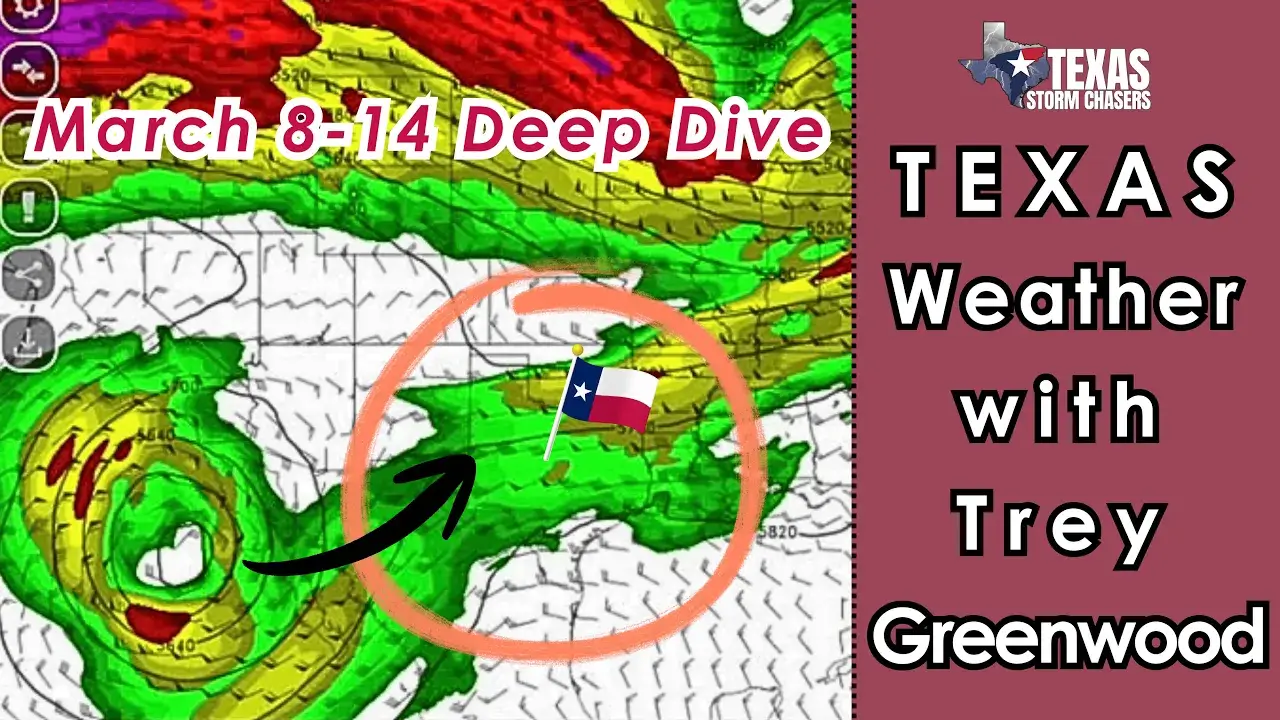
Texas is heading into an active stretch of weather over the next few days, with severe storm chances in parts of the state Monday through Wednesday before a quieter pattern develops later this week.
In this week’s Texas Deep Dive, Texas Storm Chasers meteorologist Trey Greenwood breaks down the setup driving the storm threat, where the greatest risks are expected, and why Tuesday currently appears to be the most active day for severe weather across Texas.
You can watch Trey’s full video forecast below. It has chapters so you can scroll through to the topic that interests you.
Severe weather risk begins Monday in Northeast Texas
The first storm threat arrives Monday, March 9, when the Storm Prediction Center places far Northeast Texas in a Level 1 of 5 marginal risk for severe weather.
This includes areas such as Paris, Texarkana, Longview, and Marshall. While the greatest severe weather threat on Monday is expected to remain east of Texas across southern Arkansas, northern Louisiana, and Mississippi, a few strong to severe storms may develop close enough to affect the northeastern corner of Texas.
The main concern Monday will be large hail, with a few hailstones potentially approaching 2 inches in diameter. A low tornado risk also exists in far Northeast Texas, especially near Texarkana, though that is not expected to be the primary hazard. Isolated damaging wind gusts are also possible.
Overall, Monday’s severe weather threat in Texas appears isolated and low-end, but it is not zero, especially in the far northeastern part of the state.
Tuesday looks like the main day for severe weather in Texas
Tuesday, March 10, currently looks like the most widespread and important severe weather day of the week across Texas.
The Storm Prediction Center has outlined a broad Level 2 of 5 slight risk stretching from parts of the eastern Texas Panhandle into West Central Texas, North Texas, Central Texas, and Northeast Texas. That includes cities such as Childress, Wichita Falls, Dallas-Fort Worth, Paris, Abilene, and San Angelo.
A larger Level 1 of 5 marginal risk also covers surrounding areas, including Amarillo, Lubbock, Midland, San Antonio, Austin, Waco, and Texarkana.
The primary threats on Tuesday appear to be large hail and damaging straight-line winds. Some storms may become severe enough to produce very large hail. While a tornado or two cannot be ruled out, current forecast analysis suggests the tornado threat may remain more limited than the hail and wind threat.
That said, Tuesday is the day Texans across a large part of the state should be paying close attention to forecast updates, especially from the eastern Texas Panhandle through North Texas and into West Central Texas.
A smaller risk may linger Wednesday in Far East Texas
By Wednesday, March 11, the main storm system should be shifting east, but parts of Far East Texas may still see some severe weather potential.
At this time, the risk appears focused near the Texas-Louisiana border, including areas near Texarkana and southward toward the Shreveport region. The exact placement of that risk may still shift somewhat as newer data comes in.
Wednesday’s hazards may again include damaging winds, hail, and a low-end tornado threat, but much of that will depend on how Tuesday’s storms evolve and how quickly the atmosphere recovers.
Why this pattern is developing
According to Greenwood’s analysis, the setup begins with an upper-level low that has been cut off from the main jet stream near Baja California. As that feature finally begins moving east into the southern United States, it will help trigger stronger lift and storm development across Texas.
Monday’s threat is tied to a weaker and more subtle disturbance affecting Northeast Texas and areas farther east.
Tuesday’s setup is more concerning because the stronger upper-level system moves directly into the southern Plains while a developing surface low and dryline sharpen across West Texas. That combination should provide a more defined focus for thunderstorm development and help support a broader severe weather threat.
By Wednesday, the upper-level system should be moving toward the Gulf Coast, shifting the storm risk eastward and eventually allowing a quieter weather pattern to build in behind it.
Fire weather is also a concern this week
While severe storms are the main headline, fire weather will also be a concern in parts of Texas this week.
Critical fire weather conditions have been outlined for parts of the Texas Panhandle on Sunday and again Monday, especially near and north of the I-40 corridor. Additional localized fire weather concerns may continue over the next couple of days, with another risk area highlighted for parts of West Texas and the Panhandle on Thursday.
Strong winds, dry air, and low humidity will be the main drivers of that threat.
What Texans should watch most closely
The biggest thing to watch this week is Tuesday’s severe weather setup.
Right now, the overall pattern supports storm development somewhere along and east of the dryline, with hail and damaging winds as the leading hazards. Monday’s threat is more isolated and focused in Northeast Texas, while Wednesday’s risk appears confined to Far East Texas.
After Wednesday, a ridge of high pressure is expected to build into the southern United States, which should help quiet the severe weather pattern for at least a few days.
That does not mean spring severe weather season is over. It just means Texas may get a short break after an active start to the week, because the atmosphere apparently enjoys giving everyone a brief intermission before the next act.
Final thoughts
For now, Texans in Northeast Texas should monitor Monday’s forecast, and a much larger part of the state should be prepared for possible severe weather on Tuesday. Those in Far East Texas should also stay alert into Wednesday as the system exits.
As always, forecast details can and will change, especially this time of year. Check back with Texas Storm Chasers for updated forecasts, live coverage, and severe weather information as this week’s storm threats evolve.