
Growth in Pflugerville has reshaped neighborhoods, filled new subdivisions and drawn businesses to major corridors.
Now it is reshaping the city’s underground infrastructure.
Behind the scenes, engineers and city leaders are planning and constructing a wide-ranging expansion of Pflugerville’s water and wastewater systems—projects that will determine how much the city can grow and how quickly.
The effort took on a new urgency after a pipeline failure reduced the amount of water flowing into Lake Pflugerville, prompting city officials to declare a local disaster March 4 and set restrictions across the city.
While crews work to stabilize the system and restore water flow to Lake Pflugerville, the city’s primary drinking water source, the incident highlights a broader challenge facing cities across Central Texas: how to stay ahead of demand without overbuilding—and how to pay for infrastructure built for a future that has not yet arrived.
Two-minute impact
Amid the Lake Pflugerville pipeline failure, the city projected that by April 18, water levels could drop below its raw water intake structure. This means the city would not be able to provide water to its customers. The city was made aware of the damage to the waterline on Feb. 6.
As of press time March 6, crews were installing a temporary line to restore water flow into the lake, with completion expected as early as March 10 while repairs to the damaged line continue.
City officials said the disaster declaration allows Pflugerville to pursue emergency funding and technical assistance from state agencies while the water system is stabilized.
In response to the emergency, the city activated Stage 3 water restrictions, limiting water to indoor use purposes only for all city water customers.
“City staff is working around the clock to stabilize the situation, but conservation by our community is critical,” Mayor Doug Weiss said.
The city also activated additional wells and worked with Manville Water Supply Corporation to supplement the city’s supply. Erik Prinz, general manager at Manville, said the water supplier has no plans to issue any water restrictions or stoppages for its customers.
All of this comes as the city undertakes one of the largest infrastructure expansions in its history. Pflugerville has more than $426 million in wastewater projects underway and another $419 million in long-term water system investments, including a secondary line pulling water from the Colorado River to Lake Pflugerville.
Thirteen active wastewater projects are also underway across the city, ranging from interceptor installations to lift station upgrades.
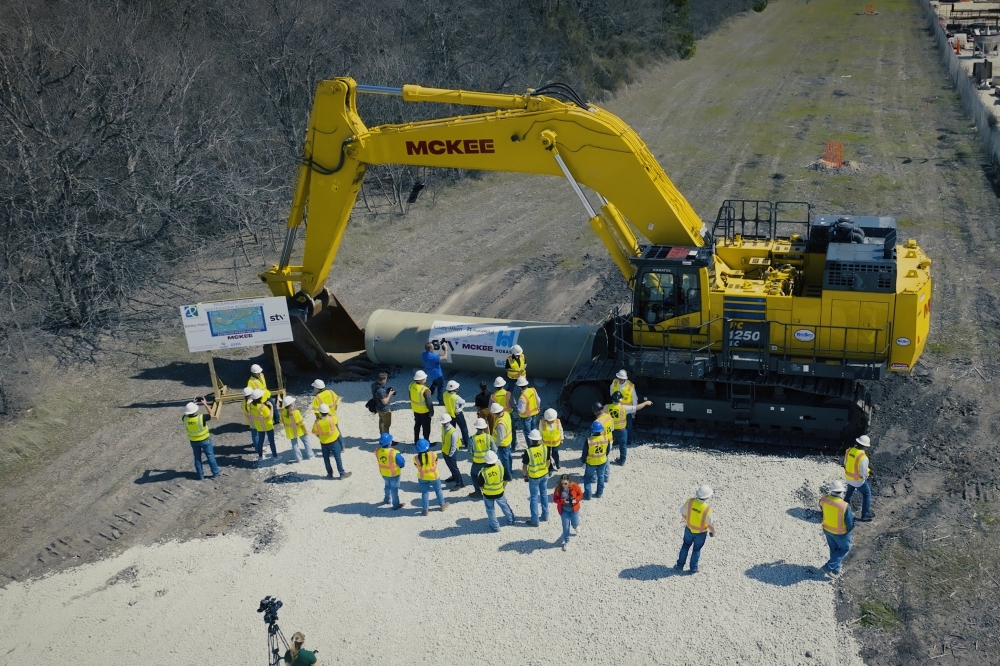
At the center of the effort is the $280.9 million new Wilbarger Creek Regional Wastewater Treatment Facility, along with major system improvements spanning four wastewater basins
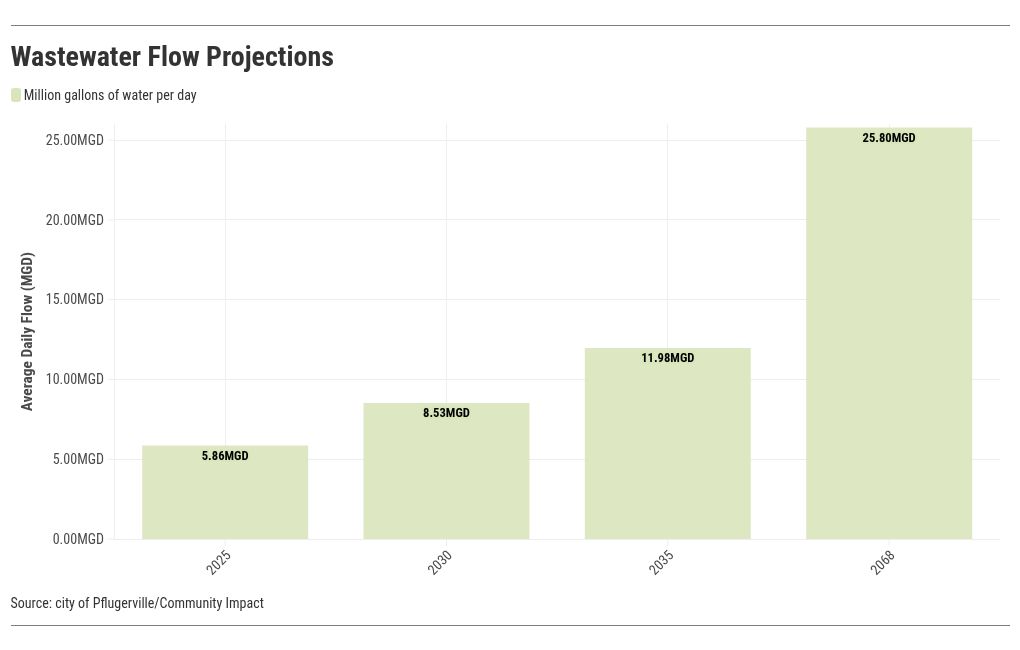
According to the city’s 2025 Wastewater Master Plan, average daily wastewater flow is projected to increase from 5.86 million gallons per day in 2025 to 11.98 MGD by 2035, eventually reaching 25.8 MGD at buildout.
“>
How it works
Pflugerville is financing its water infrastructure expansion through a combination of debt, federal assistance and available fund balances—costs that are supported by taxpayers and utility ratepayers over time. Officials say spreading costs over time allows the city to advance capacity projects while maintaining service reliability. While city leaders have lowered the property tax rate in recent years, rising property values and long-term utility debt can still influence residents’ taxes and bills.
Diving deeper
Pflugerville’s population has climbed from roughly 46,000 residents in 2008 to nearly 80,000 today, with projections surpassing 100,000 within the next decade, according to city estimates. That growth curve is the foundation of the city’s water and wastewater master plans.
When asked what happens if the city does not reach those growth targets, Weiss said officials are planning conservatively. However, rather than risk being caught short, he said, the city would rather build in overall water capacity ahead of demand.
 Matt Rector, Pflugerville public utility and engineering director, said expansion is driven not only by growth but by regulatory requirements. Under Texas regulations, wastewater plants that exceed 75% of permitted annual average flow for three consecutive months must begin planning for expansion. At 90%, construction on that expansion must begin.
Single-family homes make up about 96% of total system connections, accounting for about 62% of total water usage. Commercial customers represent roughly 3% of connections but account for almost 15% of demand. Apartments make up 0.3% of connections and 19% of usage.
That imbalance, Weiss said, means long-term strain on the system may be shaped less by the number of rooftops and more by the type of commercial and industrial development the city attracts.
What they’re saying
Weiss said commercial customers represent a small share of total accounts but consume a disproportionate amount of water.
“It’s the businesses that disproportionately use water,” Weiss said, pointing to restaurants, retail centers and other commercial developments operating throughout the day.
Weiss said the goal is to ensure businesses are not delayed by infrastructure limits, referencing other cities where development has stalled because projects could not secure water connections.
The city is developing a new wastewater basin in part to relieve pressure on existing infrastructure and open capacity for additional commercial development, particularly along the SH 130 corridor.
“We will have the capacity to continue to serve our community, the capacity to grow and the capacity to bring the amenities to our town,” Weiss said.
Officials say that balancing commercial expansion with infrastructure capacity will remain central to the city’s long-term strategy.
“We need water in order to support the growth. We also need water in order to enable the growth,” Weiss said.
What’s next
The current round of construction is only one phase of a decades-long build-out. The city’s master plan divides expansion into planning horizons through 2035 and ultimately full build-out around 2068.
Meanwhile, the city will reevaluate the duration for Stage 3 restrictions once temporary repairs to the Lake Pflugerville pipeline are completed. Customers who do not follow water restrictions may receive formal warnings or fines that could range from $1,500 to $2,000 per occurrence.
Lake Pflugerville and fishing piers are closed to recreational usage to include boating, swimming, and fishing. To find your water supply source, visit
During stage 3 emergency water restrictions, customers are not allowed to:
Irrigate lawns, including automatic or manual sprinkler systems, or hand watering with a hose and bucketFill previously empty swimming poolsWash cars at residencesWater home or business building foundationsRun ornamental fountains unless they contain fish or recirculate waterInstall landscaping or grass that requires irrigation during installationWash sidewalks or driveways