
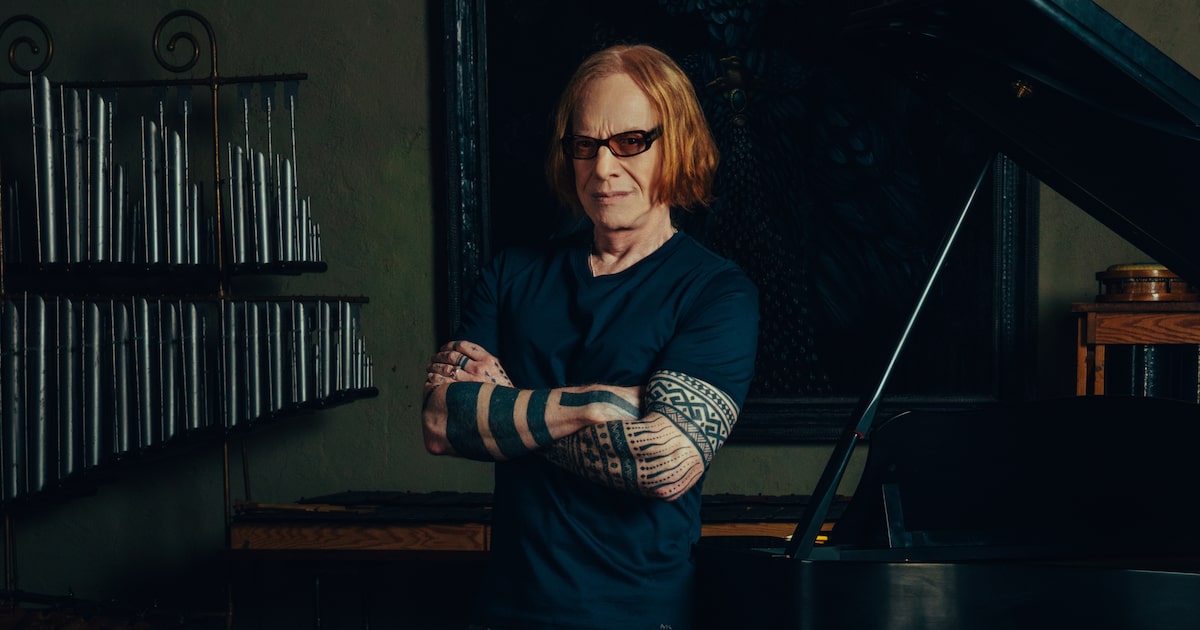
Danny Elfman pulled off one of the greatest second acts in music. He leapt from vinyl to celluloid and never looked back.
In the ’80s, he was singer-frontman for Oingo Boingo, the surreal L.A. new wave band famous for its polyfusion approach — punk, jazz, ska, you name it. But in the ’90s, Elfman broke up the group and shifted to film composing full time. Since then, he’s written scores for more than 100 movies, including nearly 20 with director Tim Burton.
He’s also the go-to composer for directors Gus Van Sant and Sam Raimi, scoring the music for their new films Dead Man’s Wire and Send Help, respectively. But his alliance with Burton is his calling card.
This month, he’ll appear as a special guest in “Danny Elfman’s Music from the Films of Tim Burton,” presented by the Dallas Symphony Orchestra and featuring the Dallas Symphony Chorus, with works from Beetlejuice, Edward Scissorhands, The Nightmare Before Christmas and 10 other films.
News Roundups
I spoke with Elfman, 72, from Los Angeles, where he lives with his wife, Bridget Fonda. This interview has been edited for clarity.
You were a huge movie buff as a child growing up near L.A. When did you zero in on the soundtracks?
From seven or eight years old on, the local movie theater was my life. I’d go every weekend and spend five hours there. But it wasn’t until I was about 12 that I noticed the music as an entity. The movie was The Day the Earth Stood Still, with a Bernard Herrmann score. Suddenly, I made a note of his name, and over the next couple of years, my favorite films would feature Herrmann and stop-motion animator Ray Harryhausen: If I saw both those names, I knew it was going to be my favorite movie of the year.
Oingo Boingo toured from 1979 to 1995. Years later, you told an interviewer “I’m terrified of audiences.” Was that a factor in ending the band?
No. I’ve had stage fright from the first time I went onstage: Stepping out in the spotlight and ad-libbing and talking to an audience was always terrifying. It still is. But I learned to evolve into an alter ego where you’re totally locked in when you’re singing, and you feel fine.
Part of [the reason Oingo Boingo split up] was the frustration of wanting to change gears, but feeling confined. You have to play the same show, more or less, every night. On top of that, I was experiencing hearing damage. Finally, around ’94, I realized if I didn’t want to be deaf later in life, I had to stop doing what I was doing.
Is there a way to describe how or why you work so well with Tim Burton?
It’s hard to define. … Just like it’s hard to define the chemistry between Spielberg and John Williams, or the Coen Brothers and Carter Burwell, or Robert Zemeckis and Alan Silvestri. Sometimes, a composer and director lock together and they’re able to keep going. When I met Tim, it was very clear to me that our sensibilities were very similar. His worlds didn’t seem that weird to me. They felt normal. We both grew up on the same horror films and fantasy films. When I met him, his idol was Vincent Price and mine was Peter Lorre.
After 18 films in 40 years, I still couldn’t tell you why Tim and I work so well together. I’m just grateful we do.
You’ve said your tombstone will probably read something like “Here lies the guy who wrote the theme to The Simpsons.” Is it true the theme came to you out of the blue while you were driving?
That’s absolutely true. It’s a real process, 95 percent of the time, to find the tone and music for a movie. And 5 percent of the time, it’s just like “Bingo!” That was just one of those lucky moments.
I thought, “This thing’s gonna run three episodes and get canceled.” But I didn’t care. When I met Matt Groening, I liked him. He showed me a pencil sketch of the opening of The Simpsons, and I told him “You know, this feels so fun and crazy and retro. … What I’m hearing in my head is an homage to Hanna-Barbera,” because the opening of The Flintstones was Fred Flintstone in his car driving home and the opening of The Simpsons was Homer doing the same thing. And Matt says “Yeah! That sounds like a good idea.”
By the time I got home, it was done in my head. I’d written the whole thing. I ran downstairs, trying not to get distracted, and I made a demo tape the same day and sent it to Matt. And that was it.
You have this rare ability to write the most whimsical music and then turn on a dime and write the saddest, most melancholy music, sometimes in the same scene. Do you have a philosophy on juggling those extremes?
No, but I’m happy if it’s “very” anything — if it’s very romantic, or very sad, or very dark, or quirky or silly. I can go with any of those. But I learned early on in my career, when I tried to do a romantic comedy, that I don’t know how to do that. I was completely at a loss. I guess I just don’t know how to write music for normal people doing normal stuff.
DETAILS: March 13 and 14 at 7:30 p.m. and March 15 at 2 p.m. at Morton H. Meyerson Symphony Center, 2301 Flora St., Dallas. $71 and up. dallassymphony.org.
 Live Nation, U.S. Justice Department reach court settlement
Court agreement requires concert giant to submit to structural reforms targeting control of ticketing, venues and artist promotion.
 Fort Worth barbecue festival will have ‘Yellowstone’-famous band and 20+ Texas pitmasters
The musical headliner for the April 18 festival is Whiskey Myers.