
Fuel prices are shown on a gas pump at a filling station in Richardson on Friday. Gas prices are rising across Texas as the Iran war disrupts global energy markets.
Tony Gutierrez/AP
U.S. crude briefly jumped to about $120 per barrel Monday — nearly twice its price in the run-up to the U.S.-Israeli war with Iran — as widening hostilities impacted Mideast oil production and crimped shipping lanes.

Texas and U.S. drivers are among those feeling the pain, with average pump prices up about 50 cents in the past week.
Article continues below this ad
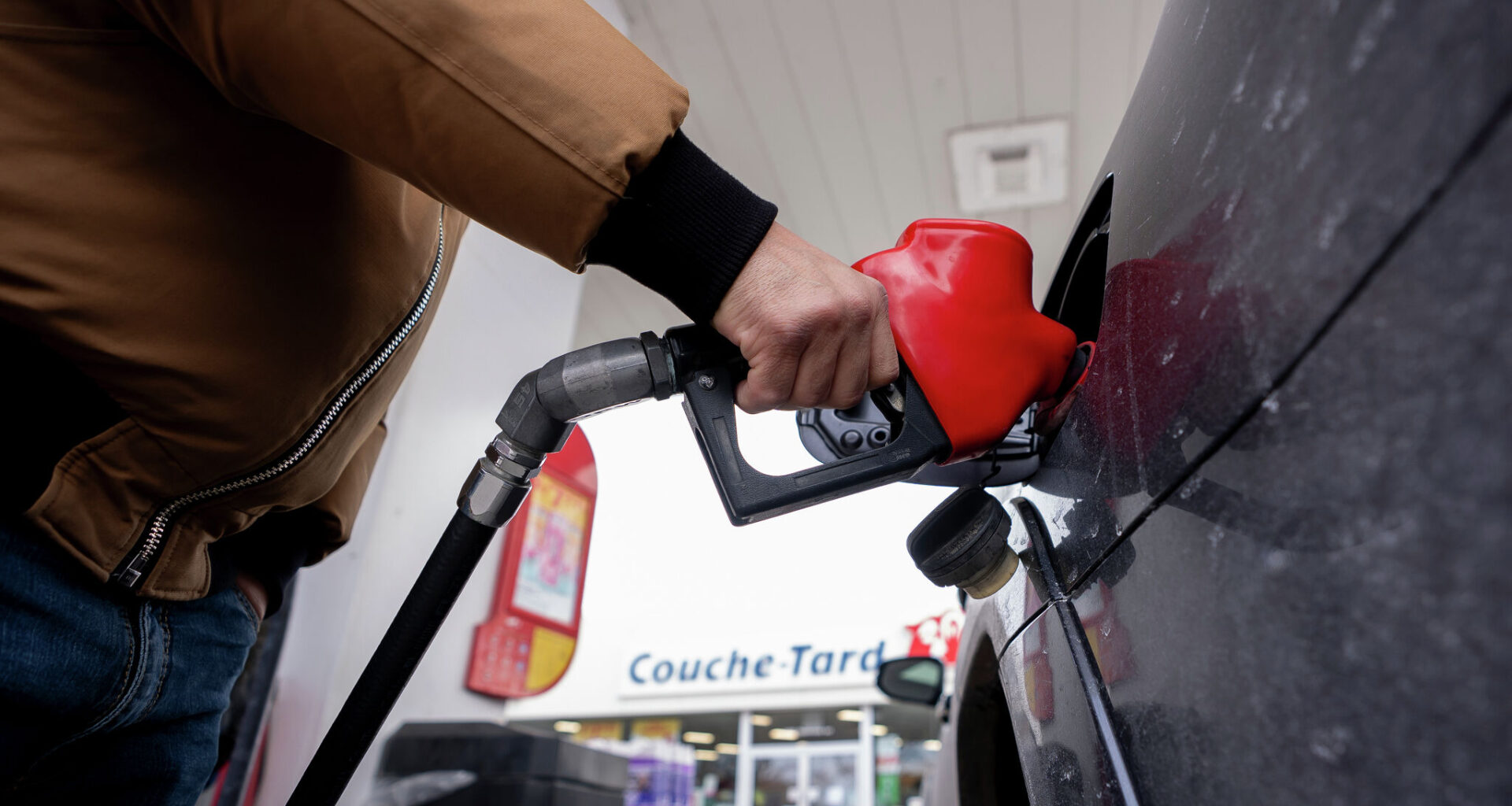
A person fills up their car at a gas station in Montreal on Thursday.
Christopher Katsarov/AP
They’re rising along with the price of crude oil, the largest component of retail gasoline prices.
West Texas Intermediate crude, the U.S. benchmark, briefly climbed to $119.48 a barrel before falling back to $95.32 by noon. Brent crude, the international benchmark, hit $119.50 — its highest level since the summer after Russia invaded Ukraine in 2022.
RELATED: ‘No upper limit’ on oil prices amid uncertainty after U.S.-Israel attack on Iran
Article continues below this ad
“In economic terms, this is already the largest oil supply shock ever,” said Nicholas Mulder, an assistant professor of history who studies the economic impacts of wars at Cornell University.
Last week, a Texas Christian University professor said “there may be no upper limit on oil prices” amid the conflict and another researcher predicted international crude could hit $140 by the end of next week.
Prices were whipsawed Monday by the possibility of an agreement among Group of Seven leaders to tap emergency oil reserves in an effort to contain soaring oil prices. Though they held off on releasing oil for now, the possibility appeared to calm markets.
Article continues below this ad
Such efforts come amid concerns that continuing oil price increases could trigger higher costs at a time many U.S. consumers are already struggling to make ends meet. Higher oil and gas prices can push overall inflation higher, further straining household budgets and denting the consumer spending that is the dominant engine behind big economies like the U.S.
In Texas, drivers Monday were paying $3.13 for a gallon of regular gasoline, up 51 cents from a week earlier. In Austin, the average price jumped to $3.17 per gallon from $2.68 last week, while San Antonio drivers were paying $3.17, up from $2.72.
The price of diesel was up even more statewide, jumping nearly $1.08 from a week ago to nearly $4.40 on Monday.
The surges come as the war, now in its second week, draws in countries and infrastructure critical to the production and movement of oil and natural gas. The war has put some of the world’s most critical oil and gas infrastructure — the pipelines, refineries and shipping terminals that keep energy flowing from nations around the Persian Gulf to the rest of the world — in the line of fire.
Article continues below this ad
Israeli strikes on Iran overnight Sunday left oil depots in Tehran smoldering, the Associated Press reported Monday.
Fuel prices are displayed at a gas station as cars drive by on Wednesday in Baltimore. The national average for regular gasoline was at $3.48 Monday, according to AAA.
Stephanie Scarbrough/AP
MORE: Gasoline jumps 12 cents in Texas in response to U.S.-Israeli attacks on Iran
The conflict has all but stopped tanker traffic through the Strait of Hormuz — one of the world’s most critical energy chokepoints. Roughly 15 million barrels of crude, about 20% of global supply, typically move through the strait each day, according to energy research firm Rystad Energy.
Article continues below this ad
But Iranian missile and drone attacks have largely halted tanker traffic carrying oil and gas from Saudi Arabia, Kuwait, Iraq, Qatar, Bahrain and the United Arab Emirates through the narrow passageway bordering Iran. Hundreds of tankers are anchored on either side of the strait to avoid coming under attack.
Iran also signaled defiance Monday by naming hard-line cleric Ayatollah Mojtaba Khamenei to succeed his late father as supreme leader amid heavy U.S. and Israeli bombardment.
The disruption has forced some producers in the Middle East to cut output as storage tanks fill and export routes remain constrained. Iraq, Kuwait and the United Arab Emirates have reduced production, while attacks on oil and gas facilities by Iran, Israel and the United States have added to supply concerns since the war began.
A thick plume of smoke rises from an oil storage facility hit by a U.S.-Israeli strike late Saturday in Tehran, Iran, on Sunday.
Vahid Salemi/AP
Amid the turmoil, policymakers are discussing the possibility of tapping emergency oil reserves. But the Group of Seven said Monday it would hold off for now.
Article continues below this ad
“We’re not there yet,” French Finance Minister Roland Lescure said after chairing a meeting of his G7 counterparts. Still, he told reporters in Brussels that the group was “ready to take necessary and coordinated steps in order to stabilize markets, such as strategic stockpiling.”
Over the weekend, U.S. President Donald Trump downplayed the idea of releasing oil from the U.S. Strategic Petroleum Reserve to bolster the global market, saying domestic supplies were ample and prices would soon fall.
The Associated Press contributed to this report.
Article continues below this ad