
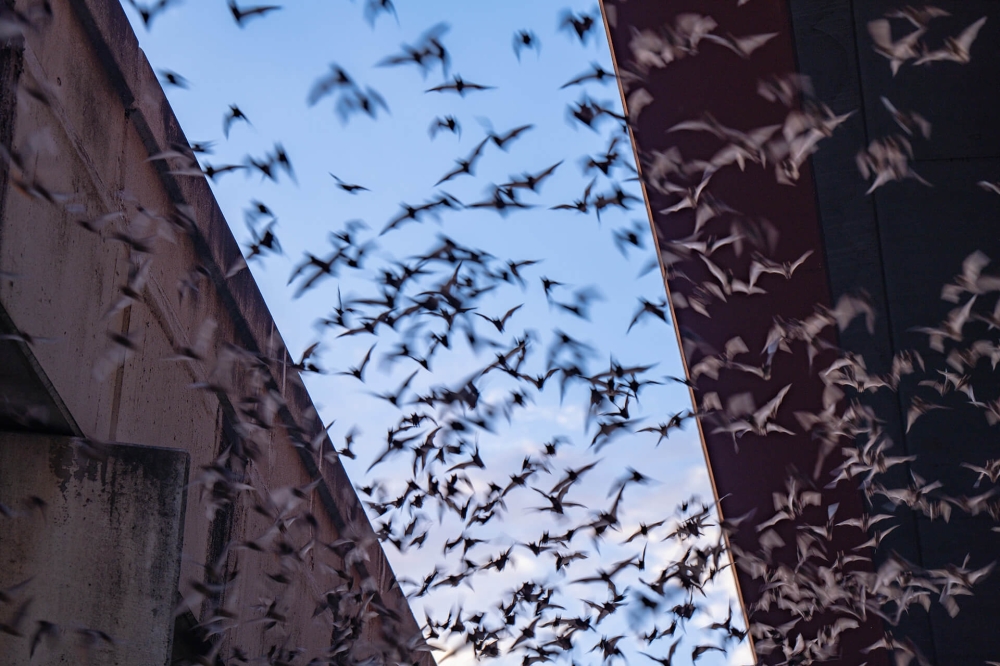
Austin is well known for its estimated 1 million bats but Round Rock also has a large population living under a bridge on I-35 that city staff consider a “hidden gem.”
In early spring, bats that flew south for the winter will return to roost underneath the highway’s box-beam bridge of the McNeil intersection. The colony is about a third of the size of Austin’s South Congress Bridge colony, the largest urban bat colony in the world, according to Texas Parks and Wildlife.
The city now has a place to view the colony from after taking ownership of a pad at the corner of McNeil Road and I-35, said Nancy Yawn, director of Round Rock’s Convention and Visitors Bureau.
The big picture
Bats have a strong presence in Central Texas, proving a challenge to both local road crews and the Texas Department of Transportation. However, a future project to widen I-35 in Round Rock could see an increase to available habitat.
As the wintry nights of February warm to springtime in March, area residents may be familiar with the sight of small, fast and chirping nocturnal mammals flying around town at sunset during the spring and summer.
Lee Mackenzie, who co-founded Austin Bat Refuge with Dianne Odegard, said the species of bats residing under the bridge are the fastest animal capable of true flight.
The nonprofit rescues and rehabilitates injured or orphaned bats in Central Texas. Mackenzie said that during winter weather events, such as the recent Winter Storm Fern in late January, his organization checks nine bridges for bats that have fallen as a result of being cold-stunned. Two of these bridges are in Round Rock: the intersection of I-35 over McNeil Road and the South Mays Street Immortal Ten Bridge over the Union Pacific Railroad line.
In recent years, Mackenzie said bat populations observed by his organization have rebounded from the 2021 Winter Storm Uri, during which he estimates about 500,000 bats in Central Texas succumbed to weather-related deaths, or left. His organization revived approximately 1,200-4,000 bats in the area at that time.
“We don’t know exactly what happened to the ones at McNeil,” Mackenzie said. “We just know that they didn’t show up on radar in the following month.”
As of February, he said the populations observed on Doppler radar have returned to the 300,000 bats seen spending the winter in Round Rock.
State agencies and nonprofits are mainly responsible for bats’ welfare, including those in Round Rock.
“>
What the experts say
Mexican free-tailed bats are one of 10-12 species residing in Central Texas, with a total of 32 species across in the state, according to Texas Parks & Wildlife.
Tracy White, an environmental specialist with TxDOT, said the state’s availability of caves and crevices made the area appealing to a variety of bat species. As Central Texas was developed, man-made habitat and local culture of appreciation for bats have allowed them to flourish.
Several bridges in the area are built with a box-beam structure, she said, creating small spaces that bats find appealing.
“I know if there’s a crack, they’ll be there,” White said.
As part of the I-35 Capital Express North project, TxDOT installed 36 bat boxes, or artificial habitats, under bridges known to be home to bats, White said.
Mackenzie said active construction in the area also provides ample human-made habitat for Mexican free-tailed bats in particular, as they are known to be “crevice bats.”
“When the cold weather comes, oftentimes they will look for places to shelter from the freezing cold temperatures and they’ll go into buildings,” he said.
When the colony at the McNeil bridge emerges for the evening, Mackenzie said the bats fly eastward toward Hutto and Taylor to feed on bugs in agricultural areas.
If bats had not recovered from the impact of Uri, he said, farmers in the area would be some of the first to know.
“The farmers would know the difference because they wouldn’t have free pest control to the tune of billions of dollars annually,” he said.
According to a report from Bat Conservation International, a 2011 study estimated that Mexican free-tailed bats provide pest control services valued at about $23 billion annually in the U.S.
Managing the impact
White said that as TxDOT planned its I-35 expansion, bats were a central consideration in setting new intersections.
Several road intersections on the highway are home to relatively small numbers of bats, she said. Crews carefully removed bats from the habitat before construction began, she said, to prevent harm to bats.
While bat boxes are a suitable solution for other populations, White said the McNeil Road colony is too large for the boxes to accommodate, and the bridge itself must serve as a habitat. Plans for a new bridge at the intersection are early, but it will use the same box-beam style that can house bats.
How it compares
Central Texas is home to many bat colonies. Here’s how the McNeil colony compares, according to Bat Conservation International:
Bracken Cave Preserve: 15 million estimated batsSouth Congress bridge: 1.5 million estimated batsMcNeil bridge: 500K+ estimated batsThe plan
Yawn said the suburban colony provides a bat tourism alternative closer to home and with smaller crowds.
While plans are still in early stages for how the city might promote its new spot as a viewing platform for the bats, Yawn invited spectators to pull up a chair.
“Bring your lawn chair,” Yawn said. “Come out, be together, and watch the bats.”
While bats return to the roost en masse in February and March, the largest emergences happen later in the summer, according to Texas Parks & Wildlife.
There is a sweet spot, Mackenzie said, in March when the sun goes down later in the evening, and bats are visible against the sunset.
“The numbers won’t be as big because the pups won’t be flying yet, but it’s still wonderful bat watching,” Mackenzie said.
He also said as the weather warms up, bats are also less likely to find their way into homes and other structures where they cannot safely remain.
“As much as we’ve changed our environment to suit ourselves, I think it’s important to recognize the wildlife that also shares this space with us,” Mackenzie said. “That’s where a lot of the magic in the world is.” The ear position of Mexican free-tailed bats can communicate much about their feelings, similar to dogs, according to Austin Bat Refuge. (Brooke Sjoberg/Community Impact)
The life of a bat
Bats come home to their roosts in February, bearing and rearing their young before migrating to warmer temperatures in the winter. The bat’s season cycle looks like this:
October-February: Bats spend winter in warmer climates, typically migrating to places such as Mexico.March-June: Female bats form maternity colonies and give birth to a single pup each.July: Baby bats grow and are ready to fly within five or six weeks.August-September: Baby bats begin flying by mid-August, and larger groups of bats emerge from their roosts.Looking forward
A future project to widen I-35 from Georgetown to Round Rock, which is in early planning stages, would provide increased space for bats and could facilitate population growth.