
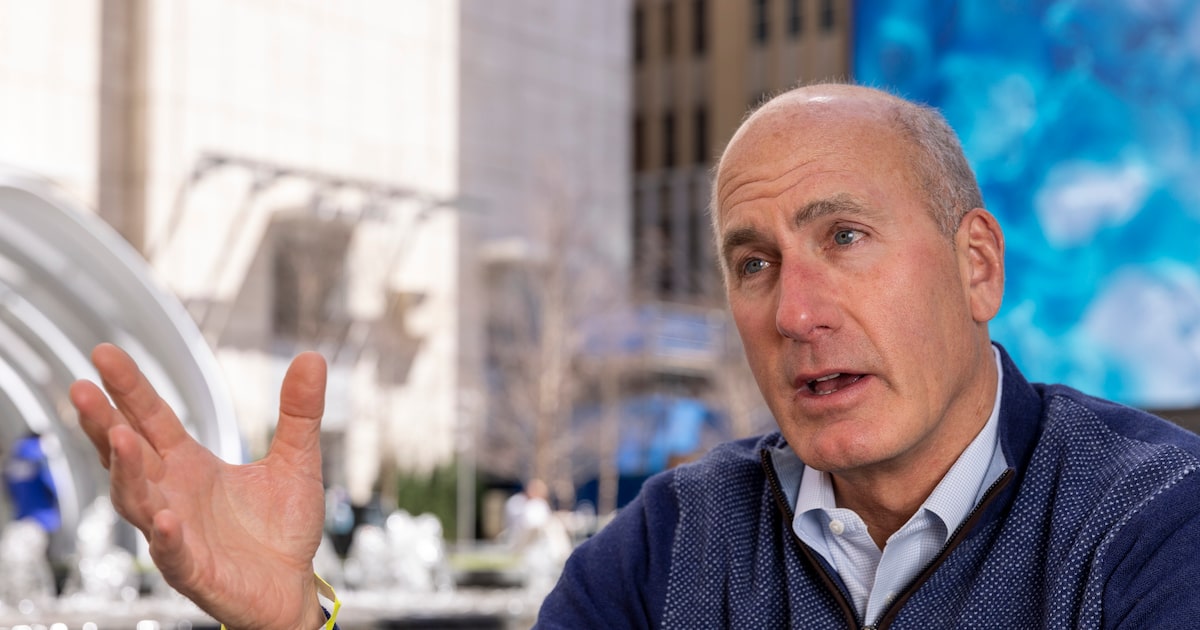
As early as May 2025, AT&T’s exit from downtown Dallas appeared likely as CEO John Stankey questioned the “effective/sustained governance” of Dallas and cited years of up-and-down efforts to make downtown more welcoming, according to emails reviewed by The Dallas Morning News.
The firm issued a request for proposals focused on suburban sites around Highway 121 and the North Dallas Tollway with no options in the city of Dallas, according to a briefing document created by the Dallas Economic Development Corp. in September.
The emails from Stankey to Dallas City Manager Kimberly Bizor Tolbert undermine past statements from Dallas city leaders that the telecom giant left for the suburbs because it primarily wanted a more horizontal campus with significant acreage for development.
AT&T announced its intention to leave Dallas’ Whitacre Tower in January for a 54-acre site at 5400 Legacy Drive in Plano — the culmination of a monthslong search and a failed effort by city leaders to keep the company within city limits.
Business Briefing
An AT&T representative and a city spokesperson did not respond to questions via phone and email regarding its downtown exit.
The emails reviewed by The News were part of nearly 5,000 pages of communications among city leaders, consultants and others regarding key events over the past year, including AT&T’s exit and debate over the future of City Hall.
The records show Tolbert and Dallas Economic Development Corp. CEO Linda McMahon emailed with Stankey and members of his staff at AT&T dating back to early 2025.
In March 2025, McMahon told Tolbert, assistant city manager Robin Bentley and others on city staff that AT&T was looking for “a potential new HQ for the company” as McMahon and Tolbert worked to meet with CEOs of Dallas companies.
Stankey met with Tolbert on May 6. Emails between the parties don’t indicate what was discussed, but Tolbert sent a letter to Stankey later that evening thanking him for engaging in a “crucial conversation about safeguarding the significant investment AT&T has made in Downtown Dallas.”
“While the City of Dallas may not match AT&T’s level of investment, we are fully committed to protecting and supporting it — for your people and your facilities,” Tolbert said. “The blueprint I shared with you is not just a city initiative — it is my personal commitment to you and your team. We are steadfast in our efforts to foster a safe and thriving environment that supports AT&T’s continued growth and success. This means creating a workplace that your employees feel confident returning to every day.”
“Our initiatives to increase police presence, expand homeless outreach, and enhance responsiveness are already in motion and will continue to evolve to meet emerging needs. Be assured that ensuring AT&T remains a vital and secure anchor in our community is a top priority,” she added.
Stankey responded to Tolbert’s letter nearly a week later, expressing that his concerns reach beyond immediate issues in the city’s central business district.
“I don’t really have anything to say that would be additive to our substantive discussion, but I know you receipted for the message that my concerns transcend the immediate issues and moment and extend to the ongoing and cyclical nature of our challenges with effective/sustained governance of the City and the inter-relationship of other issues and components to deliver a healthy business environment and neighborhood. These are the foundational issues I have to consider when I put the long-term lens on the best decisions for AT&T,” he wrote May 11.
Stankey’s response worried McMahon, according to the emails.
“His response really needs further internal discussion,” McMahon told Tolbert and others in the city’s manager’s office. “I would love to discuss before we meet with [Comerica CEO] Curt Farmer next week let me know when you have time to discuss.”
Tolbert followed up with Stankey in early August, highlighting progress leaders made with the “Safe In The City” campaign. Policing levels in downtown had increased since the end of 2024, resulting in a more than 25% reduction in crime by that point.
“Please know that we are not done and are continuing rehousing and ‘hot spot’ policing efforts with urgency,” Tolbert wrote. “This is not just a one-time initiative but the actions we are taking underscore a commitment to establishing a lasting standard of quality of life in Dallas, particularly in the downtown area.”
Stankey responded nearly a week later, thanking Tolbert for the update. While acknowledging progress downtown, he also saw “some of the dynamics where issues are being shifted to other areas of the surrounding city.”
“As we discussed in our last conversation, I have worked in central Dallas for 18 of the last 25 years of my career and we seem to run cycles on these issues. Achieving and sustaining a safe and functional environment that is welcoming to commerce, investment and individuals has been a challenge. Nobody has been more interested in removing this distraction from their primary charter than me,” Stankey wrote Aug. 12.
By September, city stakeholders were aware AT&T issued a request for proposals for a new headquarters.
Dallas leaders said factors that led to AT&T’s suburban-focused search included safety concerns in downtown, workers returning to the office, parking, landlord issues, talent attraction concerns and a lack of city investment in downtown, according to briefing documents.
Led by AT&T’s head of global real estate, Michael Ford, and CBRE broker Andy Leatherman, the Fortune 500 firm only sought sites around Highway 121 and the North Dallas Tollway. Pitches and presentations were given by Granite, Trammell Crow Co., Hunt Realty and others, according to a briefing document from the Dallas Economic Development Corp.
“They have not looked at any options in the City of Dallas since the criteria was established suburban,” the document reads. “Dallas options would be the Hunt Realty property around Reunion; Hunt Realty property next to Goldman Sachs; Artemio De La Vega development, The Central; the Billingsley development which will be developed by KDC – Arts Hall; Mike Hoque’s property around City Hall; Midtown (International District) [Scott] Beck[’s] property; just to name a few options.”
It’s unclear if AT&T was shown any of these properties.
For months, Tolbert and city officials publicly clung to the notion that they might be able to keep AT&T with Dallas despite Stankey’s concerns.
The News reported in September that AT&T was searching in the suburbs. By late October, the firm had zeroed in on sites in Plano and Frisco. Still, Tolbert hung on.
“We are working with AT&T executives to ensure the company’s future is in Dallas. We are currently having positive discussions with the goal of a mutually beneficial outcome. We will provide an update at the appropriate time,” she told The News in September.
Dallas developers did pitch their properties to AT&T in a last-minute effort.
Developer Mike Ablon, who is working on a plan to redevelop Bank of America Plaza alongside developer Mike Hoque, emailed Ford on Dec. 2. McMahon and Bentley were included in the conversation.
Ablon pitched Dallas’ tallest building as AT&T’s new home. Under the proposal, AT&T would get 200,000 to 400,000 square feet of space in the tower along with naming rights as well as a 50,000-square-foot data center and a street-facing retail store.
Ablon also offered to purchase all of AT&T’s real estate holdings in downtown minus the Whitacre Tower property, which is owned by Pacific Elm Properties and Dundon Capital Partners.
“We are reaching back out to propose a turn key solution for AT&T, including the offer to acquire all of AT&T’s existing buildings if this is something which AT&T might desire. With this goal in mind, we have outlined a list of items in the attached proposal … which we hope to use as a framework to further understand AT&T’s needs and desires, so that we may end up at a completed proposal for your consideration,” Ablon wrote.
Ablon declined to say Monday if AT&T responded to his offer. He offered no further details about the discussions.
“I’m gonna see if I can be part of a solution,” Ablon said of his pitch. “Regretfully, they made a different choice.”
The last-minute effort did not succeed.
On Jan. 5, Stankey announced the company would build a new headquarters at the site of the former EDS campus on Legacy Drive.
Plano city leaders later agreed to give AT&T $20 million in incentives and a lengthy property tax rebate for the firm to build its new global headquarters.
As part of the deal, AT&T must spend a minimum of $1.35 billion in construction costs on the project.
The firm must build a minimum of 2 million square feet of office, amenity and retail space at the site, eventually employ 10,000 full-time workers at the property and occupy the planned headquarters for 25 years.
The company is targeting partial occupancy at the new building as early as the second half of 2028.
Its lease at the 37-story Whitacre Tower runs through 2031. The company spent $100 million on the Discovery District, which includes a massive video screen, a food hall and outdoor seating space. It opened in 2021.
The future of those properties remains unclear.
Email trail
The Dallas Morning News reviewed nearly 5,000 pages of emails exchanged over the past 12 months among city officials, consultants and others involved in discussions about the future of City Hall. The messages offer a behind-the-scenes look at the debate over whether Dallas should repair the aging building or relocate government operations.
 Developer wants to build $800M Dallas hotel tower at old DMN campus downtown
Washburne increased the room count of his planned hotel after speaking with brands, he said.
 Firm signs new lease in 1 million-square-foot Plano towers
The firm will take 70,000 square feet at the campus in Legacy West.