
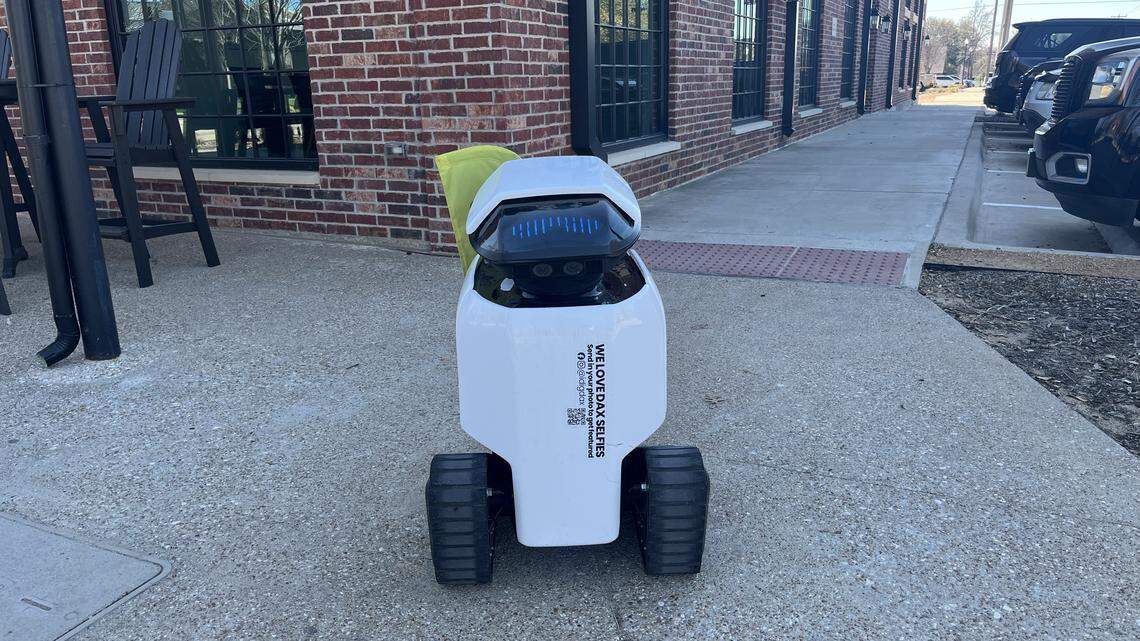
.jpg "Burleson has become the first city in Texas to participate in a program that uses robots to improve the accessibility of city sidewalks.")
Burleson has become the first city in Texas to participate in a program that uses robots to improve the accessibility of city sidewalks.
Emily Holshouser
Burleson has become the first city in Texas to participate in a program that uses robots to improve the accessibility of city sidewalks.
Under the Americans with Disabilities Act, cities are required to assess the accessibility of sidewalks for things like cracked pavement, tree roots, and other obstructions that can make it harder for people with disabilities to get around.
That work is often done by people who have to get on their hands and knees, and it takes a long time to perform — but one company wants to change that.
The “Daxbot,” as it’s called, is an “urban service robot” developed and assembled in the U.S. by the Oregon-based company of the same name. The model was created about five years ago, said Daxbot representative Mason Reeves.
⭐ Our editors also recommend:
Daxbots were deployed in Burleson in January to traverse roughly 200 miles of city sidewalks and deliver a report that will be used by the city to allocate resources to improve those sidewalks.
The robots look similar to food delivery robots or surveillance robots — which Daxbot also develops. They have a head that displays eyes on a screen, blinking and sometimes smiling while it moves around. It looks friendly, which is the point, said Andy Craig, vice president of sales at Daxbot.
“We’re really trying to cast a vision of ‘this is what robots can and should be — you know, friendly, helpful,” Craig said. “Our design is supposed to be somewhat reminiscent of a well-trained service animal.”
But the Daxbot does significantly more than deliver your Postmates order or patrol a city block. The accessibility robots are covered in cameras and sensors that can take data down to the centimeter and collect location-based information that will be used by the city later. The robot can even measure depth perception to create extremely precise measurements.
“What the robots are doing, because they’re rolling down the sidewalk, is they’re basically feeling every bump that someone in a wheelchair would feel,” Craig said. “You’re getting the continuous measurements for both slope and uplift, you know, as well as the continuous readings on the sidewalk width, which is important because you need the accessible path of travel.”
The Daxbots are just one component of a $475,000 “transition plan” contract with Kimley-Horn approved by the Burleson City Council last year. The plan is required for most cities that receive federal funding. The price tag for that contract covers the entire plan, not just the robots.
Under the agreement with Kimley-Horn, the Daxbots have aggregated data on sidewalks at dozens of city buildings and parks.
Although Burleson is the first Texas city to get the Daxbots, they have been used to conduct these accessibility assessments at UT Austin and UT El Paso, and in other states.
As for concerns about security and privacy — the Daxbot is, after all, covered in cameras — the company said that the robots do not record footage unless there is a malfunction or another issue. Additionally, the robots rarely see much of anything except for sidewalks. It might catch your feet or your front yard, but that’s about it, Daxbot said.
The results of the Daxbot assessments won’t be available for several months, Phillips said. But the city has been pleased with the program so far — and residents will be sad to say goodbye.
“People have received the robots really well in the community there,” Craig said. “I know that Burleson has been talking about having a robot party so that people can say goodbye to them.”
The program will be wrapping up soon and the robots will be taken off city streets. After that, the data will be compiled into a report.

Fort Worth Star-Telegram
Emily Holshouser is a local news reporter at the Fort Worth Star-Telegram.