
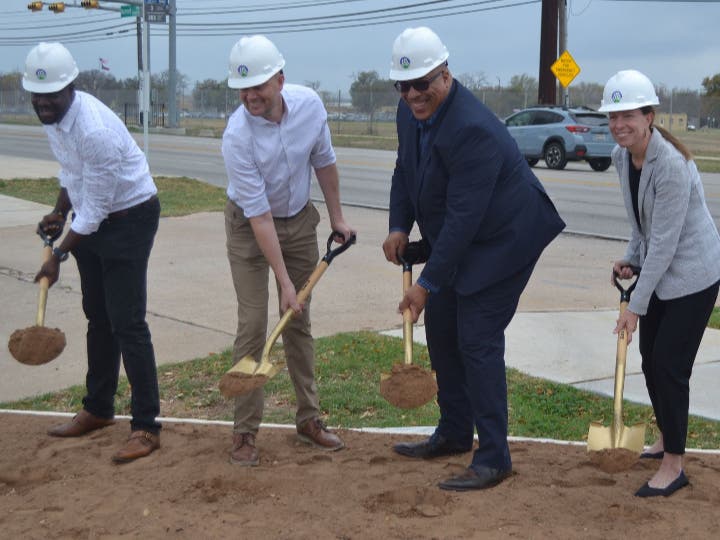
Last week, City of Austin officials celebrated the start of the Burnet Road Corridor Mobility Project at a ceremony in front of Q2 Stadium. It kicks off a slate of improvements to Burnet Road from West Koenig Lane to Mopac Expressway.
The upgrades will include:
Americans With Disabilities Act-compliant curb ramps to improve accessibilityShared-use paths for safer walking and bikingInstallation of two crosswalk signals to support safer crossingsTraffic signal upgradesDrainage improvementsRealignment of Burnet Lane at Burnet Road to improve safety and traffic operations
At the groundbreaking, Assistant City Manager Mike Rogers said, “Burnet Road is a vital connector serving residents, small businesses, employers, and transit riders from the outskirts all the way down to the heart of Central Austin.”
Rogers added that Q2 Stadium has driven increases in residential and commercial development, as well as people walking, biking, and taking transit in the area, especially on Austin FC game days.
The Burnet Road Corridor Project was funded by the 2016 Austin Mobility Bond. According to the plans, the next stretch of construction from White Horse Trail to Highway 183 is approximately 2.7 linear miles of rescoped corridor mobility improvements for Burnet Road from Koenig Lane to Highway 183, including new sidewalks, shared-use paths, curb and gutter, minimal driveway reconstruction, and upgraded traffic signal infrastructure and improvements at priority intersections.
From there, crews will work on safety and mobility improvements to the stretch of Burnet Road from Highway 183 to Bright Verde Way, including new eight-food-wide shared-use paths; ADA-compliant bus stops; curb and gutter installation; pavement rehabilitation; and intersection and traffic signal improvements at Research Boulevard, Waterford Center Boulevard, Longhorn Boulevard, and Rutland Drive.
The final stretch, Burnet Road from Bright Verde Way to Mopac Expressway, is expected to start construction this summer. That phase of the project features approximately 1.5 linear miles of corridor mobility improvements, including sidewalks, bike lanes, and shared-use paths.