
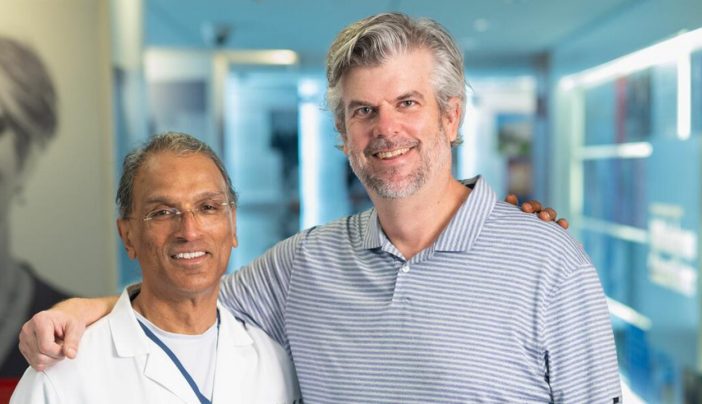
Until Groundhog Day 2018, I’d been living a healthy and normal life in Austin with my wife, Amy, and our two young children. Then one day, I woke up with a really bad headache and wound up in the emergency room with suspected meningitis. A few days later, I learned the true culprit: a type of brain tumor called astrocytoma. That diagnosis turned my whole world upside-down.
I chose UT MD Anderson for my astrocytoma treatment for two reasons. The first was a trusted friend and her colleague — both well-regarded neurologists — highly recommended it. The other was that UT MD Anderson had corrected an inaccurate diagnosis for me 10 years earlier, when I had thyroid cancer.
Cancer is no less scary the second time around
You might think that a second cancer diagnosis wouldn’t be as bad as the first, if only because you have some experience with it now and know what to expect. But that wasn’t the case for me.
My brain tumor diagnosis was significantly worse. Being diagnosed with any type of cancer is scary, but my thyroid cancer was never life-threatening. Once UT MD Anderson pathologists corrected my diagnosis, I was treated successfully for it in Atlanta, where I was living at the time. I haven’t had any issues with it since.
This brain tumor diagnosis really sent me down a rabbit hole. A quick online search revealed that life expectancy for people with my type of astrocytoma was not good. My initial oncology team in Austin took one look at the MRI and declared my tumor inoperable. They said it was in a place they couldn’t reach, and moved immediately to a palliative care plan involving chemotherapy and radiation therapy.
Discovering what’s only possible here
Fortunately, my care team at UT MD Anderson disagreed. Dr. Sujit Prabhu is arguably one of the best brain surgeons in the world. He is also an incredibly compassionate human being.
Dr. Prabhu took significant time to get to know Amy and me — and even our extended family. When he had to deliver the worst news of my life, he did it with such care and thoughtfulness that we actually left his office feeling upbeat, thinking, “We can do this.”
I made such a strong connection with Dr. Prabhu that I often share that if I ever have another child, I will name it “Prabhu.”
UT MD Anderson’s faculty and staff are also absolutely top-notch. They recognize that a cancer diagnosis is likely the worst moment of your life. But they lead you gently through the entire process and provide support all along the way. When I told Dr. Prabhu that other oncologists had deemed my tumor inoperable, he paused for a second and said, “Well, maybe for them, it is.”
We scheduled my brain surgery for a few weeks later, and started making plans for additional treatment afterward. But Dr. Prabhu was able to remove so much of the tumor that my team ended up changing my treatment plan. I was able to delay radiation and chemotherapy indefinitely, which made me really happy, as those can have permanent, detrimental effects when applied to the brain.
Instead, I am being monitored more frequently with scans, as astrocytoma is known to recur.
Genetic mutation leads to a clinical trial
In 2021, I also started taking a new targeted therapy drug through a clinical trial at UT MD Anderson. It was a multi-center study being led at UT MD Anderson by neuro-oncologist Dr. Vinay Puduvalli. It involved a drug now known as vorasidenib. My care team said I might be eligible for it because I have a genetic mutation called isocitrate dehydrogenase (IDH)-2, which affects an enzyme that triggers cancer growth.
I was apprehensive about joining the trial, as the drug’s potential side effects were fairly significant. It also involved a lot of time and travel between Austin and Houston. But in the end, it was a cutting-edge opportunity to extend my life and a chance to help others facing cancer. So, it wasn’t a hard decision.
Taking a new drug from experimental to FDA-approved
I started taking one vorasidenib pill per day in 2021. I stayed on that trial for the next three years, traveling to UT MD Anderson once a month for scans and blood tests.
I did experience some mild side effects, such as stomach pain and indigestion, but the results of the clinical trial — including mine — were so good that they eventually led to the approval of vorasidenib for the treatment of astrocytoma by the Food and Drug Administration (FDA) in August 2024. I’ve been taking that drug ever since, and my cancer remains stable.
The work that Dr. Puduvalli and his team did to study this drug has given me hope. I’m grateful to know that he and other brain experts are leading the Cancer Neuroscience Program at UT MD Anderson and continue to make new advances to benefit patients like me.
Anticipating the opening of UT MD Anderson’s Austin location
I still travel to Houston every three to six months to see neuro-oncologist Dr. Nazanin Majd for follow-up tests. So, when I found out that UT MD Anderson was planning to open a new hospital in Austin in a few years, I was over-the-moon excited.
This will make life so much easier, not just for me, but for everyone in central Texas who doesn’t have the opportunity to travel to Houston for the best cancer treatment in the world.
To me, receiving high-quality cancer care is what matters most. So, it’s a no-brainer to drive to Houston if that’s what it takes to get it. But knowing that UT MD Anderson will soon be here in Austin is incredible. I can’t wait to have it closer to home.
Request an appointment at UT MD Anderson online or call 1-877-632-6789.