
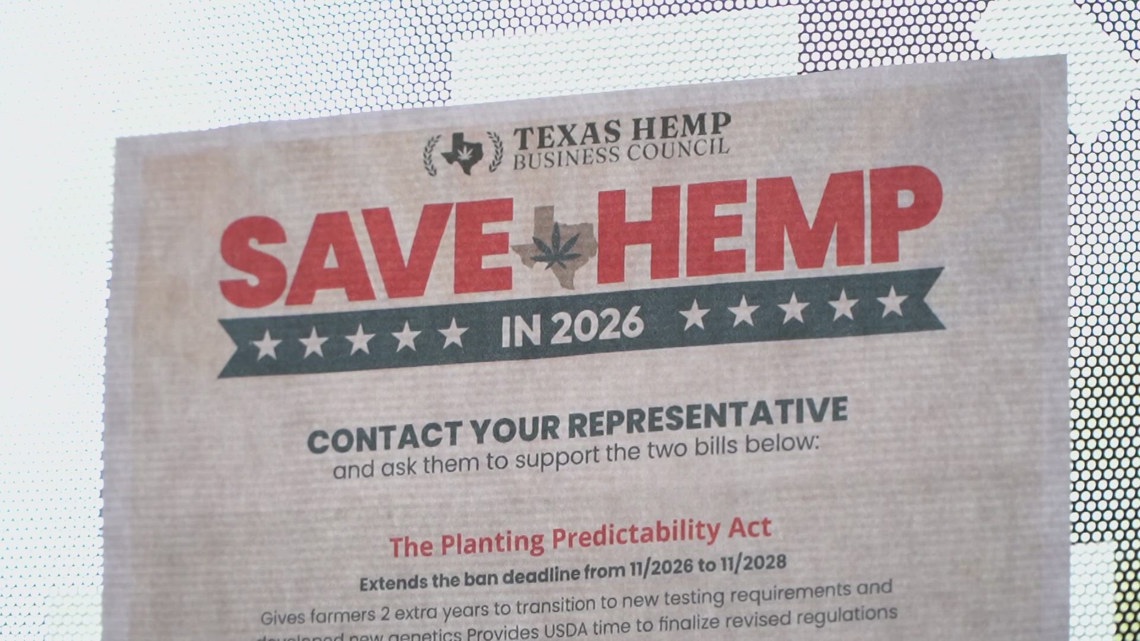
Local shop owners said the updated regulations will significantly affect both their operations and the products available to consumers.
AUSTIN, Texas — Texas’ hemp industry is preparing for sweeping regulatory changes that many retailers say could reshape the market for hemp‑derived products across the state.
Local shop owners said the updated regulations will significantly affect both their operations and the products available to consumers. Some fear the financial and compliance burdens could force smaller businesses to shut down.
“We’ve been fighting this battle for a long time,” said Shayda Torabi, president of the Texas Hemp Coalition and co-founder of Restart CBD. “It at least gives us a line in the sand. Is it the line we were expecting? Partially, yes and no.”
The Department of State Health Services (DSHS) initially proposed steep increases to licensing fees for hemp manufacturers and retailers. After two months of public feedback, the agency scaled back its plan.
Manufacturer licensing fees will be $10,000 per year, down from the proposed $25,000Retailers will pay $5,000 per year per location, instead of the originally proposed $20,000
According to DSHS, the fees were calculated to cover the costs of regular inspections of manufacturers and retailers, including inspector salaries and travel, as well as laboratory testing costs.
Even with the reductions, retailers told KVUE the new costs are a heavy lift.
“It’s still in the thousands, compared to the hundreds of dollars that it previously was,” Torabi said. “I do think there’s going to be a huge impact to businesses because not only are you having increased fees to operate, but there’s a multitude of other things.”
Beyond fees, the updated rules include 21-and-over age restrictions, revised testing requirements, updated packaging, labeling and record‑keeping standards.
Local hemp shop owners said one of the biggest changes is the new way THC levels will be calculated for compliance.
“This rule, which is a small language change to convert THCA into total THC, has huge impacts,” said Todd Harris, owner of Happy Cactus and a member of the Texas Hemp Business Council.
He said the change effectively bans cannabis flower, which accounts for roughly 70% of his store’s sales. Combined with the anticipated 400% increase in licensing fees, he fears his business may not survive.
“We have two locations. If we don’t get these rules changed and we lose flower and have those fees, I can’t see us keeping both locations at least,” Harris said. “Most likely we would go out of business as well.”
Retailers warn that limiting legal access to popular hemp products could push consumers toward unregulated markets.
Still, many in the industry hope they can adapt as the regulatory landscape continues to evolve.
DSHS said it will periodically reevaluate licensing fees to ensure they do not exceed the cost of administering the program. The adopted hemp regulations will officially take effect on March 31.