
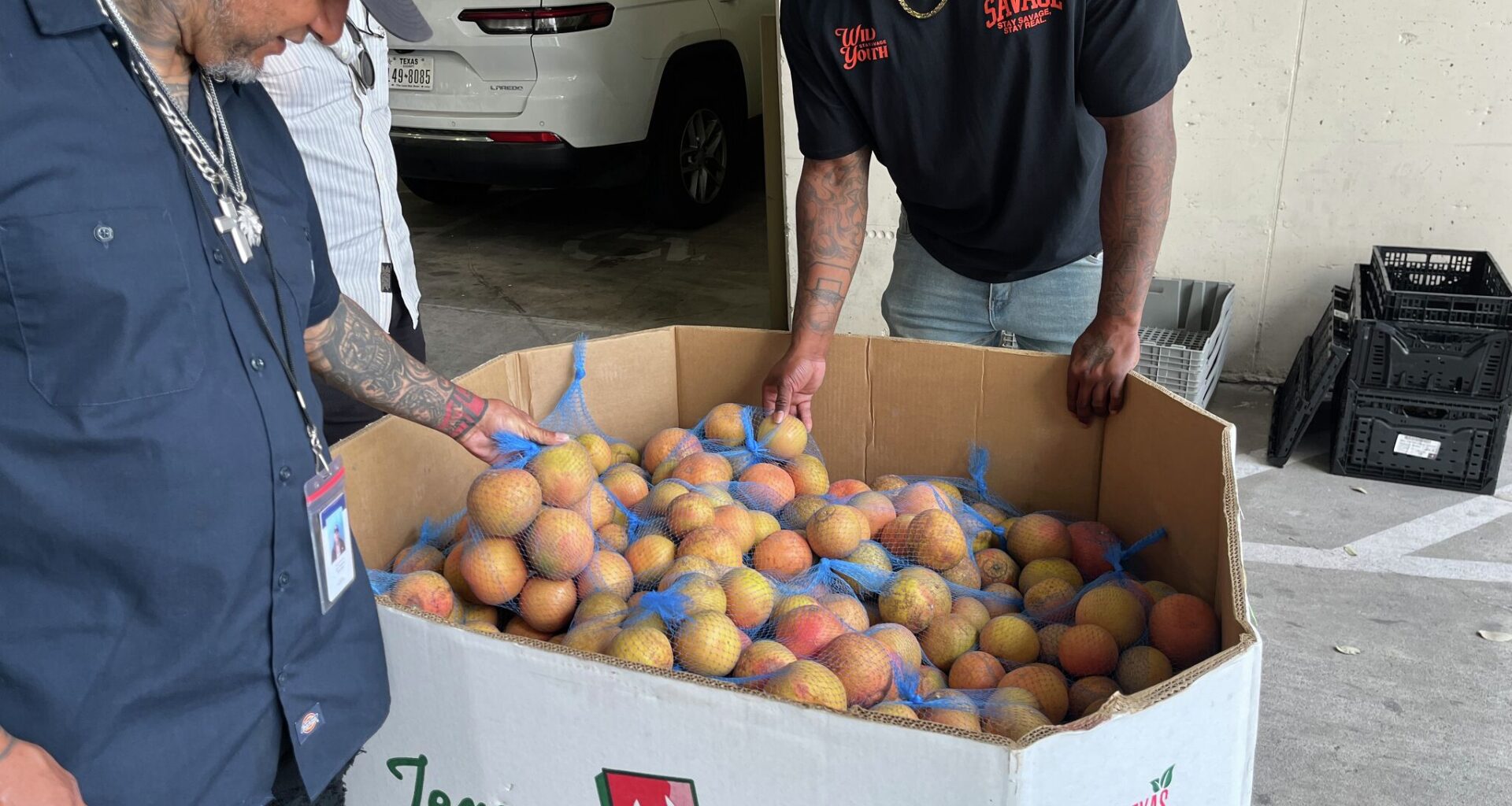
Jorge Solorzano and Lashawn Waters begin to load the grapefruit from the food bank onto carts to bring into Integral Care’s pantry at the Terrace at Oak Springs community.
Nicole Villalpando/American-Statesman
Every Tuesday, the Central Texas Food Bank truck arrives at Integral Care’s Terrace at Oak Springs apartments, followed by a delivery from H-E-B.

The 50 residents of the Austin-Travis County mental health authority’s housing community can shop at their complex’s food pantry the next day. They are joined by residents from the East Austin neighborhood off Airport Boulevard. In all, about 80 households are served by the pantry.
Article continues below this ad
Central Texas Food Bank driver TreMayne Lewis begins to unload the truck while The Other One Foundation’s Eric Daniel helps check off the items.
Nicole Villalpando/American-Statesman
H-E-B’s Heidi Post talks at Integral Care’s food pantry event. “Hunger is at the core of who we are at H-E-B,” she said of the $80,000 grant the grocer gave Integral Care for the food pantry. “We are making sure everyone has the nutrition we need.”
Nicole Villalpando/American-Statesman
Austin City Council Member Natasha Harper-Madison talks about food insecurity at Integral Care’s Terrace at Oak Springs apartment complex.
Nicole Villalpando/American-Statesman
Terrace at Oak Springs is one of two Integral Care housing complexes. A third is scheduled to open in May. An on-site food pantry is part of Integral Care’s programming aimed at improving mental health.
“You can’t do much when you are hungry,” said Kristi Kaiser, program manager at Integral Care.
Off Ben White Boulevard in Southeast Austin, the food bank’s kitchen prepares medically tailored meals for Central Health’s clients who have just been released from the hospital. Central Health is the Travis County hospital district and provides health care for people earning less than 200% of the federal poverty level.
Article continues below this ad
This pilot program, which began in November, has since become a permanent way to accelerate healing and reduce the number of people returning to the hospital.
Central Texas Food Bank driver TreMayne Lewis checks the inventory with The Other Ones Foundation’s Eric Daniel. The Other Ones participants help sort the food bank items every week.
Nicole Villalpando/American-Statesman
At Central Health and CommUnityCare clinics, the food bank’s Farmacy truck pulls up regularly to offer patients and the community fresh food such as fruits and vegetables.
Article continues below this ad
Elsewhere in Austin, new mothers receive food deliveries through a grant from the Ascension Seton Foundation as part of the Food is the Best Medicine initiative that Ascension Seton Medical Center launched in 2022. Mothers identified in the hospital’s labor and delivery department receive prepared meals and can shop for ingredients to supplement those meals.
Integral Care, Central Health with CommUnityCare, and Ascension Seton make up most of the health safety net for Austin and Travis County — mental health, specialty and primary care, and hospital care. All three have focused on making sure their clients have access to nutritious food, not just medical care.
“We know that proper health is preventative,” said Central Texas Food Bank CEO and President Sari Vatske. She pointed to studies showing that health care costs are about $18,000 higher annually for someone who is food insecure because of hospital stays and increased medication use.
Bob Gunderson, who lives at the Terrace at Oak Springs, enjoys being able to cook from the fresh foods at the pantry where he lives.
Nicole Villalpando/American-Statesman
“If we can provide nutritious food on the front end,” she said, “that helps to take care of some of the problems on the back end that are compounded.”
Article continues below this ad
The 21-county area that the food bank serves has an 18% rate of food insecurity. “That means that 1 in 5 people don’t know where their next meal is coming from,” Vatske said.
When people can’t afford their food, said Austin City Council Member Natasha Harper-Madison, they are “breaking their medications in half or not taking them at all. Food insecurity impacts whole-person health.”
Improving mental health with food security
For Bob Gunderson, who lives at the Terrace at Oak Springs complex and regularly shops at the food pantry, “the food I get from here helps me stretch my total food dollars,” he said. This food pantry helps him supplement what his SNAP benefits can cover. “It can mean the difference between 1 pound of meat to 2 or more pounds.”
Article continues below this ad
Gunderson lost part of his foot to diabetes and was in a nursing home until he qualified for housing at Terrace at Oak Springs.
With the food pantry, he’s able to make some of his favorite meals, including Cornish meat pies and stews in his slow cooker. For the Super Bowl, all the residents had a party with dishes they were able to make using pantry ingredients.
In addition to the food bank donation of food, Integral Care received an $80,000 grant from H-E-B and uses some of its own funds to supplement with items the food bank cannot provide.
“It allows us to offer more variety,” said Zeynep Kleiman, a program manager at Integral Care.
Article continues below this ad
Meats, eggs, bread and fresh produce remain the favorites. The pantry also stocks pet food, toiletries and household items like toilet paper.
The food pantry at Integral Care’s Terrace at Oak Springs gets stocked weekly with donations from Central Texas Food Bank, H-E-B and Integral Care’s budget.
Nicole Villalpando/American-Statesman
Easing the recovery after illness
At Central Health’s Food as Medicine program, people who have a chronic health condition or are recovering from a hospitalization have 7 to 14 frozen meals a week delivered to their home for eight weeks. Patients are identified by Central Health doctors or social workers at clinics or hospitals.
Article continues below this ad
“There are a couple of broken pieces in our system that this program is hoping to fix,” said Dr. Milinda Zabramba, Central Health associate chief medical director. “It’s extremely important to recognize that there is a direct correlation to health through good nutrition and better health outcomes.”
During the time patients are receiving meals, Central Health is also making sure they are signed up for SNAP benefits (food stamps), so they can continue to access food once they are able to shop and cook for themselves.
The pilot was supposed to be a yearlong test, but it was so successful that Central Health transitioned it into a permanent program.
Article continues below this ad
When a patient leaves the hospital or the respite center or skilled nursing facility after a medical crisis, “the patient can’t adhere to doctors’ orders if they don’t have access to food,” said Megan Cermak, Central Health’s senior director of public health strategy. “They end up back in the hospital.”
Often, they cannot take their medications if they lack food with which to take their medicine, Cermak said.
Central Texas Food Bank CEO and President Sari Vatske talks about the increasing food insecurity in Central Texas. It is now up to 18% in the 21-county area the bank serves.
Nicole Villalpando/American-Statesman
The food bank has a dietitian to tailor the meals to the patients’ diseases, including diabetes, renal disease, heart disease, gastrointestinal disorders or other chronic illenesses.
Article continues below this ad
All of the recipes were tested for taste and appeal before they were rolled out to patients. So far the favorites have been picadillo, cod with spinach and turkey chili.
“This is whole person care,” said Bella Kirchner, the food bank’s vice president of client programs and services. “We wrap our arms around the patient.”
Each meal costs Central Health $15.10, which includes both the cost of food and administering the program and is consistent with the Tufts University study and other medically tailored food programs around the country.
Central Health can scale up to 750 patients in the program. Next year, it intends to involve patients in CommUnityCare, a network of federally qualified health centers that grew out of Austin’s city health clinics.
Article continues below this ad
Central Texas Food Bank also prepares meals for other programs, including after-school and summer meal programs for children and food distribution at some housing centers.
Bags of grapefruit are ready sit on tables at Integral Care’s pantry at the Terrace at Oak Springs community. The pantry serves 80 households. Fresh fruits and vegetables are some of the top items participants ask for.
Nicole Villalpando/American-Statesman
Supporting new mothers
Ascension Seton Foundation’s Food is the Best Medicine program for new moms delivers six meals per week from Cook’s Nook, as well as a box of fresh vegetables and shelf-stable items from Farmshare Austin, and gift cards.
Article continues below this ad
Inten Utari, who was part of the pilot program in 2024, said, “It has really helped us. The first couple of weeks, it was a mess. I was bleeding; she had jaundice. I don’t know what we would have done.”
Most of the recipients are uninsured or underinsured, said Elizabeth Polinard, the program’s co-founder. Through the program she has been able to study how improved nutrition affects breast-feeding, mothers’ mental and physical health, and babies’ health.
The program has served 428 families with 50,488 meals and 51,633 pounds of food. Participants have seen a 29% decrease in postpartum depression rates, a 226% increase in food security, and a 74% increase in fruit and vegetable consumption.
Article continues below this ad
“Food is the Best Medicine speaks to the collaboration at a health care system level between a health care system and a not-for-profit organization like a local farm share,” said Dr. Ryan Lowery, a pediatrician who worked at CommUnityCare and now works at Dell Children’s Medical Center. “Organizations like that help move the needle at a community level,” he said.