
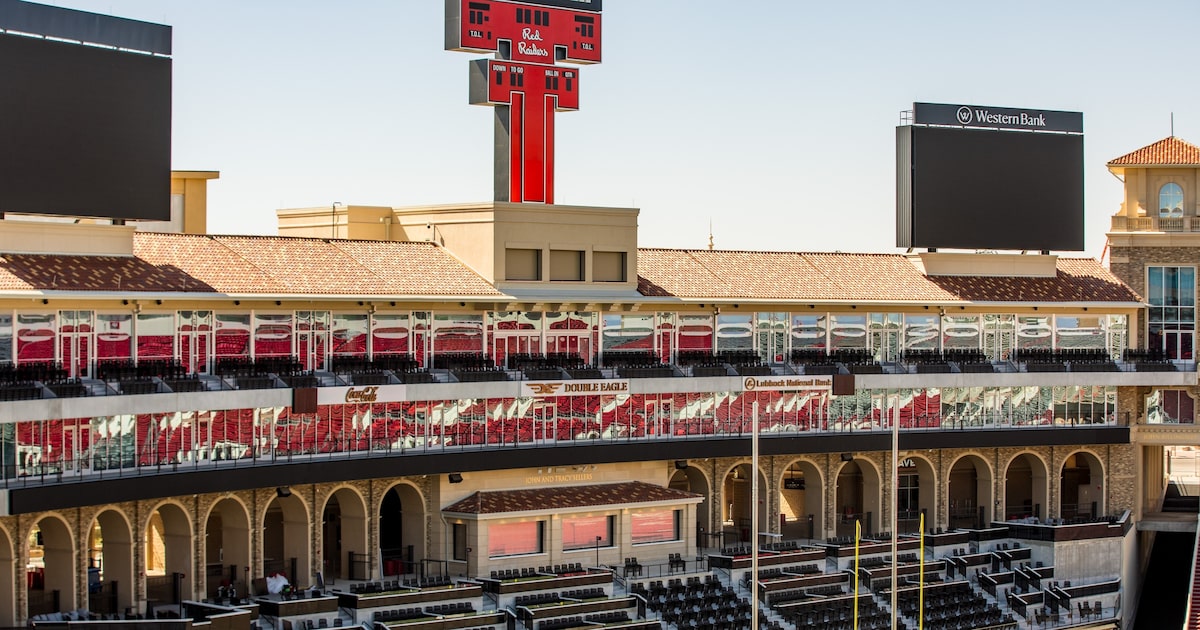
A premium seating company in Winston-Salem, N.C., is on the frontlines of the fast-evolving sports business landscape — especially in Texas.
At TCU, seven years after it enlisted the company 4Topps to install more than 1,000 seats in its Legends Club and loge boxes inside Amon G. Carter Stadium, school officials described the product in four words: high quality, low maintenance. Sassan Sahba, TCU’s senior associate athletic director for facilities and events operations, said it’s a blessing not to get a “random call over the radio that a chair is broken or cup holders are missing.”
But the impact of 4Topps, which has more than 300 clients, extends far beyond the durability of its breathable mesh seating. An increasing number of college and professional teams, particularly in Texas, are hiring 4Topps to help reshape their fans’ stadium experience at a time when teams of all sizes are grabbling with two broad issues: How to meet evolving expectations of a new generation of fans, and how to create additional revenue streams as colleges in particular confront a financial stress test in the age of athlete revenue sharing.
The story of 4Topps, founded in 2011, highlights that the changing nature of sports — especially at the college level — touches nearly every facet of an athletic department’s business strategy, even including which stadium seats they install. Drive through Texas and it’s hard to miss venues bearing the company’s fingerprints.
Business Briefing
Among colleges, there’s TCU, Texas Tech, University of Texas, Texas A&M, University of Houston, Rice University and University of North Texas. Among professional teams, there’s the Houston Astros, Austin FC, Houston Dynamo FC and others yet to be announced.
Asked to characterize business, Deron Nardo, 4Topps’ president and chief commercial officer, told The Dallas Morning News: “Business is out of control. We’re holding on for dear life. It’s growing like crazy. College has definitely been the catalyst for the most recent surge in growth, and Texas and surrounding states, Louisiana and Oklahoma, are a major driver of it. It’s a very long list, far longer than any other part of the country.”
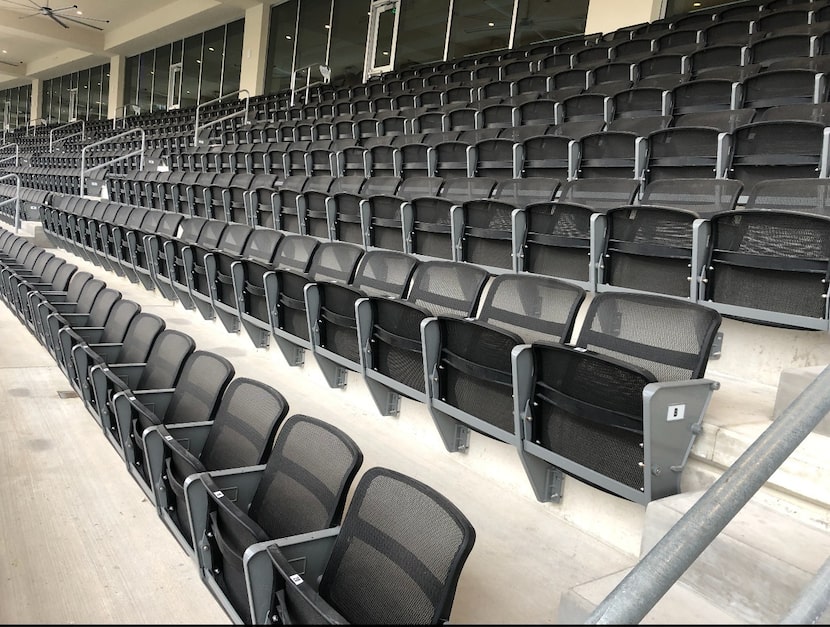
During its stadium renovations seven years ago, TCU enlisted premium seating company 4Topps to install new seating. The move was intended to enhance the fan experience in Amon G. Carter Stadium.
TCU
How Covid-19 altered the fan experience
Nardo is a Philadelphia native. His introduction to stadiums involved the now demolished Veterans Stadium, which was distinguished by its unforgiving turf, often unruly fans and cookie-cutter design.
Some 95% of its seats were plastic with the requisite suites layered in, Nardo said. The home of the Philadelphia Phillies and Eagles wasn’t exactly a beacon of architectural or creative brilliance, much less a vibrant social ambiance.
Times have changed.
While driven by health concerns, the Covid-19 pandemic accentuated the benefits of more space in venues. The social media age has placed a premium on venues with areas more conducive to taking aesthetically pleasing and sharable photos. And a new generation of fans has no interest being “stuffed into an 18-inch-wide stadium seat” for three hours, Nardo said.
“With the pandemic, there was a greater recognition that there was room to potentially lower [stadium] capacity a little bit, but do better things for people — the need for space,” Nardo said. “You start to get an environment where so many schools said, ‘We’ll take the section that’s not selling that well, that had 1,000 seats, and we’ll maybe just put 250 back in, but they’ll be around a half-circle table. There’ll be wider seats, there’ll be a drink railing, there’ll be side tables.’”
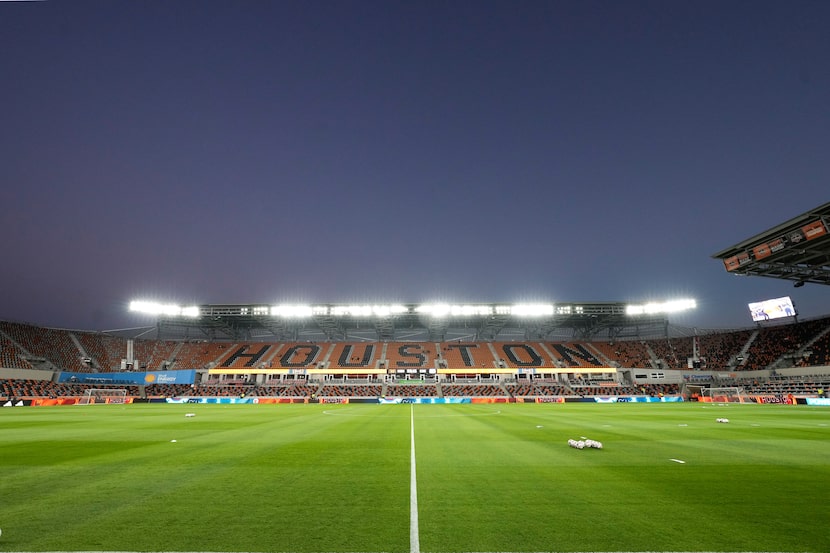
An empty view of Shell Energy Stadium before an MLS soccer match, Saturday, Feb. 21, 2026, in Houston. (AP Photo/Matt Patterson)
Matt Patterson / AP
4Topps first brought mesh seating to the sports stadium market in 2013, but the company now offers products far beyond that. From swivel seats and barstools to mesh seating and tables — Nardo said they create a vision for a more comfortable, social experience that fans now expect.
And Nardo can sell it. Three years ago, when 4Topps introduced premium seating that could be moved from a college football stadium in the fall to the baseball stadium in the spring, he began a 30-second elevator pitch with: “Have you seen the movie ‘Goodfellas,’?”
He told me to picture the three-minute scene where Ray Liotta‘s character is escorting his girlfriend and bypassing the long line outside The Copacabana nightclub. Instead of the couple being led to a table, a table is brought to them. It is placed front and center near the singer – best seat in the house.
Premium seating is all the rage in the stadium business. Nardo said there is a “bullrush” toward providing fans more premium seating. In the past, he said, only 7% of a stadium’s seating was considered premium. Now teams look to make 17 to 20% of their seating premium.
“They’re really filling in that gap between ultra-premium suites and GA [general admission] seating,” Nardo said.
Fans want a ‘hospitality-driven experience’
The push to provide more premium seating is playing out with 26-year-old American Airlines Center.
The Dallas Stars told The News that the lack of premium seating is one of the reasons why the franchise is considering moving to Plano to build a new arena. The Stars rank 29th in the league in premium seating inventory with 1,198 seats. That is barely more than half the league average of 2,300.
Bob Heere, a University of North Texas professor of sports management and director of UNT Sports Innovation Space, said there’s been a consequential shift in recent years toward creating more open, communal hospitality spaces.
“The butts-in-seats [model] is really the 20th-century model,” Heere said. “Now, the younger generation, they don’t want to sit in their seat for three hours. They want a more hospitality-driven experience. So you see that with the new Globe Life Field [in Arlington] being a very good example of it. There’s much more standing — you can see the field from everywhere. You can walk around … There’s a party, and there happens to be a game.”
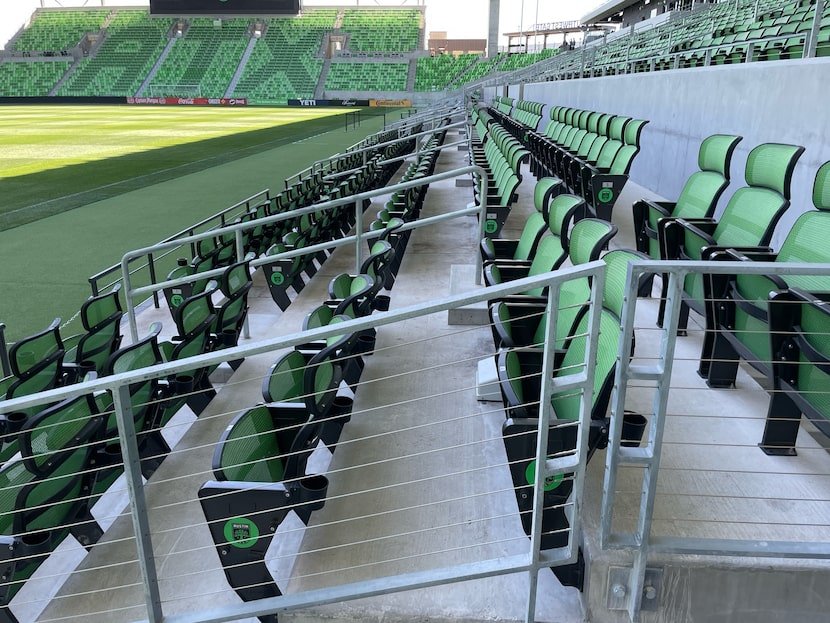
Austin FC hired premium seating company 4Topps to install mesh seating inside Q2 Stadium, intended to provide a more comfortable viewing experience for fans.
Austin FC
Branding can unlock revenue streams
All teams are seeking to unlock new revenue streams, but the issue is especially acute in the new world order of college sports.
In the first year of the revenue-sharing era, schools can share as much as $20.5 million with athletes. Some schools, like Texas Tech and SMU, lean on a cadre of deep-pocketed donors for dollars that flow to the athletes. But all schools are looking to maximize sponsorship revenue to help ease donor fatigue.
“You just need the money,” Parker Graham, CEO and founder of Vestible — a technology platform helping college athletics raise equity capital — told The News. “Show me the money.”
Nardo said 4Topps includes a lot of branding on their seats and tables, which creates more value for sponsors of teams.
“So the sponsorship folks see a seat that can be branded multiple ways,” Nardo said. “The sales staff can say, ‘I can sell my fans a cooler seat in [hot weather,’ And then we get the facility operator in the room, and we have something for everybody.”
 World Cup officials discuss impact of Iran war, Mexico cartel violence in Dallas visit
The comments came during a media tour of the International Broadcast Center in Dallas’ Kay Bailey Hutchison Convention Center.
 Dallas business tycoon Anurag Jain weighs in on the World Cup (No, not that one)
Jain’s venture capital firm was a sponsor of the U.S. men’s cricket team, whose improvement has been “off the charts,” he says