
The fraud suspect was denied the opportunity to prove his innocence. The prosecutor was denied a chance to win a conviction. And the alleged victims lost an opportunity to be compensated for their losses.
Few people, it seems, are particularly pleased with the outcome of the curious case of United States v. Adayomi Ademuyiwa – except perhaps Immigration and Customs Enforcement officials.
Broadly, the Dallas case illustrates a growing trend in which the administration’s zealous immigration enforcement, according to legal scholars and others, is undermining the most fundamental purpose of the criminal justice system: to provide justice.
This latest example of that concern began in 2025 when Ademuyiwa, who worked as a prison guard, was charged. He later invoked his right to a speedy trial so he could defend himself against federal fraud and identity theft charges.
Crime in The News
But there would be no trial — speedy or otherwise. In January, about three months before Ademuyiwa’s felony trial in Dallas was set to begin, ICE deported him to Nigeria.
That came as a surprise to his criminal defense attorney, Paul Lund, who only learned about it nine days after the fact from the defendant’s wife, according to court records.
In June 2025, the North Texas man had successfully won his release from detention after a Dallas federal judge ruled he wasn’t dangerous or a flight risk. But, instead, ICE detained him. An immigration judge did not set a bond, and he was eventually deported.
Lund asked the judge in his criminal case to dismiss the indictment, given that the government prevented Ademuyiwa from showing up to court.
“Now the government in this case seeks to benefit from that deportation by continuing with a prosecution where they have denied the defendant his fundamental rights,” Lund wrote in his Feb. 20 motion.
“The Government is the one who then deported the defendant while simultaneously seeking to prosecute him for these offenses of which he is not guilty.”
Chief District Judge David Godbey declined to do so during the March 2 trial date — more than a month after Ademuyiwa had been deported. The prosecutor sought a bench warrant for his arrest in the event he returns to the U.S, court records show. The judge denied the request.
The case remains open. When reached by phone after the hearing, Lund said he hadn’t time to evaluate his next move. He declined further comment.
Media representatives with the Department of Homeland Security and the U.S. attorney’s office in Dallas did not respond to questions and requests for comment about the case.
Ademuyiwa entered the U.S. legally on a visa several years ago and overstayed, court records show. He later received authorization to work in the country.

A U.S. Immigration and Customs Enforcement flight operates out of King County International Airport-Boeing Field in August 2025 in Seattle.
Lindsey Wasson / AP
Haim Vasquez is a Dallas immigration attorney who worked more than a dozen years ago as a Dallas County prosecutor. Deportation before trial in cases such as this, he said, creates an additional lost opportunity for the victims — the ability to receive any compensation from a convicted defendant.
None of the alleged victims in the federal fraud case, who are not identified in court records, will likely “see a penny,” Vasquez said, from a deported defendant — even though he may have had bank accounts and other property that could have been seized to pay compensation.
“We will never know now.”
Such speedy deportations in ongoing criminal cases have occurred across the country since last year, according to immigration lawyers, published reports and legal experts. In some cases, the criminal charges were dropped. But not always – as Ademuyiwa’s situation shows.
Related

One Nevada law professor called ICE a “getaway driver” for immigrants who are charged with crimes. That professor, Michael Kagan, runs an immigration clinic at the University of Nevada-Las Vegas law school and said ICE is more concerned with boosting its deportation numbers than it is about seeing justice done.
“If you have unrestrained, aggressive immigration enforcement where ICE basically is trying to grab and deport as many people as possible as quickly as possible, then they will thwart the criminal justice system,” Kagan said.
The right to trial, he said, is “something we hold sacred in the United States.” Yet ICE is depriving the accused of that right to defend themselves in court, Kagan said, while also denying closure and justice for crime victims.
Ademuyiwa was charged with a co-defendant, Olamilekan Idris Yusuff, in the case. A trial date was scheduled in June for Yusuff after he pleaded not guilty to fraud and ID theft – as well as a charge of making false statements in immigration documents.
Parallel proceedings
Ademuyiwa was arrested in June 2025 at a state prison in East Texas where he worked as a guard for the Texas Department of Criminal Justice, according to testimony at his June detention hearing.
He was charged in federal court with conspiracy to commit access device fraud; access device fraud; and aggravated identity theft related to conduct allegedly committed from late 2020 to early 2021, court records show.
The indictment remains sealed, indicating that there may be others who have been charged but not yet arrested.
The defendants are accused of “using debit cards containing fraudulently obtained unemployment insurance funds to withdraw cash for personal use,” a prosecutor wrote in a court filing. The case involves the “stolen identities of 14 victims,” according to authorities.
Assistant U.S. Attorney Madeleine Case attempted to keep Ademuyiwa in custody until his trial, telling a judge “There would be a strong incentive for the defendant to flee” due to the strength of the case and because “there’s a lot to lose here.”
Lund said Ademuyiwa had a job, a wife and no criminal history – though he did have “unresolved immigration issues.” Ademuyiwa’s wife was at the detention hearing, and Lund said his client helped raise her three children.
“I’ve spoken with his wife extensively. They do live together. It is a real marriage,” Lund told the judge. “In her words, ‘I keep him on a tight leash.’ If he were released, he would go back and live with her once he’s able to clear up the immigration matter.”
Ademuyiwa also had multiple family members and children in Nigeria, authorities said.
U.S. Magistrate Judge Rebecca Rutherford ordered him released with conditions following a June 2025 detention hearing, court records show.
Heather Dotson, of DHS’s inspector general office, testified at the hearing that more than 20 unemployment insurance debit cards in different names were sent to an Irving apartment where Ademuyiwa lived from 2016 to 2020.
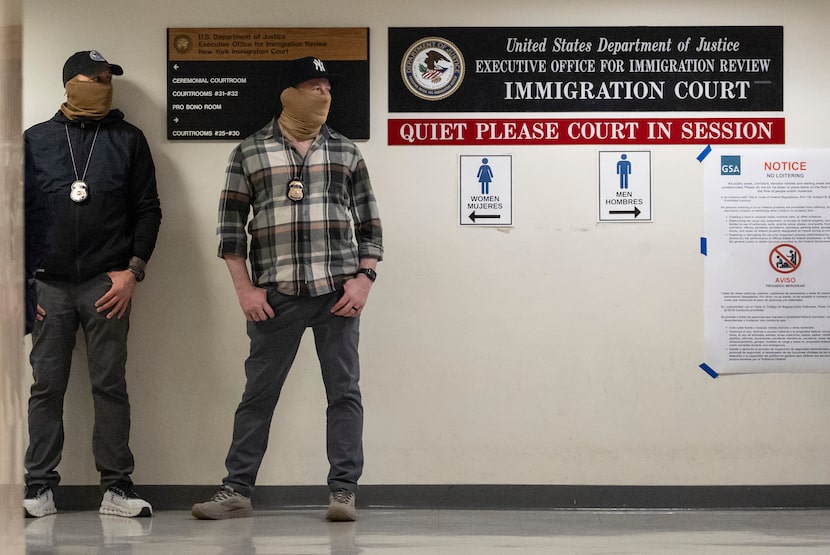
Federal agents stand outside immigration court at the Jacob K. Javits federal building in New York on March 6, 2026.
Yuki Iwamura / AP
At the hearing, photographs were shown of Ademuyiwa using one of the cards at an ATM machine to withdraw cash. A fraudulent unemployment claim for $15,000 was made with the card in 2020 and paid out, Dotson said. Then the victim became unemployed in 2022 and wasn’t able to receive his benefits due to the fraud associated with his name, Dotson said.
“In fact, he had to wait almost a year to get unemployment insurance benefits,” she said in her testimony.
Deportation Officer Lonnie Felps testified that Ademuyiwa entered the U.S. as a visitor in May 2015 with a nonimmigrant visa. The visa expired in November 2017, and Ademuyiwa applied for legal permanent residence while in “overstay” status, based on his marriage to a U.S. citizen, Felps said.
That application was not approved, Felps said, and it remained pending while U.S. Citizenship and Immigration Services investigated whether or not Ademuyiwa’s marriage was “fraudulent.” The investigation began after the couple were interviewed, he said.
Meanwhile, Ademuyiwa was granted authorization to work in the U.S., Felps said. After the defendant’s arrest, an immigration hold was placed on him, “pending removal proceedings,” Felps said.
Lund asked Felps if Ademuyiwa would be transferred to ICE custody if the judge ordered him released on conditions. He said yes. Then Ademuyiwa would have the right to go before an immigration judge to request a bond of no less than $1,500, Felps confirmed.
Rutherford advised Ademuyiwa that she had no control over any immigration proceedings that might result. She told him that if he’s worried about being deported, “he should waive the issue of release in this case.”
He did not.
She told him the U.S. Marshals were to hold him for 48 hours before he could be released, to give ICE a chance to take him into custody, if desired.
Ultimately, the government had Ademuyiwa transferred to immigration court where it was successful in obtaining a detention order, court records show.
“In other words, the government used the precise same argument that Judge Rutherford rejected to convince an immigration judge working under the Executive Branch that the defendant should be detained,” Lund wrote in his motion.
It’s unclear which immigration judge heard the case. Federal immigration records are not accessible without knowing the “alien number” assigned to non-citizens.
President Donald Trump ordered expedited removals upon taking office last year, and numerous immigration judges across the U.S. have been replaced with military lawyers. Critics say that was done to speed up deportation proceedings.
The government announced the appointments in October, including five new judges in Dallas and Fort Worth. All five are military lawyers, according to their biographies published in the announcement.
The Attorney General appoints immigration judges, who serve an administrative role and fall under the executive branch. They are overseen by the Justice Department and can be replaced. Federal district judges, by contrast, receive lifetime tenure if their nominations are approved by the Senate, and they serve as independent members of the judiciary.
“They are literally replacing them with military judges who don’t know the law,” said Dan Gividen, a Dallas criminal defense lawyer who is a former federal prosecutor and former deputy chief counsel for ICE.
They see their “marching orders” as denying bond and other relief to immigrants, he added.
Deported before trial
After being held for several months in immigration custody, Ademuyiwa was deported to Nigeria on Jan. 21, court records show.
“The undersigned learned of his client being removed to Nigeria through the Defendant’s U.S. citizen wife on January 30, 2026,” Lund wrote.
The government’s actions in deporting Ademuyiwa made it impossible for him to attend his trial or assist in his defense, Lund wrote. When the government keeps a defendant in custody, it is responsible for bringing him to the trial so he may “confront his accusers” and be present at every stage of the trial, Lund wrote.
Case, the prosecutor, opposed the defense motion seeking dismissal of the charges and asked Godbey to allow the matter to proceed to trial, arguing that “the negative outcome of a civil proceeding should not cause the dismissal of a criminal proceeding.”
She also asked the judge to issue the bench warrant when he failed to appear on March 2. Case said Ademuyiwa “rolled the dice” in civil immigration court and lost.
“The U.S. attorney’s office has attempted to resolve this case expeditiously, and victims will be prejudiced if the case against the defendant is dismissed,” Case wrote in her filing.
The victims, she wrote, had their identities and benefits stolen by Ademuyiwa, and they might not “see justice accomplished if the defendant ever returns to the United States.”

A van exits the Earle Cabell Federal Building on Thursday, May 22, 2025, in Dallas.
Smiley N. Pool / Staff Photographer
Lund’s response to that was to suggest that the government “look in the mirror” for the reason why the alleged victims “will have no day in court.” And he criticized the prosecutor for suggesting Ademuyiwa should not have sought his release from custody in the criminal case.
“The government’s assertion that the defendant is to blame for his removal from our society when he dares to assert his constitutional right to freedom is a deeply chilling position that offends the very idea of justice,” Lund wrote.
Ademuyiwa’s wife could not be reached for comment.
Gividen said he would not have been happy had he been the prosecutor in the case.
“If you remove them from the country before I get to prosecute them,” he said, “that’s the best thing that could have happened to them.”
Ademuyiwa was facing deportation anyway, if convicted, Gividen said. All the government did, he surmised, was to remove the possibility of his serving years in federal prison in the meantime.
In 2020, Gividen successfully convinced the local U.S. attorney to drop charges against a client of his who was deported before his trial on a charge of illegally reentering the country.
“You gotta figure out – what do you want to do?” he said about his theory of the case. “Do you want to prosecute him? Or do you want to remove him? But don’t try to do both.”
The process could create yet another issue. Prosecutors sometimes leverage defendants to testify against co-defendants or others in different — and sometimes more serious — cases. They can’t testify, though, if they’ve been deported. Gividen said the quickie deportations could cause such a scenario, forcing a prosecutor to proceed without a key witness, increasing the likelihood that a criminal defendant could go free
To seek bail or not?
The situation is causing criminal defense attorneys to give advice that would once be considered anathema to long-standing principles of justice.
Michael Lowe, a former Dallas County prosecutor, is advising criminal defendants with immigration holds that they may not want to pursue release on bond if they are being held on criminal charges in the Dallas County jail.
Bonding out of jail, he says, could subject them to the clutches of ICE, which can detain and transfer them to a different county or state before deporting them before they have a chance to defend themselves.
“Sometimes the best thing your family member can do is stay in county jail and fight the criminal case from custody,” Lowe wrote on his blog. “Because the moment they walk out on bond, ICE is waiting. And once ICE has them, the fight changes in ways that are very difficult to undo.”
Lowe noted that as long as a defendant remains in custody pending trial, ICE cannot take them. The ICE detainer only activates when the person is about to walk out of jail.
“As long as the criminal case is pending and your family member has not posted bond, they stay in the county jail. They stay local. You can visit them. Their criminal defense attorney can see them regularly. And most importantly, their criminal case can be fought aggressively in the courts.”
Lowe said in a phone interview that he’s never seen federal prosecutors in Texas opt to drop criminal charges when defendants are deported before their trials.
“Those cases stay pending forever,” he said.

Demonstrators hold signs against the backdrop of the Earle Cabell Federal Building (right) during a rally at Civic Garden Park to protest immigrant detentions at the Dallas immigration court on Sunday, May 25, 2025, in Dallas.
Smiley N. Pool / Staff Photographer
Lowe said if the government holds the position that a defendant deserves to be punished for a crime committed in the U.S., it should follow through and see it done.
“If they really believe that,” he asked, “then why would the federal government allow this person to get deported?”
These cases also raise the larger question of whether it’s fair to subject defendants with immigration complications to two different but parallel systems of justice with goals and laws that often conflict.
Kerry Martin, a criminal defense lawyer who formerly worked with the Michigan Immigrant Rights Center, wrote in a 2020 article for the Michigan Journal of Race and Law that a growing number of federal judges have found that ICE, with such practices, was violating defendants’ rights under the Bail Reform Act.
“These courts have ordered that the government either free the defendants from ICE custody or dismiss their criminal charges,” Martin wrote.
In a phone interview, Martin said deportations of noncitizens before their criminal trials seem to have increased since last year. “There is just no regard for an ongoing or forthcoming prosecution,” he said.
It shows “the incredible zeal for getting the [deportation] numbers up,” Martin added. “Because that’s all this administration seems to care about.”
Martin argued in his article that the Bail Reform Act provides a “right to remain released” pending trial – a right he said ICE was routinely violating.
“Many others have ended up in similar situations: granted pretrial release in a criminal case, only to end up in ICE detention,” Martin wrote. “In fact, it has become so common that some immigrants do not seek bail at all, fearing that they will be immediately transferred to ICE custody.”
Kagan, the law professor, said deporting accused criminals before they’re given an opportunity to defend themselves in court does not serve the prosecution or defense.
“It thwarts criminal justice,” he said. “Essentially, guilt and innocence don’t matter with immigrants.”
The larger problem, said Kagan, is having an immigration detention system that is “much harsher” than that in federal criminal courts. It’s not unusual, he said, for immigration judges to lock people up when criminal court judges would release them on bond.
The dual system exists due to a different set of laws, he said. A “different psychology” also exists in immigration court, Kagan added, where judges – who fall under the executive branch – tend to be more deferential to the prosecutor.
Vasquez, the immigration lawyer, believes allowing a criminal case to go forward “serves a greater interest than just deporting somebody.”
The defendant gets a chance to be rehabilitated, and the victims may achieve some closure, he said. In financial crime cases such as Ademuyiwa’s they might have also been able to use the conviction to clear up any damage to their credit.
“The alleged victims.” Vasquez said, “should be allowed to have their day in court.”
Related