
Nearly 2,000 ballots cast by Dallas County Democrats who got in line after voting hours were extended on March 3 due to mass confusion at the polls will not be counted in final primary results after the county party dropped its litigation of the matter.
District Judge Staci Williams granted the party’s request on election day to extend voting by two hours — to 9 p.m. — after hundreds of voters were rerouted amid the precinct-based system forced by the Republican Party.
The Texas Supreme Court blocked the extension that evening after the office of Attorney General Ken Paxton filed a petition challenging the decision.
This week the county Dallas County Democratic Party declined to challenge the matter further, stating “the Texas Supreme Court is no longer a viable forum for seeking a fair and independent application of the law regarding this issue.”
Breaking News
There were 1,756 provisional ballots cast by Democrats who got in line after 7 p.m. that will not be included in final results, according to elections department spokesperson Nic Solorzano.
No race appears to have a margin small enough to be affected, according to unofficial results.
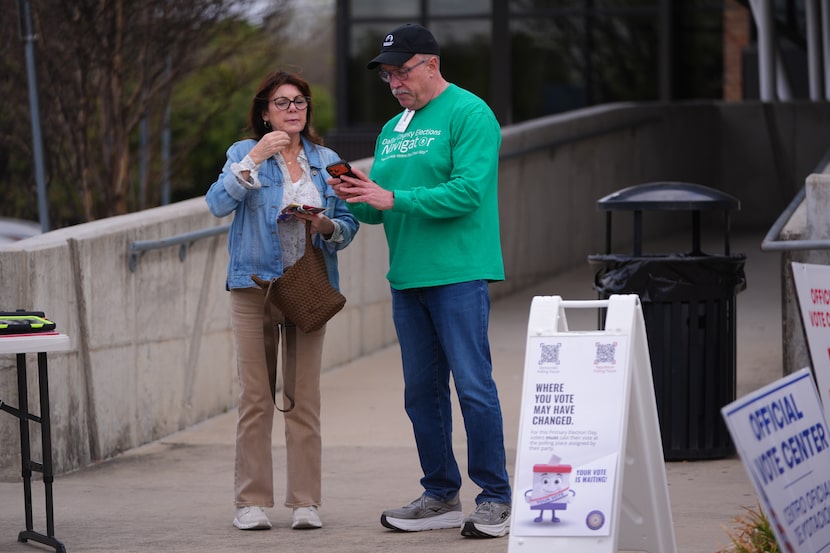
Dallas County election navigator Edwin Hightower Jr. (right) helped a voter who arrived at the wrong polling station find her correct voting location in Dallas on March 3, 2026. (LM Otero/The Associated Press)
LM Otero / AP
Democratic Party Chair Kardal Coleman said in a statement the group will continue organizing and supporting voter protection efforts to overcome roadblocks he said were placed by the GOP.
“The Texas GOP has held a thirty year stranglehold on this state — and in that time they have weaponized Texas law to disenfranchise millions of Texans — because they know if every eligible voter has access to the polls, they lose,” Coleman said. “Continuing to pursue this case in a hostile forum would incur massive legal costs, resources that are better spent on the ground protecting our voters.”
Last year, the Dallas County Republican Party decided to hold a separate March 3 primary from Democrats and revert to precinct-based voting on election day. It was a change from the countywide voting system in place since 2019 that allowed residents to cast a ballot at any vote center regardless of their address.
Because county officials control early voting in Texas, the universal system remained in place for that 10-day period.
But on election day, hundreds of voters were turned away from polls when they arrived at what were typically universal voting sites and rerouted to their assigned polling place.
Some Democrats and Republicans within the same precinct, or the same household, were required to report to different polling sites due to it being a separate primary.
Although the county placed navigators at some polling sites with party-specific tablets to look up voters’ precincts and redirect them accordingly, that presented problems too. If navigators failed to ask for a voter’s party affiliation before searching for their precinct, some people were sent to the wrong site. The same problem occurred when election clerks used their check-in poll books instead of the party-programmed navigator tablets.
Democratic leaders tried to avoid this outcome by pushing for a joint primary. But state law only allows countywide voting on election day if both parties agree, leaving all voters affected by the Republicans’ decision.
Dallas County GOP Chair Allen West previously said precinct-based voting “reduces the opportunity for fraudulent activity,” although research shows voter fraud is exceedingly rare in the U.S.
The situation was worsened because state Republicans pushed a midcycle redistricting upon encouragement by President Donald Trump, which redrew voting precincts and changed where some residents were required to vote.
The new maps were adopted by the Commissioners Court in December.
By March 3, the Secretary of State’s votetexas.gov website was not updated with Dallas County’s new maps, so voters who searched for their polling place using the state resource may have been directed to the wrong location. By the afternoon, the state website was directing voters to use Dallas County’s search tool instead.
Secretary of State spokesperson Alicia Pierce said the polling location data on votetexas.gov is maintained by counties, not the state. Elections administrator Paul Adams said his office had emailed polling place changes to the state as they were being finalized through February and could not explain why the website didn’t reflect the updates.