
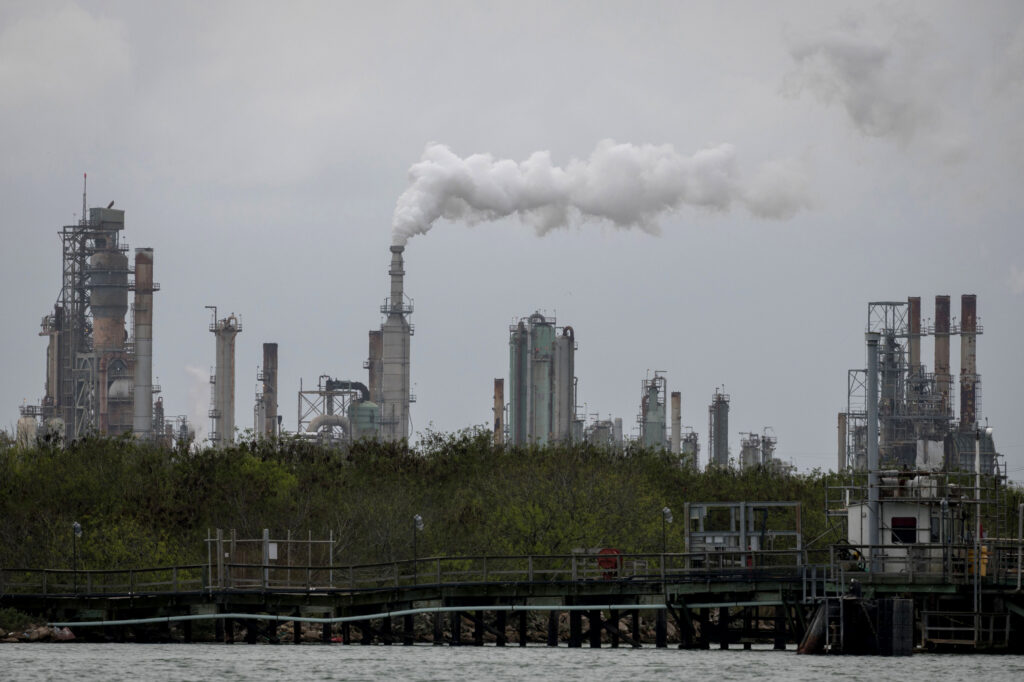
Trump claimed a “massive win” this week when he announced that the Indian private energy company Reliance Industries is investing in a proposed oil refinery in Brownsville, Texas.
Trump took to his social media platform Truth Social to announce the “FIRST new U.S. Oil Refinery in 50 YEARS” would be built in the coastal city. While plans for the refinery aren’t new—they date back a decade—Trump hopes to claim credit if the refinery is finally built.
The president is looking for a win as the U.S. and Israel’s war in Iran drives up global energy prices. Brownsville environmentalists, who previously challenged the refinery’s permit application, denounced the refinery as a “zombie” project that will pollute the air and waterways.
“Thank you to our partners in India, and their largest privately held Energy Company, Reliance, for this tremendous Investment,” the president wrote on Tuesday. “This is what AMERICAN ENERGY DOMINANCE looks like. AMERICA FIRST, ALWAYS!”
The project was originally developed by Jupiter Brownsville LLC, which obtained state permits in 2021. Houston-based Element Fuels took over the project in January 2024, according to regulatory filings. In December 2025, America First Refining, which shares the same ownership, took over from Element Fuels.
Officials at the Port of Brownsville hastily organized a press conference Wednesday morning.
“We’re going to be able to close this deal and bring that refinery to the Port of Brownsville,” said William Dietrich, the port director and CEO. He said that construction will begin in the “near term” on the “shovel-ready” project.
Local environmentalists protested outside the press conference.
“The Brownsville community has opposed this oil refinery for over seven years since it was first proposed, and will continue to do so because it will release toxins into our air, waterways, and our environment,” the South Texas Environmental Justice Network said in a statement.
The White House did not respond to a request for comment.
Long-Standing Proposal Could Move Forward
Plans for the refinery go back years. So does the local opposition.
Jupiter Brownsville LLC applied for permits from the Texas Commission on Environmental Quality (TCEQ) in 2017. Local environmentalists, shrimpers and fishers filed a protest with the agency. The case went to an administrative hearing and the agency eventually issued the permits in 2021, requiring the company to reduce nitrogen oxide emissions and enhance its pollution monitoring.
Since 2021, the developers have obtained three extensions for the deadline to start construction. On Feb. 26, TCEQ staff extended the deadline for America First Refining to begin construction from April 19, 2026, to Oct. 19, 2027. A TCEQ staffer wrote in the extension letter that this is the “third and final” extension allowed under Texas state law.
“If construction has not begun by October 19, 2027, Permit Number 147681 shall be automatically void,” the TCEQ staff member wrote.
Reliance Industries and America First Refining did not respond to questions from Inside Climate News. Reliance Industries has not publicly commented on the deal.
This story is funded by readers like you.
Our nonprofit newsroom provides award-winning climate coverage free of charge and advertising. We rely on donations from readers like you to keep going. Please donate now to support our work.
Charles McConnell, a former assistant energy secretary with the Obama administration who now teaches at the University of Houston, said that the Texas Gulf Coast has long played an essential role in the global oil refinery industry. He said that energy companies like Reliance, which sources most of its crude oil in the Middle East, are reconsidering their investment strategies as the war in Iran threatens access to oil in that region.
“This is an obvious opportunity for [Reliance],” he said.
A Brownsville refinery would make the company “less dependent on less-dependable places,” he said.
But McConnell said that it is still too early to tell if the refinery will be built.
“When you have a company like Reliance in the conversation, it makes it a lot more plausible,” he said. “You have more arrows pointing in the right direction with major players that are serious.”
McConnell said new technology has allowed energy companies to increase capacity at their existing U.S. refineries, instead of building new ones. But he said that with the capital and the correct market, the U.S. could see its first new refinery in decades.
Trump’s Truth Social announcement claimed that the refinery was a “$300 billion deal,” which he called “THE BIGGEST IN U.S. HISTORY.”
University of Texas at Austin energy expert Michael Webber called these figures “disinformation” in a post on the social media platform X. The cost of building the refinery has previously been pegged at $3 to $4 billion.
America First Refining’s press release claimed that the deal will “improve” the U.S. trade imbalance by $300 billion.
Environmental Debate Over Refinery Resumes
The refinery’s site covers 240 acres within the Port of Brownsville and would process 160,000 barrels a day of shale oil from the Permian Basin, according to the port’s press release. The port said that America First Refining expects to create 500 jobs. The company said the refinery will use hydrogen and clean-fuel systems to minimize emissions.
The South Texas Environmental Justice Network called a “clean” oil refinery an oxymoron. The group also questioned how much water the refinery would need.
“The Port of Brownsville is lacking foresight and continues to demonstrate bad business practices by pushing the Rio Grande Valley region towards a major water shortage catastrophe,” the group said in a statement, referencing recent reporting by Inside Climate News in Corpus Christi, Texas.
A major liquefied natural gas terminal is also being developed at the Port of Brownsville. The SpaceX launch site is only a few miles away. South Texas Environmental Justice Network warns that these industrial projects threaten the coastal wetlands of the Rio Grande delta.
“The oil refinery, which plans to operate across the ship channel from the shrimp basin, will severely harm the Rio Grande Valley’s shrimping and nature tourism industries,” the group said.
About This Story
Perhaps you noticed: This story, like all the news we publish, is free to read. That’s because Inside Climate News is a 501c3 nonprofit organization. We do not charge a subscription fee, lock our news behind a paywall, or clutter our website with ads. We make our news on climate and the environment freely available to you and anyone who wants it.
That’s not all. We also share our news for free with scores of other media organizations around the country. Many of them can’t afford to do environmental journalism of their own. We’ve built bureaus from coast to coast to report local stories, collaborate with local newsrooms and co-publish articles so that this vital work is shared as widely as possible.
Two of us launched ICN in 2007. Six years later we earned a Pulitzer Prize for National Reporting, and now we run the oldest and largest dedicated climate newsroom in the nation. We tell the story in all its complexity. We hold polluters accountable. We expose environmental injustice. We debunk misinformation. We scrutinize solutions and inspire action.
Donations from readers like you fund every aspect of what we do. If you don’t already, will you support our ongoing work, our reporting on the biggest crisis facing our planet, and help us reach even more readers in more places?
Please take a moment to make a tax-deductible donation. Every one of them makes a difference.
Thank you,

Reporter, El Paso, Texas
Martha Pskowski covers climate change and the environment in Texas from her base in El Paso. She was previously an environmental reporter at the El Paso Times. She began her career as a freelance journalist in Mexico, reporting for outlets including The Guardian and Yale E360. Martha has a B.A. in Environmental Studies from Hampshire College and a master’s degree in Journalism and Latin American Studies from New York University. She is a former Fulbright research fellow in Mexico. Martha can be reached on Signal at psskow.33.