
By Rachel N. Madison
Reporting Texas
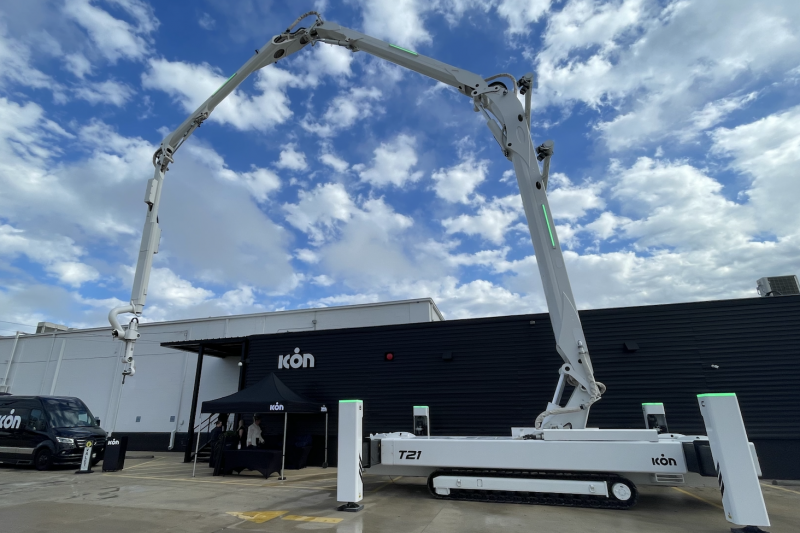
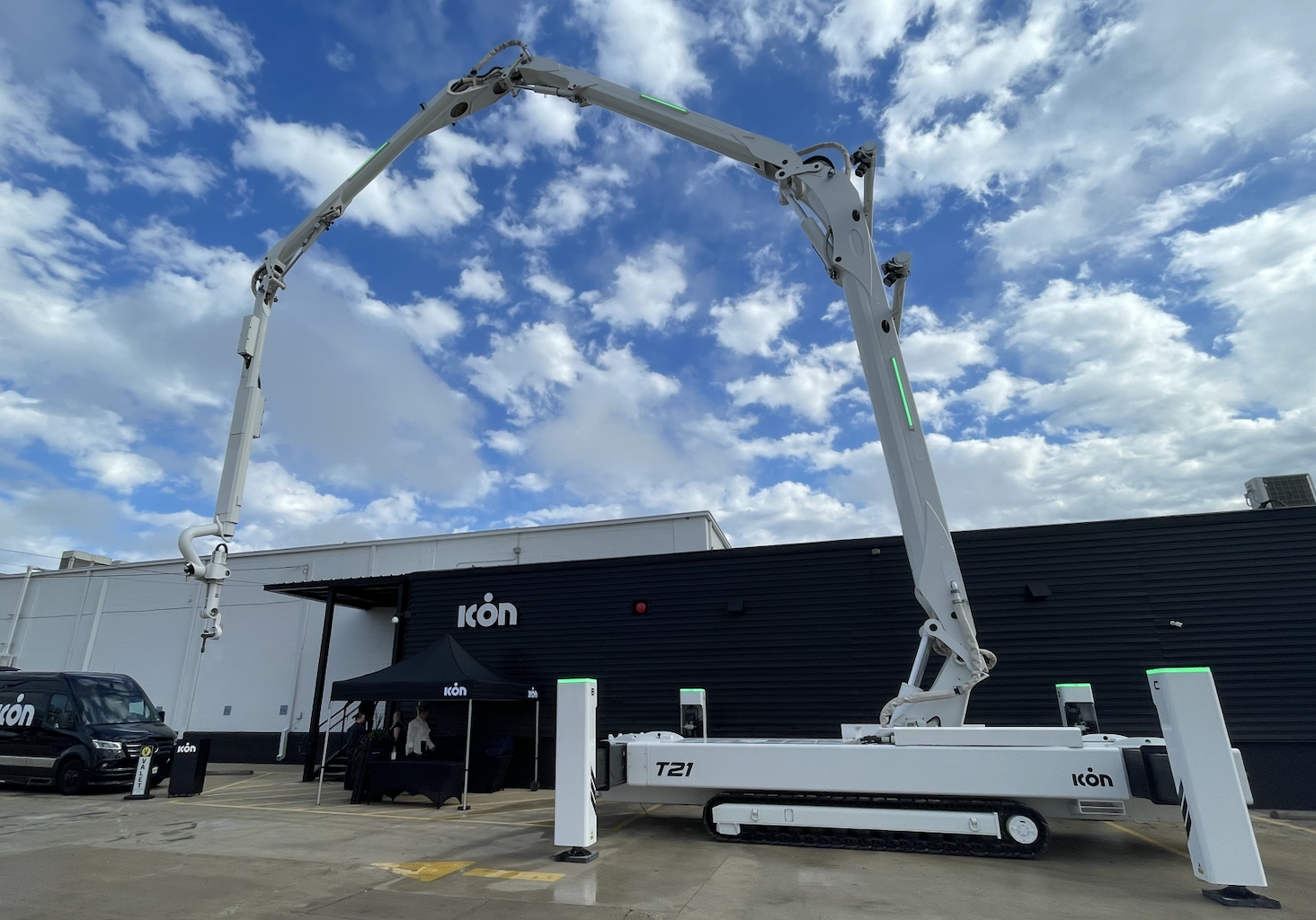
Austin-based ICON says its Titan 3D-printing system, seen here outside its headquarters, ushers in a new era of low-cost and fast construction. Rachel N. Madison/Reporting Texas
Most people are still amazed by 3D printers’ ability to print handheld objects. Imagine if you could print an entire house. It turns out that you can.
3D-printing construction company ICON announced an upgraded printing arm, “Titan,” at its South Austin headquarters Wednesday. The new system is designed for large-scale, multi-story commercial development, which will be put in the hands of builders to employ 3D printing across the country.
“We’ve been developing these technologies for eight years now, and the mission of the company is to put new ways to build in the hands of the global construction and building industry,” ICON co-founder and CEO Jason Ballard said.
Founded in Austin in 2017, ICON made headlines a year later when it revealed its first 3D-printed home, “House Zero” during South by Southwest. It later partnered with Mobile Loaves and Fishes to construct over a dozen homes in East Austin’s Community First! Village, which provides affordable long-term housing for formerly homeless people. ICON has since gone on to partner with mainstream housing developers, the military and NASA.
“You might say that ICON has three businesses,” Ballard said. “We have a build business where we are using our tools to show the world that you can run a construction business very effectively, and we have our government business where we work with national defense and intelligence.”
“Now, we can finally begin this next chapter: our tech business, where we’re actually selling and supporting the technology for other builders,” he said.
The company says that Titan offers automated low-cost, fast and easy-to-operate equipment, as well as a catalog of ready-to-print designs that push the boundaries of traditional architecture.
3D-printed structures have drawn interest from climate-conscious consumers because of their economic and environmentally sustainable techniques and materials.
“Traditional construction is slow, resource-intensive and fundamentally unsuited to the scale of the need,” ICON senior vice president Brooke Bauguess said in an email correspondence last month.
ICON’s technology, she said, “replaces a traditional building system made up of multiple materials and trades, including brick or siding, vapor barriers, sheathing, framing, sealants, insulation, and drywall with three materials — CarbonX, insulation and steel reinforcement.”
CarbonX, the trademarked concrete formula used in the printer, is “the lowest carbon residential building system ready to be used at scale,” said Bungane Mehlomakulu, the company’s senior director of building and construction science.
CarbonX framing has a lower overall carbon footprint than stick-frame homes and is also more resilient against potential weather-related damages, according to a 2024 report on the material co-authored by the MIT Concrete Sustainability Hub.
As Texas faces increasing threats from extreme heat and rainfall, developing resilient structures will be key to community viability, the report said.
Kerry Cook, a professor of earth and planetary sciences at the University of Texas at Austin, said mitigating climate impacts is “going to be an increasing challenge.”
“The temperature so far has increased about 3.5 degrees Fahrenheit” over pre-industrial times, she said. “Based on the business-as-usual scenario, by the end of this century, our temperature in Texas will increase between 7 and 15 degrees Fahrenheit.”
This will pose extreme health and economic impacts as Texans strive to stay cool in summer months. ICON believes its concrete structures can help residents stay safe and save energy as temperatures continue to rise.
“Everyone on Earth expects these builds to last longer than stick-frame buildings, especially when you consider natural disasters like fires, floods, and hurricanes,” Icon’s Ballard said.
3D homes also often exceed energy efficiency and building codes thanks to concrete walls that “keep the internal surface temperatures lower than wood framed homes under similar outdoor conditions,” Mehlomakulu said. “Cooler surfaces in the summer and warmer temperatures in the winter contribute to a more comfortable environment and typically require less air conditioning to feel comfortable.”
Many ICON homes also incorporate rooftop solar panels and EV charging stations to enhance sustainability.
While the environmental perks draw many prospective residents to Wolf Ranch in Georgetown, a partnership development between ICON and homebuilder Lennar and the largest 3D printed neighborhood in the world. Some homeowners’ experiences, however, haven’t lived up to their expectations.
Nearly a year later after moving into her $440,000 home, Wolf Ranch resident Christine Kwak said that she has not received the benefits she was promised.
Kwak was unable to activate her solar panels after the company, Sunnova, declared bankruptcy that summer. She has also noticed hairline cracks in the walls due to temperature changes, as well as pipe and fiber optic cable failures.
“Several of my neighbors have also complained about HVAC systems, window cracks, and water flooding,” resulting in substantial out of pocket expenses.
She blames homebuilder Lennar for poor quality control; she said the builder has not responded to her complaints.
“We just bought a new home and were so excited,” she said. She now regrets the purchase.
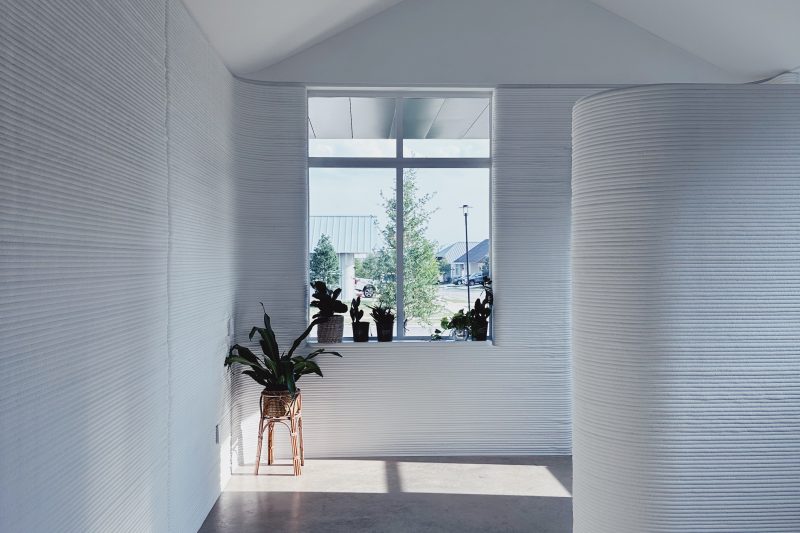
Wolf Ranch resident Beau Oliver praises the design and comfort of his 3D-printed home in Georgetown’s Wolf Ranch. Photo courtesy of Beau Oliver
Other residents have had more positive experiences.
Resident Beau Oliver moved into Wolf Ranch last year with his husband after he fell in love with the unique design and architecture of the unit. He immediately noticed the “house stays very consistently cool and comfortable,” although he said he hasn’t yet seed energy cost savings.
However, he also acknowledged that there were issues.
“When we first moved in they hadn’t pulled the fiber optic cable to our house so we didn’t have internet,” he said. Oliver also had to install a separate satellite dish and install his own solar panels.
“It’s a bummer because it’s all wrapped up in the efficient tag on the homes, but it wasn’t true” he said. “We had to do extra work.”
ICON’s role in Wolf Ranch was print-only, according to Ballard. It was the homebuilders’ responsibility to then install electricity, HVAC systems and other appliances.
“We show up, print and leave,” he said.
The City of Georgetown said that it does not yet have inspector codes for concrete 3D construction but that all Wolf Ranch homes were inspected through the city’s inspection services department.
Not all homes passed initial inspection, and some required builder corrections to address the issues, said the city’s communications manager, Keith Hutchinson. To date,
Georgetown officials said they are not aware of complaints from 3D homeowners.
Lennar did not respond to numerous attempts for comment about residential complaints.
ICON currently has 200 more 3D-printed structures in development, including a new church and 100 more houses in the Community First! Village where it all started.
“From the very beginning of our journey, it has been our goal to see this innovative technology reach those in need,” Bauguess said.
After nearly a decade, continuing this community development reflects a full-circle moment. Today, ICON’s has 230 3D-printed homes and structures across five states and two countries.
Sixth-generation Texan Ballard assures that Texas will always play a key role in the ICON story. He said the “blue collar ethos” of Texas is what made building up the business possible.
“I felt very fortunate that there was a city like Austin that was a hub for innovation, for creativity and for the arts, and it ended up being a great city to do this in,” Ballard said.
Ballard hopes that Titan will revolutionize the building industry, and he sees demand increasing in Texas.
“Our aperture is wide open,” he said, “to work with anyone to do great things.”
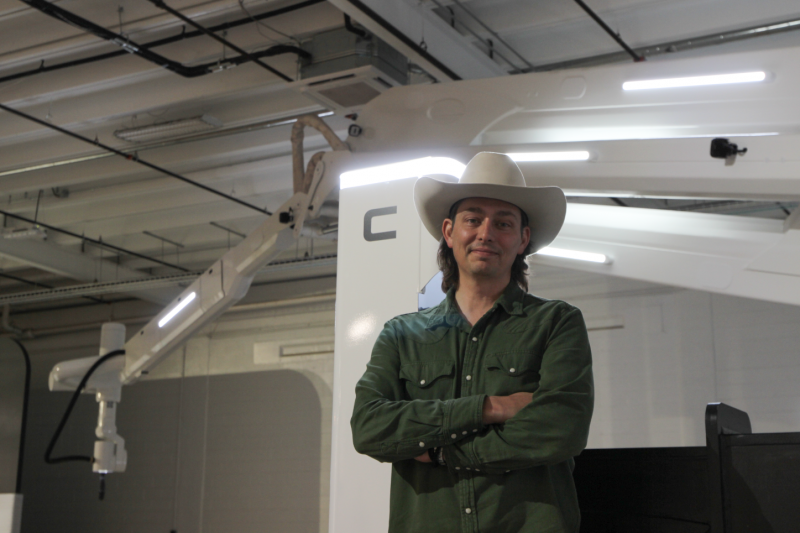
Icon co-founder and CEO Jason Ballard at the Titan launch on Wednesday morning. Rachel N. Madison/Reporting Texas