
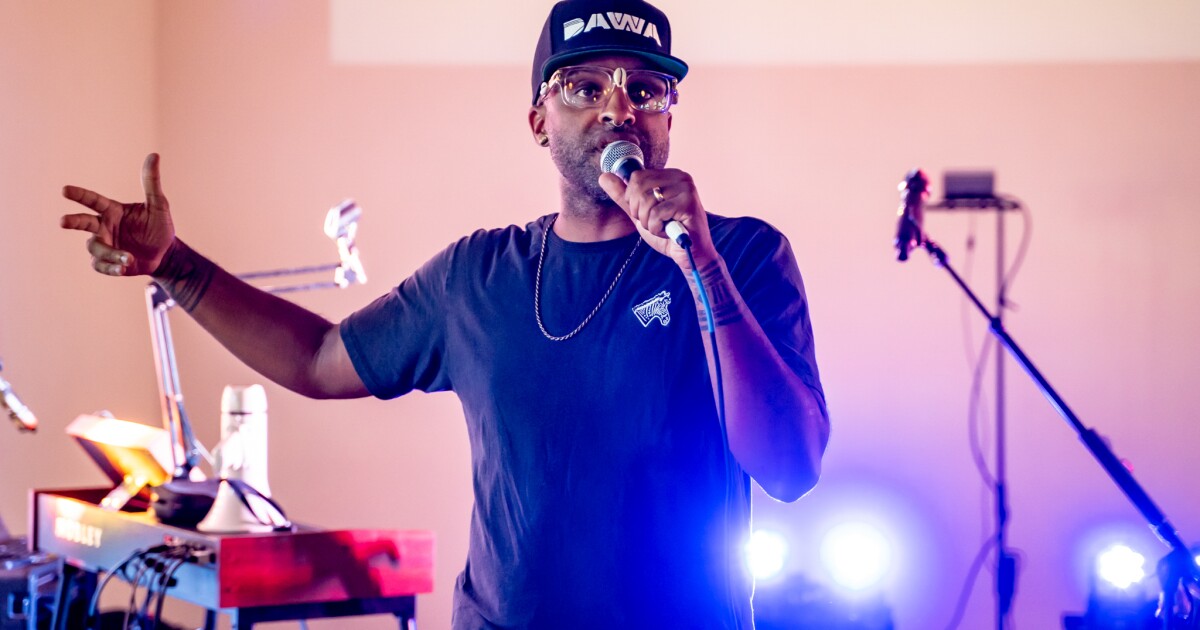
An Austin nonprofit dedicated to investing in the BIPOC community is presenting a free four-day event during South by Southwest called Vision:8291.
The name of the event is a symbolic reversal of Austin’s 1928 Master Plan, which segregated the city by forcing Black and brown residents into East Austin. The event aims to move “beyond trauma” to center BIPOC voices and innovation.
It’s hosted by Diversity Awareness and Wellness in Action, or DAWA, a group formed in 2019 to support “community front-liners”— teachers, social workers, health care providers, musicians and artists.
The event, which runs Saturday through Monday at the Almost Real Things gallery in the Canopy Arts building, will feature live podcast tapings, panels, keynotes, film screenings, networking activities, and showcases exploring music, organizing and technology.
KUT’s Miles Bloxson recently spoke with DAWA founder Jonathan “Chaka” Mahone, who won a SXSW Community Service Award this year, and Angel from the Bloc, one of the presenters at the event.
This transcript was transcribed by an AI tool and lightly edited by a human.
Miles Bloxson: So Chaka, you’ve been doing this for four years. Can you tell us what DAWA is?
Chaka Mahone: DAWA is an organization that fills in the gaps for who we call community frontliners. We have one with us in the building today — the givers. Those are the teachers, social workers, health care providers, service‑industry workers, and creatives of Austin.
We started in 2019, and some of the highlights are that we’ve given away over half a million dollars to that group. Eighty percent of those individuals identify as women, and over 60 percent identify as Black. The people who take care of us — the nurturers, the givers — are essential to this city.
We feel they need to be protected, celebrated, elevated, and placed at the forefront when talking about decisions that shape our future.
Bloxson: And you’re putting on an event this weekend. Can you tell us about Vision:8291 and the inspiration behind it?
Mahone: Many NPR listeners are familiar with the 1928 Master Plan. If not, it was a moment when city officials decided to segregate Austin. They cut off access to water and sanitation and essentially moved Black and brown people to what is now known as East Austin.
After communities recovered and began rebuilding, gentrification, redlining and other policies followed. That community has been impacted for generations by these decisions.
Vision:8291 is a reversal of 1928. It’s about imagining a future beyond the trauma — for ourselves and our communities. It’s about centering BIPOC voices and innovators, giving people with ideas the chance to be heard, to be seen, and to connect.
Bloxson: And Angel, how does it feel to be part of this year’s event as a presenter?
Angel from the Bloc: It feels amazing, especially as a native Austinite. Chaka and I have talked about this — East Austinites often internalize racism because of things like the 1928 Master Plan. It teaches you that the great things in this city — ACL, South by Southwest, events that uplift creatives — aren’t for us.
I grew up in the live music capital, going to South by every year, but I never imagined having an opportunity to speak, connect and be platformed in this space.
Bloxson: Chaka, what can people expect from Vision:8291? Every year the bar gets higher.
Mahone: First, it’s free. Second, it’s in East Austin on Springdale Road. Very accessible. Parking isn’t a problem. On Saturday, we kick off with the Music Blueprint. Musicians and creatives can learn about tour realities in 2026 from Jackie Venson, how to get music into TV and film, and how to secure sync placements.
We’ll also host the first live recording of the popular podcast The Manager’s Playbook by Mauricio Ruiz, who has interviewed some of the biggest names in music.
That’s just Saturday. On Sunday, we have Angel from the Bloc talking about social media as an organizing tool, along with Celine from Community Powered ATX. Jamiah Hargins from LA Crop Swap will also be there. He’s growing food in every space imaginable and getting it to people affordably.
The theme for Sunday is The Creative Catalyst. Richie Reseda —who spent seven years in the California State Prison and later created the Netflix documentary Songs from the Hole—will screen the film and lead a workshop.
On Monday, we’re talking about the future. And the future is always now. We have Troy Carter, co‑founder of Venice Music and former manager of Lady Gaga and John Legend. I’ll also be giving a keynote about community as our greatest technology, and what that philosophy means for the future of Austin and cities like it.
On Tuesday, we have the Unity Showcase featuring Cure for Paranoia out of Dallas—an incredible performer. We also have Austin artists Jersey J, The Smooth Nature, Vintage Jay, and Nicotine. All talented artists on the rise. Yes, we center BIPOC creatives and innovators, but this is for everyone.
Bloxson: Angel, being from East Austin, how important is it for you to see events like Vision 8291 happening in the place you call home?
Angel from the Bloc: It’s so important. Chaka and I talk about the difference between surviving and thriving. Moving beyond collective trauma means celebrating the culture and the positive things in our community. It has taken nearly 100 years to begin healing.
Even just telling people about a joyful event happening on Springdale Road changes something in me. Growing up, Springdale was rarely mentioned positively. And when it was, it usually involved gentrification. But now we’re talking about Springdale as the site of a positive, community‑serving event led by Black people. It means everything.
Bloxson: What you’re saying resonates with me as someone who also grew up on Springdale Road. I attended Pecan Springs Elementary — back when the apartments were called Springdale Apartments.
How can people support you, Angel?
Angel from the Bloc: I have a podcast on YouTube—Angel from the Bloc. Same handle on TikTok and Instagram (Bloc without the K—B‑L‑O‑C). I also have a Substack with the same name. Interacting with my content is the best way to support me. It reminds me I’m not speaking into the void—that my words are reaching people.
Bloxson: And Chaka, how can people keep up with you and DAWA?
Mahone: The goal is to raise money for grassroots organizations in Austin. My experience over 16 years is that companies come for South by Southwest, pay artists to perform, and then leave—like a monsoon that dries up overnight.We want people to come, learn, enjoy—and also donate. All funds raised go back to BIPOC‑led grassroots organizations in Austin, the people on the ground solving real issues every day.
Bloxson: I’ve been speaking with Angel from the Bloc and Jonathan “Chaka” Mahone about their upcoming Vision:8291 events March 14 through 17 during South by Southwest. For more information, visit dawaheals.org.
Angel from the Bloc: Thank you.
Mahone: It’s been a pleasure. Thank you.