
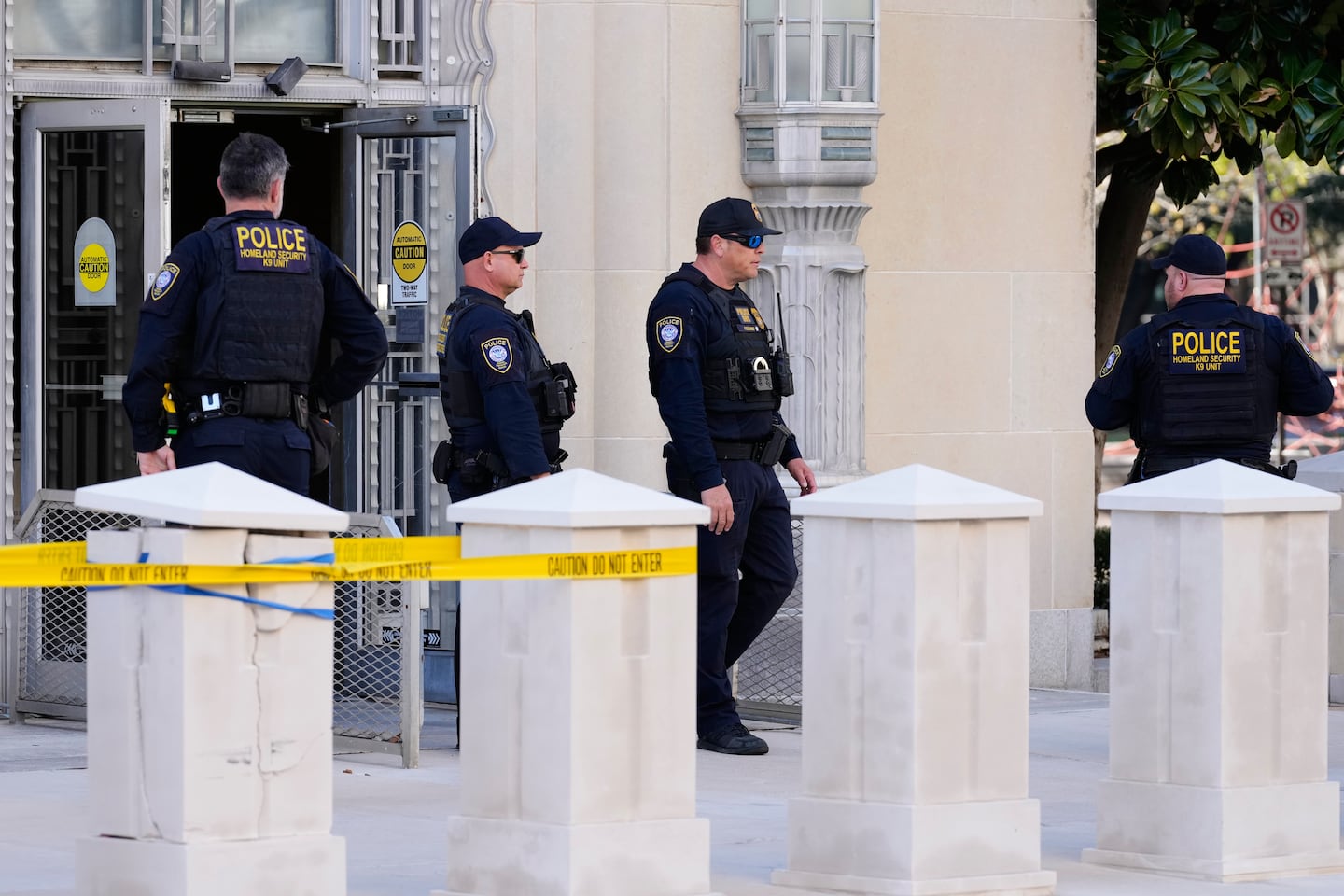
The trial was closely watched beyond the Fort Worth, Texas, courtroom as some legal experts and critics called it a test of the lengths the government can go to punish protesters.
Lawyers for the accused say they were not antifa members and had instead organized a “noise demonstration” to show support for immigrants who had been detained as part of the Trump administration’s mass deportation operations.
Get Starting Point
A guide through the most important stories of the morning, delivered Monday through Friday.
FBI Director Kash Patel has called the Texas case the first time a material support to terrorism charge has targeted people accused of being antifa members.
Short for “anti-fascists,” antifa is not a single organization but rather an umbrella term for far-left-leaning militant groups that confront or resist neo-Nazis and white supremacists at demonstrations.
The nine defendants, indicted by a grand jury collectively last fall, include alleged ringleader Benjamin Song, a former Marine reservist; Savanna Batten; Zachary Evetts; Autumn Hill; Meagan Morris; Maricela Rueda; and a couple, Elizabeth and Ines Soto. The accused included a middle school teacher, a college student, a mechanical engineer, and a UPS worker.
They faced a combination of charges, including attempted murder, rioting, providing support to terrorists, conspiracy to use and carry explosives, and conspiracy to corruptly conceal documents. One of the nine, Daniel Sanchez-Estrada, was not at the scene and was accused of later trying to hide a box of “anti-government propaganda.”
Eight of the defendants (except Sanchez-Estrada) were convicted of providing support for terrorists. Eight of the defendants were convicted as well of riot and the explosives charges, which were fireworks. Only Song was convicted of attempted murder for shooting the officer. Sanchez-Estrada was convicted of concealing documents and conspiracy to conceal documents.
All pleaded not guilty and did not testify at the two-week trial. Most faced potential life sentences. (Sanchez-Estrada faced up to 40 years.) Sentencing has been scheduled for June 18.
The jury began deliberating Wednesday after closing arguments, when prosecutors stacked evidence seized from the accused in front of them: guns, alleged antifa flags, and pamphlets. During deliberations, jurors asked to review two books prosecutors entered into evidence, according to federal public defender Christopher Weinbel, who represented one of the defendants: “Antifa: The Anti-Fascist Handbook” and “If We Go, We Go On Fire.”
Assistant US Attorney Shawn Smith argued during closing arguments that the defendants, led by Song, plotted the attack by arming themselves, wearing all black clothing known as “black bloc” to conceal their identities, and hiding their phones in bags that prevent police from tracking them — all “antifa tactics,” he said.
“What’s at issue here is using legal things to do illegal things,” Smith said. “Why wear black bloc? Why pay cash for otherwise legal fireworks? Why put your phone in a Faraday bag? The answer is: You know what you’re doing is illegal.”
As the jury watched, Smith displayed slides on a flat-screen TV and said that even though only Song was specifically accused of shooting the officer, the group members “are liable because they know or should have known what Song was going to do” and they “helped him cover it up … because of antifa.” Smith said that after the shooting, the group began deleting messages and hiding “anarchist hate-the-government material.”
Defense attorneys argued the case was politically motivated, the evidence slim. Defendants who were armed had obtained their guns legally, they noted. Pamphlets, zines, and books seized from the accused were also legal, evidence of the group’s shared political beliefs, not membership in an organized group, attorneys said.
The attorneys quoted Alexander Hamilton and Thomas Jefferson, saying that American democracy was on trial. They said the defendants’ chat messages displayed at trial showed they had planned a peaceful demonstration, not a violent attack.
“In America, we don’t prosecute people for their political beliefs,” said Batten’s attorney, Chris Tolbert.
The indictments followed an executive order signed by President Trump that instructed federal law enforcement to take “investigatory and prosecutorial action” against those who financially support antifa, and it labeled the group a “domestic terrorist organization.” That designation isn’t part of existing US law.
“They’re asking you to put protesters in jail for being terrorists,” said Blake Burns, who represented Elizabeth Soto, addressing the jury. “That’s not something that’s happened before. You guys are literally the only people on Earth that can stop that from happening.”
Already this year, federal prosecutors have charged protesters in Minneapolis who opposed the ICE operation there in which two protesters were killed and condemned by then-Homeland Security Secretary Kristi L. Noem as “domestic terrorists.” Noem faced harsh criticism during a Senate hearing earlier this month before Trump removed her from her post.