
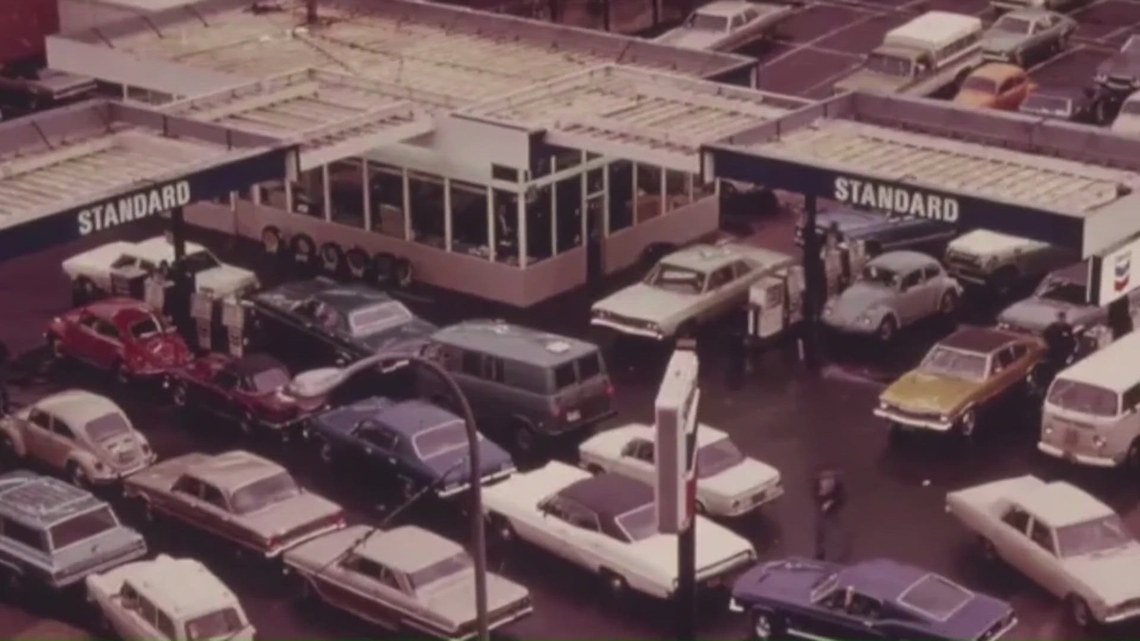
Remembering the 1970’s, when troubles in the Middle East led to rising fuel prices, gasoline shortages and long lines at gas pumps across Texas and the U.S.
AUSTIN, Texas — Although gasoline was cheap and abundant in the United States after World War II, the country had major wake-up calls in the 1970’s when two major crises would suddenly reveal how vulnerable America’s energy supply really was.
The first shock came in 1973, during a Middle East conflict known as the Yom Kippur War. Several oil-producing Arab nations announced an oil embargo against the United States and other allies for their support of Israel.
Across America, gasoline prices surged, from an average price of about 40 cents a gallon in 1973 to 55 cents a gallon by 1974, a 35% increase. Adjusted for inflation, the 1974 average was equivalent to around $3 for a gallon of gasoline today.
To reduce oil consumption, the federal government imposed a nationwide 55 mph speed limit, and automakers suddenly faced pressure to build smaller, more fuel-efficient cars.
Just a few years later, Americans faced another shock.
In 1979, political turmoil erupted during the Iranian Revolution, disrupting one of the world’s largest oil exporters and dramatically cutting global supply.
Gas stations ran out of fuel. At stations that still had fuel, cars lined up for blocks as drivers waited for their chance to fill their tanks.
Gasoline in 1979 jumped from an average of 63 cents a gallon to 86 cents a gallon. By 1980, it reached a high of $1.19 a gallon, about $4.50 a gallon in today’s dollars.
The long gas lines of the 1970s eventually disappeared—but the lessons from the oil crises of the 1970s still shape America’s energy debates today.