
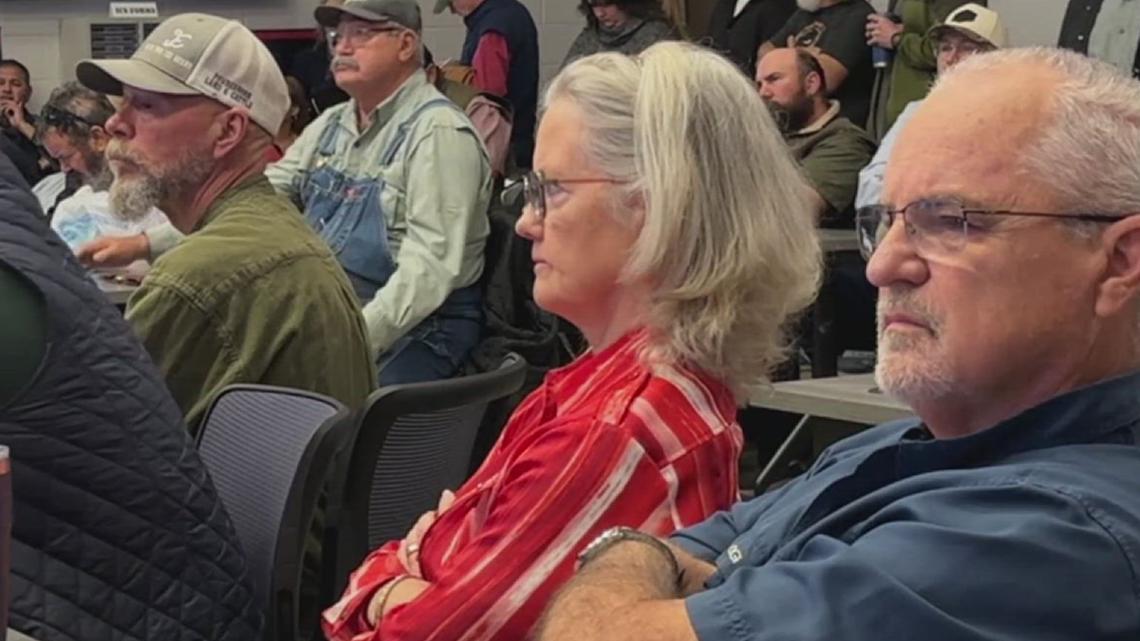
Sinton leaders say key data is being withheld for the Evangeline groundwater project, while Corpus Christi says it remains committed to regional cooperation.
CORPUS CHRISTI, Texas — Just a few days after Sinton sat out of a meeting with Corpus Christi aimed at resolving tensions over the Evangeline groundwater project, the dispute between the two cities is escalating.
Leaders in the City of Sinton say key scientific data tied to the Evangeline Groundwater Project has not been provided, and accuse attorneys for Corpus Christi and Evangeline/Laguna of dismissing their concerns.
In a statement sent to 3NEWS on Friday, Sinton City Manager John Hobson said the city and the St. Paul Water Supply Corporation are focused on protecting the shared aquifer serving communities across San Patricio County.
“Our objective has been and will continue to be protecting the interests of the communities of Sinton, St. Paul and surrounding San Patricio County by protecting the integrity of the aquifer in which we all share,” Hobson said.
Hobson said Sinton and St. Paul submitted a counterproposal Feb. 20 to Evangeline/Laguna and the City of Corpus Christi aimed at creating what he described as a “cooperative, science-based regional solution”. He said attorneys for Corpus Christi and Evangeline/Laguna later responded by characterizing the proposal as overly restrictive and unnecessary.
“From the outset, we have operated under a simple principle: regional solutions only work when every participant has access to the same scientific information and can evaluate impacts on equal footing,” Hobson said. “Transparency is not a “harsh” demand—it is the minimum standard for responsible groundwater management.”
He said the city’s concerns center on transparency and access to scientific information used to evaluate the aquifer.
“Groundwater modeling, recharge estimates, and pumping impact analyses are not optional details; they are the foundation of sound planning,” Hobson said. “When that information is withheld, meaningful progress becomes far more difficult.”
He also emphasized that their protest of the groundwater permit application was necessary to ensure a public hearing under rules of the San Patricio Groundwater Conservation District.
Acccording to Hobson, District rules allow permits to be issued without board action if no protest is filed within 10 days of public notice. Hobson said that meant the project could have been automatically approved without the formal protests filed by Sinton and the St. Paul Water Supply Corporation.
“In plain terms: without formal protests from the City of Sinton and the St. Paul Water Supply Corporation, the Evangeline/Laguna and Corpus Christi groundwater project would have been automatically approved,” Hobson said.
Despite the protests, Corpus Christi officials say the project is already moving forward through its design phase.
City Manager Peter Zanoni said Friday the Evangeline Groundwater Project in San Patricio County is about 60% through the design process, with fieldwork expected to begin in April. Early work would include establishing access roads and installing water lines while the city continues waiting on permits from the San Patricio Groundwater Conservation District.
The project is expected to produce about 24 million gallons of water per day, with partial delivery into the Mary Rhodes Pipeline targeted for November if approvals move forward.
Zanoni said the city’s broader water supply projects are largely ready but still depend on final approvals.
“We have 76 million gallons of new water supply coming online. The only missing piece is a permit or two,” Zanoni said.
Hobson said Sinton believes those approvals should not move forward until more scientific data about the aquifer is shared with surrounding communities that rely on the same groundwater source.
“Exercising that right is not obstruction, it is responsible leadership,” Hobson said.
3NEWS reached out to Zanoni for comment. He sent the following statement:
“City Manager Peter Zanoni acknowledges the statement recently posted online by the City of Sinton regarding the Evangeline/Laguna groundwater project.
The City of Corpus Christi remains committed to transparency and constructive dialogue regarding the Evangeline Groundwater Project and the long-term sustainability of regional water resources.
Just days ago, Senator Adam Hinojosa attempted to facilitate an in-person meeting to discuss the concerns being raised. The City of Corpus Christi accepted that invitation and remains ready to sit down directly to review the issues and address questions through open discussion.
While we have made every effort to meet and discuss these matters directly, the City of Sinton has not yet joined us in that discussion.
South Texas currently is experiencing severe drought conditions affecting San Patricio County and six additional counties across the Coastal Bend served by Corpus Christi Water.
At a time when communities across the region are facing increasing water pressures, our focus should remain on advancing responsible solutions and maintaining strong regional partnerships.
As the regional water provider, the City of Corpus Christi will continue to work through established processes and engage with our neighboring communities to support long-term water reliability for the Coastal Bend.”
Sinton’s full statement:
“Our objective has been and will continue to be protecting the interests of the communities of Sinton, St. Paul and surrounding San Patricio County by protecting the integrity of the aquifer in which we all share.
As Senator Hinojosa has repeatedly emphasized, solving our region’s water challenges demands real regional collaboration—not just in words, but in practice. Water supply in South Texas is inherently interconnected. Municipal systems, rural water supply corporations, industrial users, and groundwater districts all draw from shared sources and face the same long-term pressures.
State water planning frameworks are built on the expectation that communities will coordinate across political boundaries, share data, and evaluate impacts together. Without that cooperation, no single entity can responsibly plan for drought, growth, or long-term aquifer sustainability.
The actions of Sinton and St. Paul have reflected that commitment. We have not buried our heads in the sand, as some have suggested. We have actively been trying to respond to the initial term sheet provided by CCW. The counterproposal we submitted to Evangeline/Laguna and the City of Corpus Christi on February 20, 2026, was designed to move us toward a cooperative, science based regional solution. Over two weeks later, their attorney responded, characterizing our proposal as “pretty much nothing but a redline strikeout of the terms proposed by Sinton,” and further claimed that our terms were “so draconian and/or unnecessarily harsh, or simply unnecessary” because, in his view, the issues we raised were already addressed in documents Corpus Christi Water has provided to Sinton, St. Paul Water Supply Corporation (SPWSC), the San Patricio Groundwater Conservation District (SPGCD), and the public.
That characterization misses the point. From the outset, we have operated under a simple principle: regional solutions only work when every participant has access to the same scientific information and can evaluate impacts on equal footing. Transparency is not a “harsh” demand—it is the minimum standard for responsible groundwater management.
Unfortunately, that spirit of collaboration has not been reciprocated. The attorneys for Corpus Christi and Evangeline/Laguna have declined to provide the scientific data we requested—data that is essential to any informed decision about the future of the aquifer. Groundwater modeling, recharge estimates, and pumping impact analyses are not optional details; they are the foundation of sound planning. When that information is withheld, meaningful progress becomes far more difficult and undermines the very regional approach the State of Texas encourages.
For those who may not be familiar with SPGCD rules, here is what they provide:
• If no protest is filed within ten (10) days of publication of the notice of application, the General Manager or a Board representative may issue the permit without action by the Board.
• If a hearing is required, the Board must set a date for a public hearing on each administratively complete application that requires one. The initial public hearing must be held within 35 days after the hearing date is set.
In plain terms: without formal protests from the City of Sinton and the St. Paul Water Supply Corporation, the Evangeline/Laguna and Corpus Christi groundwater project would have been automatically approved. The pumping volume of water requested could have already been initiated, possibly doing irreversible damage to the aquifer, and consequently, those who rely on it.
State law and SPGCD rules exist to ensure due process. They give communities like Sinton and SPWSC the right to present our case before an administrative judge, to question assumptions, and to insist that long term impacts on our water supply be fully understood and openly discussed. Exercising that right is not obstruction, it is responsible leadership.
Evangeline/Laguna and Corpus Christi have made their position clear: their comments on our counterproposal signal a “take it as presented” approach, not a willingness to negotiate in good faith.
John Hobson
City of Sinton
City Manager”
Though no meeting is planned currently between the two cities, Sinton Mayor Mary Speidel told 3NEWS that she plans to attend the Special City Council Meeting to address the Inner Harbor Desalination Project in Corpus Christi on April 9.