
Image credit:
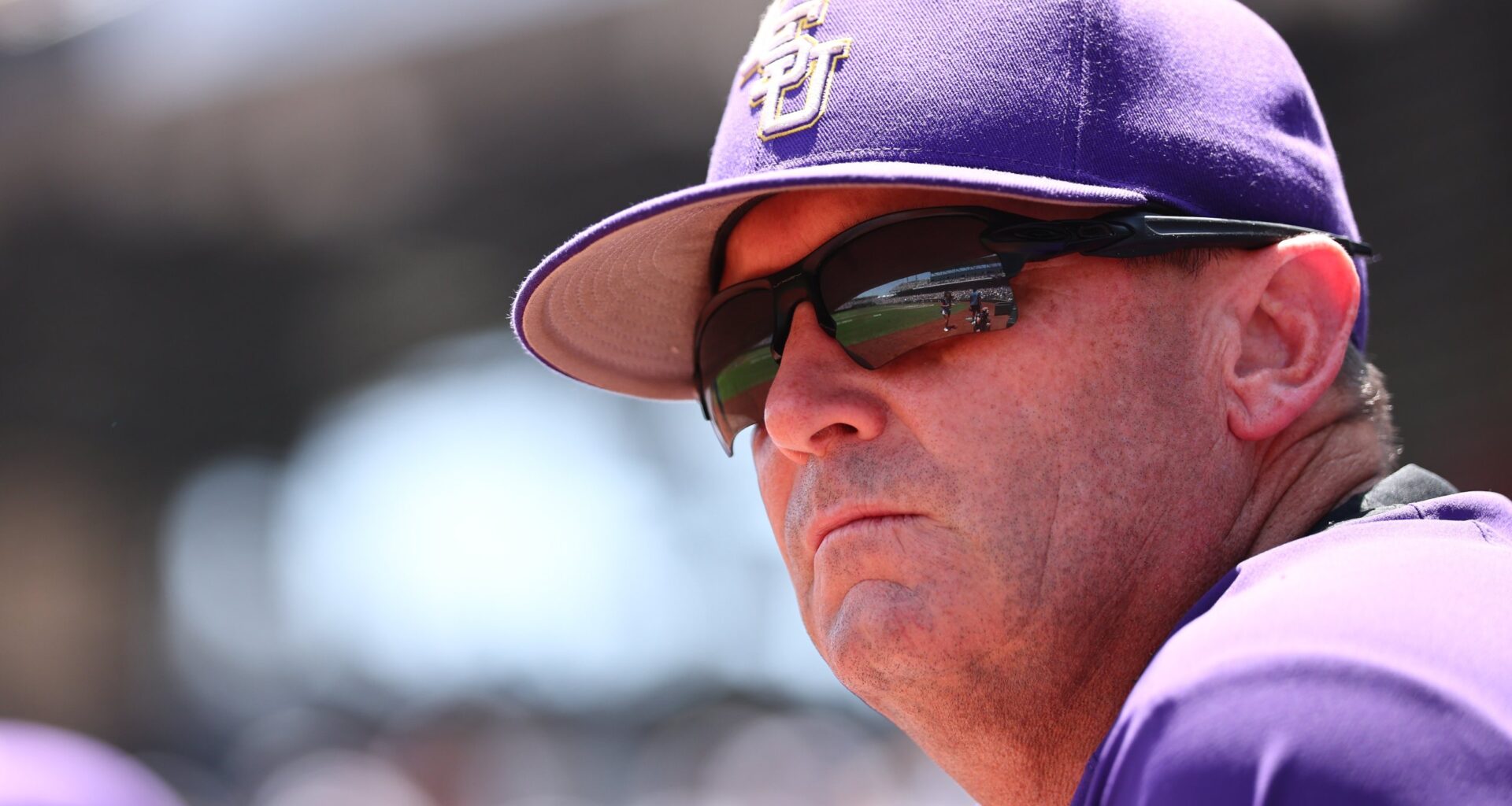
LSU coach Jay Johnson (Photo by Tyler Schenk/Getty Images)
Friday night delivered chaos across the country as NCAA Top 25 teams collided, unbeaten streaks ended and several contenders made early conference statements.
Here are the top storylines from Friday’s action, including a look ahead toward the postseason, injury notes and more.
LSU Keeps Slumping
The frequency illusion, more formally known as the Baader-Meinhof phenomenon, is the moment you notice something once and then suddenly start seeing it everywhere. It’s the experience of spotting a single red car on the road before realizing there are dozens more.
LSU’s struggles have started to feel that way.
The Tigers allowed a 3-5 Northeastern team to score 13 runs in a Monday night loss on March 2, a one-red-car type outing from a staff that had been consistently excellent for more than a year. Then they allowed seven runs to Louisiana the following night and were outscored 11-5 over the final two games of their series against Sacramento State that weekend, dropping a stunning set to close non-conference play.
Those red cars kept driving by because the problems were there all along. The difference now is that LSU’s pitching is showing enough cracks for everyone to notice them.
Friday night at Vanderbilt offered another example. Starter Casan Evans saw his ERA climb to 6.45 after allowing six runs on five hits and five walks over three innings. Relievers Cooper Williams and Gavin Guidry then combined to allow seven runs over 1.2 innings, including a walk-off, two-run home run to Vanderbilt right fielder Logan Johnstone in the ninth.
Vanderbilt trailed No. 13 LSU 12-10 entering the ninth. Brodie Johnston trimmed the deficit to one with a sac-fly to center. Logan Johnstone won it with a two-run shot. The reigning national champs have lost five of their last seven. pic.twitter.com/2u8PfSITg6
— Jacob Rudner (@JacobRudner) March 14, 2026
Through 19 games, LSU’s team ERA sits at 4.79 while just two lineup regulars are hitting over .276. For a program accustomed to dominance, the road suddenly looks a lot more crowded with red cars.
“I think you have to invest in a way that a loss like this is going to hurt really bad when something like that happens,” LSU coach Jay Johnson told media members in attendance in the aftermath of the walk off.
If you’re searching for positives from Friday night, it has to be LSU’s offense. The unit, which has been mired in a group-wide slump, erased a 10-4 deficit and carried a two-run lead into the ninth inning.
Johnson recognized that effort in his postgame remarks, saying he was “proud of our team for the way we fought back.”
But LSU’s pitching was so substandard it ultimately didn’t matter. The Tigers issued 11 free passes against the Commodores, tied for the second-most in a game by a Johnson-coached LSU team.
Johnson remains hopeful that the group will ultimately learn from it.
“I think we’re a much better team now than we were at the beginning of this week,” he said.
No. 16 Ole Miss Ends No. 3 Texas’ Win Streak at 16
Texas entered Friday night as one of just two unbeaten teams left in the country, and for most of the evening it looked like that distinction would survive another challenge. Hosting No. 16 Ole Miss, a veteran club with legitimate power throughout its lineup, the Longhorns carried a 7-3 lead into the ninth inning and stood one out away from extending their perfect start.
Then everything unraveled.
Ole Miss scratched across a run on a grounder to first before Clemson transfer Tristan Bissetta delivered the decisive blow, launching a towering 464-foot go-ahead grand slam with a bat flip that sent the Rebels’ dugout into a frenzy and suddenly flipped the score to 8-7. Texas third baseman Temo Becerra answered in the bottom half with an RBI single to force extras, but it was ultimately Ole Miss that prevailed in the 11th on a bases-loaded walk.
The loss ended Texas’ 16-game winning streak and marked the program’s best start to a season since 2005. It does little to dampen the sky-high expectations surrounding the Longhorns, but it also served as a clear reminder that Ole Miss has the talent to stand toe-to-toe with the nation’s best.
The Georgia Tech Express
The force behind Georgia Tech’s preseason No. 4 ranking was always its immense offensive upside.
With returning stars like Drew Burress, Vahn Lackey, Kent Schmidt, Alex Hernandez, Caleb Daniel and others, the Yellow Jackets entered the spring with one of the nation’s most dangerous collections of bats. Five weeks later, that projection has hardened into reality. Georgia Tech doesn’t just have potential at the plate, it has the best lineup in the country.
A day after opening its top-15 series at No. 12 Clemson with a smothering 10-0 run-rule win, Georgia Tech returned and delivered another emphatic statement, beating the Tigers 9-3 to clinch the series in South Carolina. The victory pushed the Yellow Jackets to 17-2 overall, 4-1 in the ACC and 2-0 against ranked opponents. They’re averaging 13 runs per game and have topped 20 runs three times.
Lackey has been at the center of it all, and his draft stock is rising accordingly. The junior catcher is batting .493 with nine home runs, six doubles, a triple, 31 RBIs and 20 walks against just nine strikeouts. He also played every defensive position in one game and leads Georgia Tech with seven stolen bases.
Any preseason debate over whether Lackey belonged in the first round this July has largely disappeared. The question now is how high a team might be willing to take him. One MLB scouting director told Baseball America he believed the preseason first-team All-American would profile as a first-round talent even as a corner outfielder because of his athleticism and feel for the game.
Lackey’s production has become emblematic of Georgia Tech’s offense as a whole. The Yellow Jackets are relentless, explosive and showing no signs of slowing down.
No. 21 Tennessee Wakes Up On Time
It’s useful to catalog the moments that might eventually weave themselves into the fabric of a team’s season. Friday night in Athens felt like one worth bookmarking for No. 21 Tennessee.
The Volunteers’ offense had sputtered through the previous three weekends, averaging just 3.6 runs per game. So when Tennessee entered the final third of its SEC opener at No. 6 Georgia trailing 4-2, it was fair to wonder whether the Volunteers had enough left to steal it.
Then, suddenly, they did.
Manny Marin tied the game in the sixth with a two-run double. An inning later, Henry Ford launched his seventh home run of the season to push Tennessee in front. By the eighth, the dam had fully broken; Stone Lawless and Marin added a pair of solo shots that closed the door on a 7-4 victory.
One game does not rewrite a season or erase a slump. But in the SEC, where margins are thin and momentum can be fleeting, an opener like this carries real weight.
For first-year head coach Josh Elander, Tennessee’s late surge provided a timely reminder that the Volunteers’ offense might have just been dormant, not incapable.
Arkansas State Opens Sun Belt Play With Top 10 Win
Mike Silva wasted little time establishing a new standard after taking over a struggling Nicholls program in 2022. A year after finishing just above .500 in his debut season, Silva guided the Colonels to their first regional appearance since 1998. In 2024, he became the first coach in program history to lead Nicholls to back-to-back NCAA Tournament appearances.
Now at Arkansas State, Silva appears to have his latest rebuild moving along a familiar trajectory.
The Red Wolves had not recorded a winning season since 2017 when Silva arrived in 2025 and guided them to a 26-28 finish. One year later, Arkansas State already owns a ranked win over Arkansas and opened Sun Belt play Friday with an 8-5 victory over No. 10 Southern Miss.
It is far too early to declare the Red Wolves a postseason team. It is not too early to notice that they look the part of a competitive Sun Belt club.
Second baseman Lane Walton has emerged as one of the nation’s most productive infielders, hitting 10 home runs with seven doubles and three triples across 80 at-bats. Four other Arkansas State hitters already have at least three home runs, giving the lineup a level of depth the program has rarely possessed.
Of the eight Arkansas State pitchers who have logged at least 10 innings this year, only one carries an ERA above 3.00 and four sit below 2.50.
The road through the Sun Belt will not be forgiving. Arkansas State still needs another win this weekend in Hattiesburg to turn Friday’s result into a meaningful series, and looming conference matchups against Coastal Carolina, South Alabama, Louisiana and Texas State will test whether the Red Wolves’ early momentum is sustainable.
But Silva’s track record suggests skepticism is rarely rewarded.
He has built a career turning middling programs into conference contenders. Early signs indicate Arkansas State could be the latest example.
UC Santa Barbara’s Trajectory
There is a lot of protection that comes with being a 40-win team in the Big West.
Since 2018, teams in the league that have reached that threshold have never been left out of the NCAA Tournament regardless of RPI or strength of schedule. Forty wins in the Big West is essentially a golden ticket, much the way winning 13 conference games in the SEC almost always secures a bid.
Will UC Santa Barbara reach 40 wins this year? There is no way to guarantee it on March 13. But do the odds look incredibly favorable for the Gauchos to pull it off? They certainly do.
Everything is clicking for UCSB (14-2; 4-0 Big West) through the first month and change. Andrew Checketts’ ace, righthander Jackson Flora, delivered his best start of the season on Friday against UC Davis with 7.1 shutout innings, 11 strikeouts, one walk and just two hits allowed.
The Gauchos’ pitching staff now owns a 2.36 ERA and does not have a single member with an ERA higher than 3.54. Their offense is averaging 6.6 runs per game, not overwhelming, but more than sufficient for the caliber of pitching the team is running out every weekend.
Perhaps most importantly, UCSB does not appear particularly vulnerable within its own conference. UC Irvine, Santa Barbara’s fiercest rival, sits at 9-9 overall and 1-3 in Big West play. Only Hawaii (10-7; 1-3), Cal Poly (10-7; 4-0) and CSUN (10-7; 2-2) are currently above .500 overall.
That leaves 40 wins looking not just attainable, but increasingly likely for a club led by perhaps the best pitcher in the 2026 draft class.
For now, UC Santa Barbara’s trajectory appears exactly where it wants it.
Odds And Ends
– TCU opened conference play with a hard-fought 5-4 win at Arizona State. The Sun Devils put the tying run 90 feet away with one out in the ninth, but the game ended on an attempted sacrifice fly when TCU left fielder Colton Griffin fired a one-hop strike to the plate to cut down the runner. It remains to be seen how much momentum the Horned Frogs can draw from the victory. They lost star center fielder Chase Brunson, Baseball America’s No. 46 prospect for the 2026 draft entering the season, to an apparent lower leg injury that caused him to grab the back of his ankle and require help leaving the field.
– No. 17 Florida State opened ACC play with authority, bludgeoning No. 18 Wake Forest 10-0. Lefthander Wes Mendes went the run-rule distance with 11 strikeouts and two walks over seven innings, pushing his season total to 41 strikeouts in 28.2 innings.
– USC emerged from Friday night as the nation’s lone undefeated team at 18-0 after a 15-1 run-rule win over Northwestern. Lefthander Mason Edwards struck out 10 over six innings while allowing his first run of the season. Through 30 innings in his draft year, Edwards has allowed just one run while striking out 52 against 11 walks.
– No. 8 Arkansas edged No. 2 Mississippi State in a thriller to claim Game 1 of their series. The ninth inning delivered the drama. Ryder Woodson tied the game for the Bulldogs with a home run before Arkansas answered immediately when TJ Pompey led off the bottom half with a walk-off blast.
– UT Arlington opened its weekend set at No. 24 UTSA with a 15-11 win, marking its third ranked victory in six opportunities this year. The Mavericks are oddly 3-8 against unranked teams.