
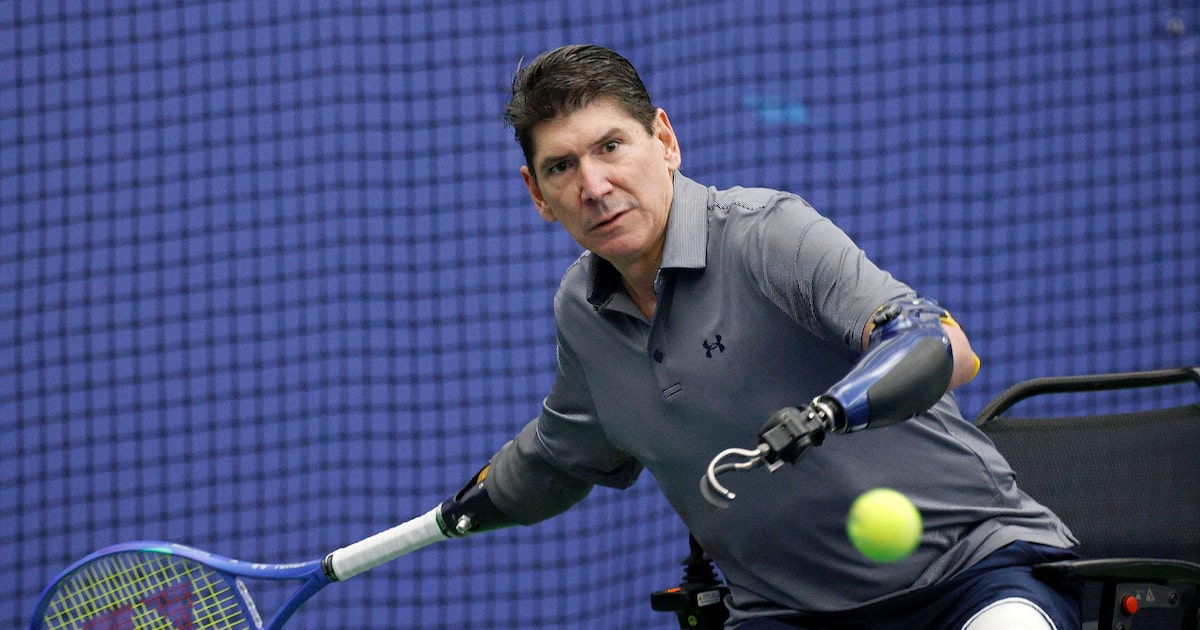
Ron Rosas wasn’t born with a tennis racket in his hand. But from the age of five, when he could first see over the net on a tennis court, he was swinging one like he knew what he was doing. Now, the Dallas man is learning to swing again. This time, without hands and feet.
Rosas grew up in El Paso, where his dad was a dentist and his mother, a school teacher, encouraged the five Rosas children to play tennis. By the time Rosas was in middle school he was one of the top junior tennis players in the country. And after he wrote a letter to Notre Dame tennis coach Bobby Bayliss lobbying for a spot, Rosas’ dream school offered him a four-year scholarship.
Rosas was a standout player at Notre Dame. In 1992, he and teammates such as David DiLucia led the 10th-seeded Fighting Irish to the national championship match.
After graduation, Rosas’ path followed that of many college athletes. He played in a few professional events, trying to make the sport a career; suffered an injury; moved on to coaching; and finally accepted a job outside of athletics altogether – at a bank in Dallas.
Opinion
That’s where he met Victoria – at a Christmas party in Dallas. Both had been married previously. Both had kids.
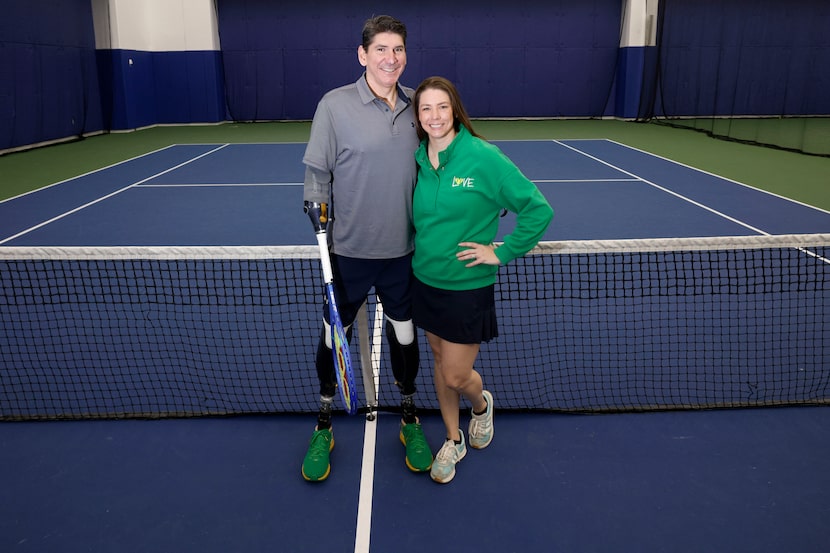
Ron Rosas, a University Park resident and a quadriplegic, poses for a photo with his wife Victoria Rosas before he plays tennis at Dallas Country Club, Sunday, Feb. 22, 2026, in Dallas.
Chitose Suzuki / Staff Photographer
“I remember the first night I met Ron,” recalled Victoria, “It sounds very cliche but our eyes met and that was kind of it. There was a magical kind of connection. It was something I’d never felt before. And we kept that going all through dating and getting married. On our first date he took me ugly Christmas sweater shopping. I quickly realized that he was a great guy and a really good dad. He was thoughtful and caring and a lot of fun.”
Ron and Victoria married and blended their families. Bella, now 22, Gabi, 20, and Preston, 20, were then joined by little sister Vivienne, 8, in University Park. The family began attending Christ the King Catholic Church. And of, course, the kids all learned how to play tennis.
Then on December 29, 2022, the Rosas’ world was suddenly turned upside down.
Devastating Illness
Rosas felt like something was wrong and went to a nearby clinic to be tested. The results were negative for strep, the flu and for Covid. He was sent home.
But he continued to feel worse. Victoria could not get the pulsometer to read when attached to his finger. She called an ambulance.
At Texas Health Presbyterian Hospital, Rosas was diagnosed with a severe case of pneumonia and then was quickly intubated.
Over the next several days, as doctors and nurses fought to save his life at multiple hospitals, his condition continued to decline. The infection in his lungs spread to his blood and led to septic shock. He was put in an induced coma. A priest administered last rites.
In critical care, Rosas was given Vasopressors that raised his blood pressure and forced blood to his vital organs, according to a doctor’s message the family shared with me. The process ultimately saved his life, the family said, but it led to severe necrosis to his extremities.
When he awoke, after being in a coma for 16 days, he was given the shocking news that nobody, especially an athlete, wants to hear. Both arms and both legs would have to be amputated.
Dauntless Spirit
The Rosases chose Dr. Jason Souza at Ohio State University Wexner Medical Center, who specializes in reconstructive surgery, particularly for amputees, and has extensive experience in limb restoration and nerve repair.
Rosas had two requests: He wanted a quality of life without constant pain, and he wanted to play tennis.
The key to holding a tennis racket again was to save Rosas’ elbow, to amputate his arm below the joint. With some borrowed parts and skin from Rosas’ back, Souza successfully reconstructed his elbow. In fact, all four limbs were removed below the joint. A team of specialists in Dallas provided four prosthetics.
Rosas remembered the first time he gripped a racket using a prosthetic arm. “It was surreal.”
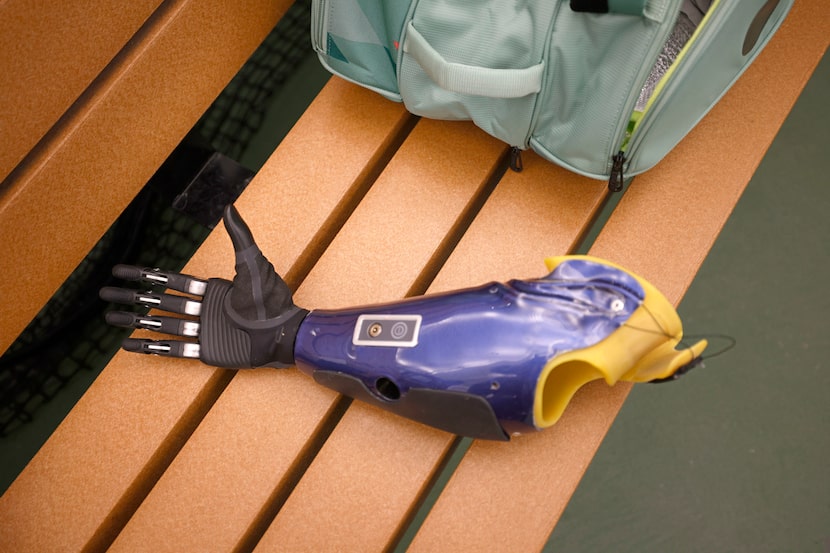
A prosthetic hand that belongs Ron Rosas, a University Park resident and a quadriplegic, is seen on the bench at Dallas Country Club, Sunday, Feb. 22, 2026, in Dallas. Rosas used another special prosthetic hand to play tennis.
Chitose Suzuki / Staff Photographer
Rosas doesn’t just want to play tennis again. He wants to compete. The International Tennis Federation has a wheelchair division. Rosas is eligible to compete in the quadriplegic division, open to tennis players who have lost 25% or more of their limbs. Rosas is swinging for a championship. He would be the first. To date, a quadriplegic has never won the wheelchair division.
Rosas’ courage and determination are already inspirations for people throughout the nation who have heard about or seen his story. There will likely be many more because Rosas’ story is set to become a documentary film.
Second Serve
Sixteen years ago an able-bodied Ron Rosas was giving tennis lessons at the Dallas Country Club to a Dallas film maker named Rocky Powell. The two established a friendship that has continued through today.
After Rosas’ illness, Rocky and his son Dillon set about to tell Rosas’ inspirational story as a 90-minute feature documentary. The project is in its early stages, but they have already produced a teaser. The film’s title: Second Serve.
“We were inspired to create this film after witnessing Ron’s resilient human spirit firsthand,” Dillon said. “It truly moves you beyond words.”
Rosas is using his story to serve in other ways, as well. He has counseled several recent amputees on what to expect and how to best deal with the changes. His insights have been helpful and his example has been motivational.
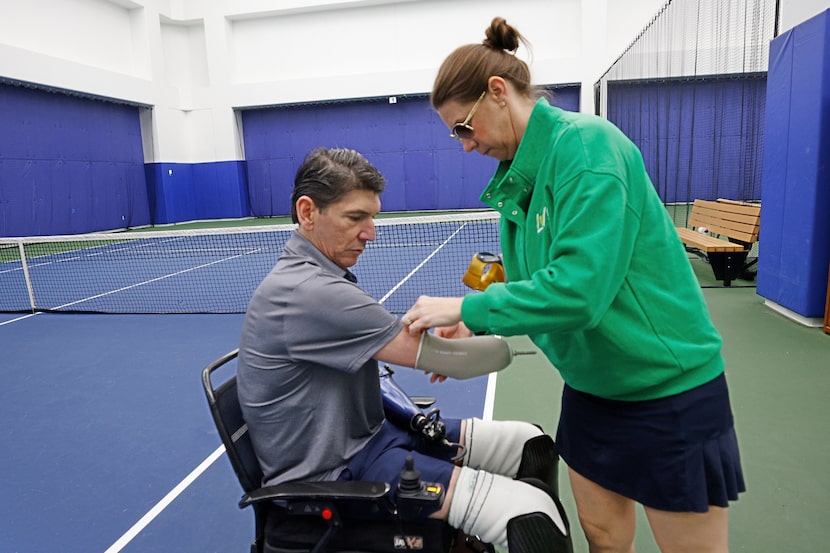
Victoria Rosas helps her husband Ron Rosas, a University Park resident and a quadriplegic, wears a prosthetic hand before he plays tennis at Dallas Country Club, Sunday, Feb. 22, 2026, in Dallas.
Chitose Suzuki / Staff Photographer
I asked Rosas the obvious question: how he keeps going.
“The biggest thing would be the support of friends and family,” Rosas said. “I’ve got support from friends in our neighborhood and friends from the Dallas Country Club, Christ the King Catholic Church, Notre Dame and others. My secret weapon is Victoria. Plus having the right medical, psychological and prosthetic teams is important. For me, I am a part of our children’s lives and that helps me stay motivated.”
Ron Rosas may be the most inspiring story in Dallas. After a devastating loss, he feels like he has life to live, tennis to play, a family to love and a future to embrace.
Kirk Dooley is the author of 10 books and is the founding editor of Park Cities People.