
Texas football coach Steve Sarkisian is due over $11 million in 2026. Mike Elko, his counterpart at Texas A&M, agreed to a contract extension in November that is set to pay him $10.75 million this year.

Together, Texas and Texas A&M athletics employed 15 people who earned over $1 million in 2025, documents obtained by the American-Statesman show. The two titanic athletic departments also employed 122 workers who made $51,000 or less.
Article continues below this ad
Texas Longhorns outfielder Aiden Robbins (43) puts his “horns up” around the bases after a home run in the eighth inning as the Longhorns take on the Michigan State Spartans in the second game of a three-game series at UFCU Disch-Falk Field in Austin, Feb. 21, 2026.
Sara Diggins/Austin American-Statesman
Texas Longhorns outfielder Aiden Robbins (43) celebrates his home run in the eighth inning as the Longhorns take on the Michigan State Spartans in the second game of a three-game series at UFCU Disch-Falk Field in Austin, Feb. 21, 2026.
Sara Diggins/Austin American-Statesman
Texas Longhorns infielder Jayden Duplantier (0) runs home to score, putting the Longhorns in the lead in the seventh inning of the their 3-1 win over the Michigan State Spartans in the second game of a three-game series at UFCU Disch-Falk Field in Austin, Feb. 21, 2026.
Sara Diggins/Austin American-Statesman
Texas Longhorns head coach Jim Schlossnagle sings “The Eyes of Texas” after the Longhorns 3-1 win over the Michigan State Spartans in the second game of a three-game series at UFCU Disch-Falk Field in Austin, Feb. 21, 2026.
Sara Diggins/Austin American-Statesman
The Texas Longhorns put their “Horns Up” after their 3-1 win over the Michigan State Spartans in the second game of a three-game series at UFCU Disch-Falk Field in Austin, Feb. 21, 2026.
Sara Diggins/Austin American-Statesman
Texas Longhorns infielder Jayden Duplantier (0) runs home to score, putting the Longhorns in the lead in the seventh inning of the their 3-1 win over the Michigan State Spartans in the second game of a three-game series at UFCU Disch-Falk Field in Austin, Feb. 21, 2026.
Sara Diggins/Austin American-Statesman
Michigan State Spartans pitcher Carter Monke (7) pitches in the seventh inning as the Longhorns take on the Michigan State Spartans in the second game of a three-game series at UFCU Disch-Falk Field in Austin, Feb. 21, 2026.
Sara Diggins/Austin American-Statesman
Texas Longhorns outfielder Anthony Pack Jr. (6) makes it to third base in the seventh inning as the Longhorns take on the Michigan State Spartans in the second game of a three-game series at UFCU Disch-Falk Field in Austin, Feb. 21, 2026.
Sara Diggins/Austin American-Statesman
Texas Longhorns outfielder Jonah Williams (9) gets ready to bat in the eighth inning as the Longhorns take on the Michigan State Spartans in the second game of a three-game series at UFCU Disch-Falk Field in Austin, Feb. 21, 2026.
Sara Diggins/Austin American-Statesman
Texas Longhorns infielder Jayden Duplantier (0) runs home to score, putting the Longhorns in the lead in the seventh inning of the their 3-1 win over the Michigan State Spartans in the second game of a three-game series at UFCU Disch-Falk Field in Austin, Feb. 21, 2026.
Sara Diggins/Austin American-Statesman
Texas Longhorns infielder Jayden Duplantier (0) slides back to second base in the seventh inning as the Longhorns take on the Michigan State Spartans in the second game of a three-game series at UFCU Disch-Falk Field in Austin, Feb. 21, 2026.
Sara Diggins/Austin American-Statesman
Texas Longhorns infielder Temo Becerra (1) throws to first base in the eighth inning as the Longhorns take on the Michigan State Spartans in the second game of a three-game series at UFCU Disch-Falk Field in Austin, Feb. 21, 2026.
Sara Diggins/Austin American-Statesman
Texas Longhorns outfielder Anthony Pack Jr. (6) avoids a collision with Michigan State Spartans infielder CJ Deckinga (13) as he runs from second to third base in the seventh inning as the Longhorns take on the Michigan State Spartans in the second game of a three-game series at UFCU Disch-Falk Field in Austin, Feb. 21, 2026.
Sara Diggins/Austin American-Statesman
Texas Longhorns pitcher Max Grubbs (38) pitches in the eighth inning as the Longhorns take on the Michigan State Spartans in the second game of a three-game series at UFCU Disch-Falk Field in Austin, Feb. 21, 2026.
Sara Diggins/Austin American-Statesman
Texas Longhorns infielders Temo Becerra (1) and Ethan Mendoza (5) jog in to the dugout after keeping Michigan State scoreless to maintain a one point lead in the eighth inning as the Longhorns take on the Michigan State Spartans in the second game of a three-game series at UFCU Disch-Falk Field in Austin, Feb. 21, 2026.
Sara Diggins/Austin American-Statesman
Texas Longhorns outfielder Aiden Robbins (43) catches a ball in the outfield in the eighth inning as the Longhorns take on the Michigan State Spartans in the second game of a three-game series at UFCU Disch-Falk Field in Austin, Feb. 21, 2026.
Sara Diggins/Austin American-Statesman
Texas Longhorns pitcher Thomas Burns (45) pitches in the ninth inning as the Longhorns take on the Michigan State Spartans in the second game of a three-game series at UFCU Disch-Falk Field in Austin, Feb. 21, 2026.
Sara Diggins/Austin American-Statesman
Texas Longhorns pitcher Thomas Burns (45) pitches in the ninth inning as the Longhorns take on the Michigan State Spartans in the second game of a three-game series at UFCU Disch-Falk Field in Austin, Feb. 21, 2026.
Sara Diggins/Austin American-Statesman
Texas Longhorns pitcher Thomas Burns (45) celebrates after pitching in the ninth inning as the Longhorns take on the Michigan State Spartans in the second game of a three-game series at UFCU Disch-Falk Field in Austin, Feb. 21, 2026.
Sara Diggins/Austin American-Statesman
Teammates embrace Texas Longhorns outfielder Aiden Robbins (43) after the Longhorns 3-1 win over the Michigan State Spartans in the second game of a three-game series at UFCU Disch-Falk Field in Austin, Feb. 21, 2026. Robbins hit a home run in the eighth inning to extend the Longhorns’ lead to two points.
Sara Diggins/Austin American-Statesman
Texas Longhorns pitcher Thomas Burns (45) and catcher Carson Tinney (8) embrace after the Longhorns 3-1 win over the Michigan State Spartans in the second game of a three-game series at UFCU Disch-Falk Field in Austin, Feb. 21, 2026.
Sara Diggins/Austin American-Statesman
Texas Longhorns outfielder Aiden Robbins (43) smiles after the Longhorns 3-1 win over the Michigan State Spartans in the second game of a three-game series at UFCU Disch-Falk Field in Austin, Feb. 21, 2026. Robbins hit a home run in the eighth inning to extend the Longhorns’ lead to two points.
Sara Diggins/Austin American-Statesman
Texas Longhorns head coach Jim Schlossnagle welcomes outfielder Aiden Robbins (43) back to the dugout after his home run in the eighth inning as the Longhorns take on the Michigan State Spartans in the second game of a three-game series at UFCU Disch-Falk Field in Austin, Feb. 21, 2026.
Sara Diggins/Austin American-Statesman
Nationally, the college sports industry is booming. The Aggies brought in $235.5 million as an athletic department in the 2025 fiscal year — their third-highest total under the current reporting system instituted in 2005. The Longhorns, receiving reduced SEC media revenue as part of a one-year financial haircut they agreed to take upon joining the conference, still raked in $353 million.
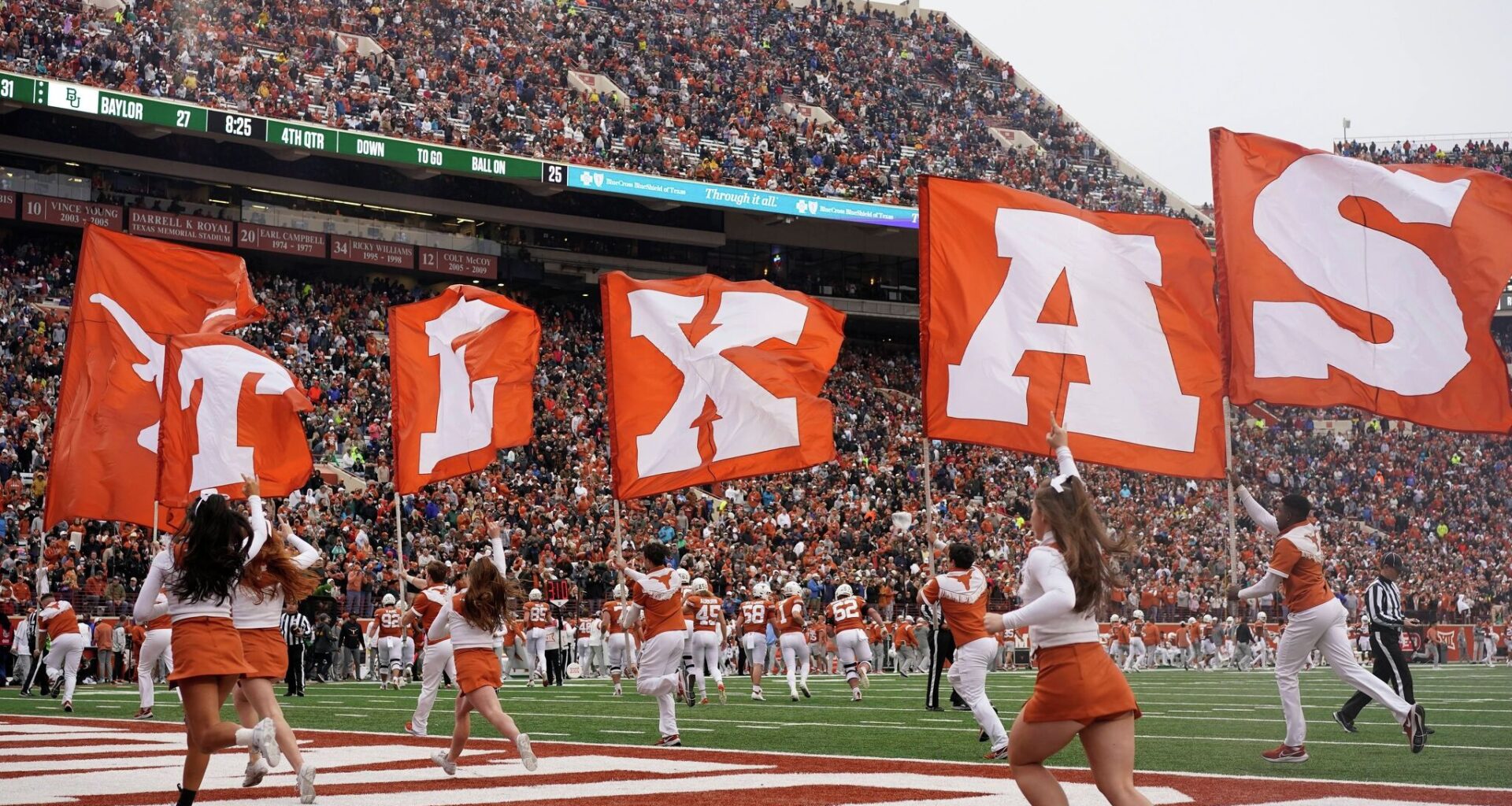
Members of the Texas Longhorns spirit squad carry flags across the field after a touchdown against Baylor at Royal-Memorial Stadium this past season.
Scott Wachter/USA Today
Roughly 3.4% of that combined income went toward compensating the bottom 50% of the Longhorns’ and Aggies’ payroll.
Article continues below this ad
“It’s a lot different pay scale outside of college athletics and any other industry,” said Kyle Stafford, who recently left his public relations job at Texas A&M for a similar role at NASCAR. “…PR roles in any corporate setting, or really just in general, any other setting, any other company, any other business, are generally more well paid.”
These vial, but behind-the-scenes employees — many of whom are college-educated — are sometimes asked to work long hours for wages that, in Austin, fall almost 20% short of local averages.
This is the reality for support staffers in athletic departments across Texas. And recent shifts in the college sports ecosystem have created questions about the long-term employment viability for support staff members who help ensure their athletic departments run smoothly.
Article continues below this ad
Changes put athletic departments under pressure
Ambitious, top-level athletic departments like Texas and Texas A&M are sharing around $20 million in revenue with their athletes as a result of the 2024 House v. NCAA settlement. The same legal outcome also offered schools the chance to fund more athletic scholarships. At Texas, that will require further investment of around $10 million each year, according to athletic director Chris Del Conte.
Jason Yaman, the executive director of College Sports Communicators, said the impact of that financial crunch is still pending among college sports’ Everyday Joes. The CSC represents the interests of communications employees, typically referred to as “sports information directors,” who work in athletic departments. These college-educated professionals often find themselves in the bottom half of athletic department payrolls in Texas.
Tasked with writing news releases, organizing team events and promoting student-athletes, SIDs usually work night and weekend shifts. Their job rejects the five-day work week, often requiring them to devote well over 40 hours per week to their responsibilities.
Article continues below this ad
MORE: Texas baseball coach Jim Schlossnagle reaches 1,000 wins. Here’s what it took to get there
In a 2025 CSC survey, 38.2% of members said they don’t feel they earn enough compensation to meet their needs when factoring in the financial realities of the geographic area where they work. Another 11.8% felt ambiguous toward the question.
“So many of the conversations that I hear, primarily amongst athletic directors and conference commissioners, are related to revenue, and how they’re continuing to drive revenue and squeeze every dollar they can, largely to fund the rev share,” Yaman told the Statesman.
In the same survey, less than 15% of those polled said they would recommend a career in college athletics.
Article continues below this ad
“I loved working in the college sports industry,” Stafford said. “The people are great, the time and the memories that you make, they’re priceless. But I just wanted to have more time to spend with family. The schedule is tough on people.”
Yaman is deriving that conclusion from discussions with administrators around the nation. So, what’s the future outlook of these jobs in modern college athletics?
“The impact on communicators, and again, support staff in general, I think it’s still evolving,” Yaman said.
How Texas universities compensate their rank-and-file workers
More locally, data in Texas indicates athletic departments generally haven’t provided their employees with pay rises to offset the inflation rate, which sits at roughly 23% from January 2020 to January 2025, according to the U.S. Bureau of Labor Statistics.
Article continues below this ad
The Longhorns, quantitatively, pay their everyday employees the best among the 15 Texas universities researched for this story. But their compensation compares less favorably when contextualized by community income. According to the most recent census data, the average non-family household income for Austin is $70,193.
The graph shows how 15 different institutions in Texas compensate the bottom 15% of their payroll.
Sara Diggins
The bottom faction of Texas athletics’ workforce in 2025, earned an average of about $57,000. That number is up from about $45,000 six years ago.
“We had a lot of workers making $35,000, and we had a big push to get them to $50,000,” Del Conte told the Statesman earlier this month. “To be at $57,000, we’re making progress. We looked at that. But that was such a hard climb, because we were (paying) industry standard, not Austin standard.”
Article continues below this ad
Despite that jump, the Longhorns remain one of four schools surveyed that don’t compensate their low-level employees to that community standard alongside UTSA, UT-Arlington and North Texas.
Del Conte told the Statesman that the athletic department is back to dishing out annual merit-based raises in 2026. Texas declined to distribute those raises twice in the last six years — once because of the COVID-19 pandemic, and once because of the short-term financial losses resulting from the institution’s move to the SEC.
Even with the gap in pay relative to local standards, Del Conte said Texas often receives between 500 and 1,000 applicants when it lists a job opening.
“There’s a lot of kids that are going to (Austin Community College) where they’re getting an apprenticeship, and they’re working here because they want to be in Texas Athletics,” Del Conte said. “We’re very fortunate that way, but I do think it’s an ever-changing model.”
Article continues below this ad
Since 2020, only three of the 15 public Texas universities surveyed by the Statesman escalated pay for the bottom half of their payroll at a rate that matched or exceeded inflation: Texas, Tarleton State and East Texas A&M. The Aggies, who fell shy of inflation rates by paying their bottom-half employees roughly 20% more in 2025 compared to 2020, did not respond to multiple interview requests from the Statesman for this story.
But Texas A&M employees benefit from geography.
Predictably, data shows it’s easier for schools located in smaller Texas cities — often college towns, where students can factor more heavily into the Census’ income data — to compensate their employees at a rate that compares favorably with their neighbors. For example, the median household income in College Station is $50,523. The average bottom-half Texas A&M employee earns over $54,000 annually. The Aggies, Stephen F. Austin and East Texas A&M are the only three schools of the 15 sampled where low-level employees take in more than the median household income. Not coincidentally, those universities are located in three of the five least-expensive towns among the 15 considered for this story.
The graph shows how salaries for rank-and-file workers at Texas and Texas A&M match up with community cost-of-living standards.
Sara Diggins
MORE: Where UT athletics stands in early 2026
Article continues below this ad
Inside workforce changes at Texas schools small and large
The data obtained by the Statesman also reflects substantial changes in workforce size.
The Longhorns employed more people in 2025 than any of the 15 institutions surveyed by the Statesman by some distance. But Texas is also the only athletic department that trimmed its overall head count from 2020 to 2025.
The Texas payroll included 430 people in 2020, while that number dropped to 419 in 2025. Houston and Texas A&M, comparatively, increased their department head counts by 25 and 26 employees over that span, respectively.
Article continues below this ad
Del Conte attributed some of Texas’ staff cuts to his efforts to restructure the athletic department. When he arrived in 2018, the Longhorns were the only school in the country with a women’s athletic director and a men’s athletic director. The two departments, Del Conte said, were “completely different, separate athletic programs. Separate employees. Separate everything.”
“When I got here…we got to work through some efficiency,” Del Conte said. “That’s really what transpired. And then you had COVID. The unintentional consequence of COVID allowed us to really dive into how we’re organizationally structured, moving into a one-unit system. There was nothing nefarious about it. This is just what happened.”
Some smaller schools are experiencing more substantial growth when it comes to sheer numbers. UT Rio Grande Valley fielded a 59-person payroll in 2020. In 2025, the Vaqueros paid 100 employees. That change, according to athletic director Chasse Conque, was driven by the university’s decision to add football as a varsity sport. The Vaqueros debuted on the gridiron in 2025. They’ll be sharing revenue with their athletes under the terms of the House settlement, but nowhere close to the $20.5 million cap. And those efforts are entirely donor-funded, Conque said, helping UTRGV retain its staff.
“In a day where there’s a lot of really difficult decisions that are having to be made, we’ve been really fortunate to grow,” Conque told the Statesman in February. “You go back to 2021, that’s when our students voted to pass and to support the student referendum for football, swimming and diving, marching band, our spirit squads. Since then, there’s been just this tremendous awakening here in the Rio Grande Valley.”
Article continues below this ad
North Texas, Tarleton State, Sam Houston and Texas State each also added at least 30 athletic department employees over the same span. Like UTRGV, all of those institutions recently undertook dramatic changes to their athletic department.
North Texas jumped from Conference USA to the American Athletic Conference in 2023. Sam Houston joined Conference USA in the same year, elevating its football program from the FCS level to FBS. Tarleton State finalized its reclassification from Division II to Division I in 2024. Texas State announced its intent to move from the Sun Belt to the Pac-12 in 2025.
College sports are constantly changing. And managing payroll is part of how institutions react to those changes. Unless the landscape shifts unexpectedly again, Del Conte said he doesn’t anticipate making further staff cuts.
Article continues below this ad
“Because of where we’re at, and if we can maintain success, we can do a lot of things,” Del Conte said. “You don’t ever know when another COVID’s going to come. You never know when there’s going to be a recession, all kinds of things. There’s unknowns. But if it’s status quo like it is now, we’re in good shape.”