
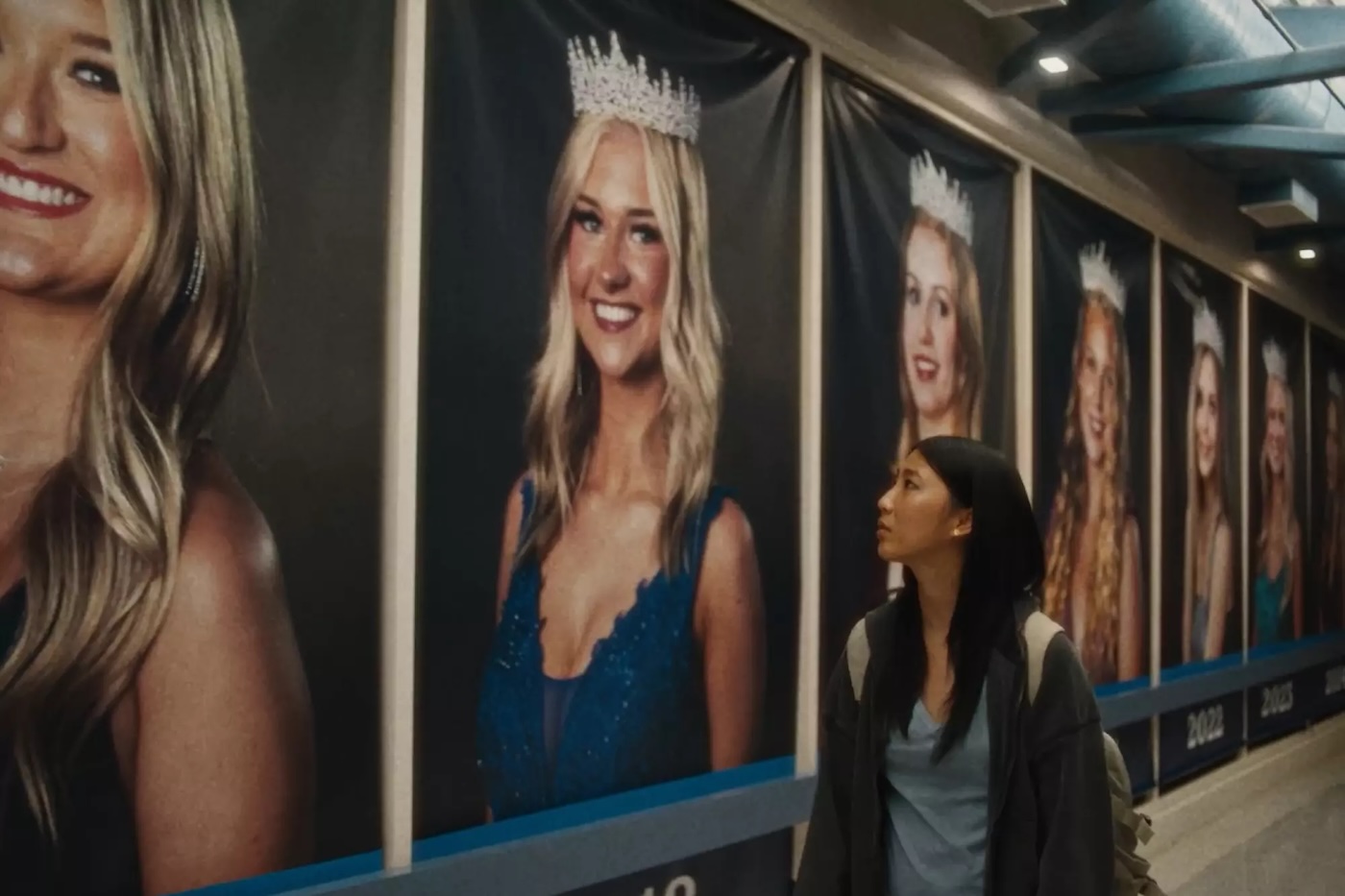
Amy Wang’s satirical body-horror film “Slanted” brings new meaning to the term “ethnic cleansing.” Here, it’s not the violent forced removal of an entire race, but the voluntary medical procedure to turn any ethnicity into a white person. Now add the pressures of high school, and you get “Mean Girls” meets “The Substance.” Shirley Chen (“DÌDI”) plays Joan Huang, a Chinese-American teenager who dreams of being crowned prom queen at her Georgia high school. Past winners are idolized with huge portraits—all of them, blonde hair, blue eyes, perfect teeth—none of them resemble Joan. Faster than you can say “Face Off,” Joan visits the mysterious Ethnos med spa where she’s transformed into, well, Mckenna Grace (“Regretting You”). As Castor Troy would say, “It’s like looking in a mirror, only not.”
When we first meet Joan, she’s eight years old (played by Kristen Cui), a passenger in her father Roger’s (Fang Du) car. Joan’s piercing eyes are absorbing the surroundings as they drive through the suburbs. She notices the people, an American flag, and a billboard of two bikini-clad blonde-haired women endorsing All-American Burgers. She doesn’t speak, but Joan’s intent gaze is easy to decipher. They don’t look like her. “Everyone is going to love you,” Dad says before dropping Joan off at her new school, Owen Valley Elementary, on day one. The family recently moved from China to the small Georgia town.
The cards are stacked against Joan from the start. “This is Joan Huang. She came aallll the way from China,” the teacher tells the class. As the class begins to recite the Pledge of Allegiance, the teacher tells Joan, “You can just listen for now.” Then one of the boys sticks out his tongue while making a slant-eyed gesture at Joan. At lunch, she notices all the girls at her table eating sandwiches while she opens her bento box with chicken and rice. The girls pinch their noses, implying it stinks.
Joan and her stern mother, Sofia (Vivian Wu), stop by the local high school where Roger works as a janitor. While visiting her father, Joan witnesses the prom queen being crowned. As people applaud and cheer, we notice a twinkle in little Joan’s eye. A goal has been set.
Fast-forward about a decade: Joan (Chen), now a teenager, sits in her bedroom, watching a makeup tutorial on her laptop. Collages of models adorn the walls and posters of Sabrina Carpenter and Taylor Swift. When Joan discovers that the most popular girl in school, Olivia (Amelie Zilber), won’t be running for prom queen because of a minor acting gig, Joan sees it as her shot to win the contest. Her best friend, Brindha (Maitreyi Ramakrishnan), tells Joan it’s a waste of time and that she doesn’t need it.
Olivia is the Regina George of the story, complete with her own version of The Plastics. She announces that since she’s not running for prom queen, she will endorse another girl. Joan dyes her hair blonde, which draws some attention from Olivia, but not enough to earn her endorsement.
A mysterious text hits Joan’s phone from a company called Ethnos, Inc. She thinks it’s a beauty salon, offering to remove the black roots showing after her dye job. She pays them a visit and discovers the company offers “ethnic modification.” Translated: they transform Black, Brown, and Asian people into a white person using an experimental, irreversible cosmetic procedure. We don’t know how it’s done since the film doesn’t show us the procedure. All we know is that Joan steps in looking like Shirley Chen, and she steps out looking like Mckenna Grace, blonde hair, blue eyes, perfect smile.
Of course, Joan’s parents freak out. At first, they don’t believe this white girl is their daughter. Details only Joan would know would finally convince them. Themes of internalized racism emerge as Joan explains that she wasn’t ashamed of her culture; she just wanted an easier life without bias.
Nobody seems to question what happened to Joan when she never showed up at high school again. When she comes back as a white girl, she goes by the name Jo Hunt. Of course, Olivia and the popular crowd welcome Jo. She becomes popular and one step closer to making her dream of being prom queen come true. But at what cost?
“Slanted” doesn’t have the edge of “The Substance,” and I wouldn’t call it a horror film. It’s also not a comedy like “Mean Girls,” but there are a few funny moments, including a ridiculous song called “It’s Good to Be White!” In fact, the premise of the film sounds like a bad, but well-intended, ABC Afterschool Special. It’s not. I was drawn into the story and never disengaged, thanks in part to the exceptional performances.
This is Amy Wang’s feature directorial debut. She also wrote the film. Inspired by acts of violence against Asians in Atlanta and New York City, which offered a fresh perspective on America to the Chinese-Australian filmmaker, she started contemplating what life would be like as a white person. Drawing from films like “The Farewell” and “Minari,” the familial element in “Slanted,” combined with various genres, doesn’t always transition smoothly, but it works much better than expected. Everything comes with a price. Wang does a solid job of illustrating the costs of Joan’s actions and the pressure of wanting to ‘fit in.’
(3 stars)
Now showing in theaters
This <a target=”_blank” href=”https://fortworthreport.org/2026/03/14/slanted-review-amy-wangs-feature-directorial-debut-about-race-and-identity-is-like-a-teenage-version-of-the-substance/”>article</a> first appeared on <a target=”_blank” href=”https://fortworthreport.org”>Fort Worth Report</a> and is republished here under a <a target=”_blank” href=”https://creativecommons.org/licenses/by-nd/4.0/”>Creative Commons Attribution-NoDerivatives 4.0 International License</a>.<img src=”https://i0.wp.com/fortworthreport.org/wp-content/uploads/2021/04/cropped-favicon.png?resize=150%2C150&quality=80&ssl=1″ style=”width:1em;height:1em;margin-left:10px;”>
<img id=”republication-tracker-tool-source” src=”https://fortworthreport.org/?republication-pixel=true&post=447277&ga4=2820184429″ style=”width:1px;height:1px;”><script> PARSELY = { autotrack: false, onload: function() { PARSELY.beacon.trackPageView({ url: “https://fortworthreport.org/2026/03/14/slanted-review-amy-wangs-feature-directorial-debut-about-race-and-identity-is-like-a-teenage-version-of-the-substance/”, urlref: window.location.href }); } } </script> <script id=”parsely-cfg” src=”//cdn.parsely.com/keys/fortworthreport.org/p.js”></script>