
HOUSTON, Texas (KTRK) — Towering skyscrapers might seem small in comparison to the larger-than-life history that sits just beneath them on the edge of downtown Houston.
In fact, in those shadows sits the city’s oldest cemetery and the resting place of Houston’s founding fathers, the New York – born Allen brothers, Augustus Chapman and John Kirby.
Just steps away from there, you can follow the road to Freedmen’s Town.
“This is where Blacks settle after Emancipation. Now, people did move out to the Third and Fifth Wards, but this is were people settled at first. A lot of people moved here and made an impact,” said Debra Blacklock-Sloan, Lead Docent for Freedmen’s Town Museums and Education Liaison.
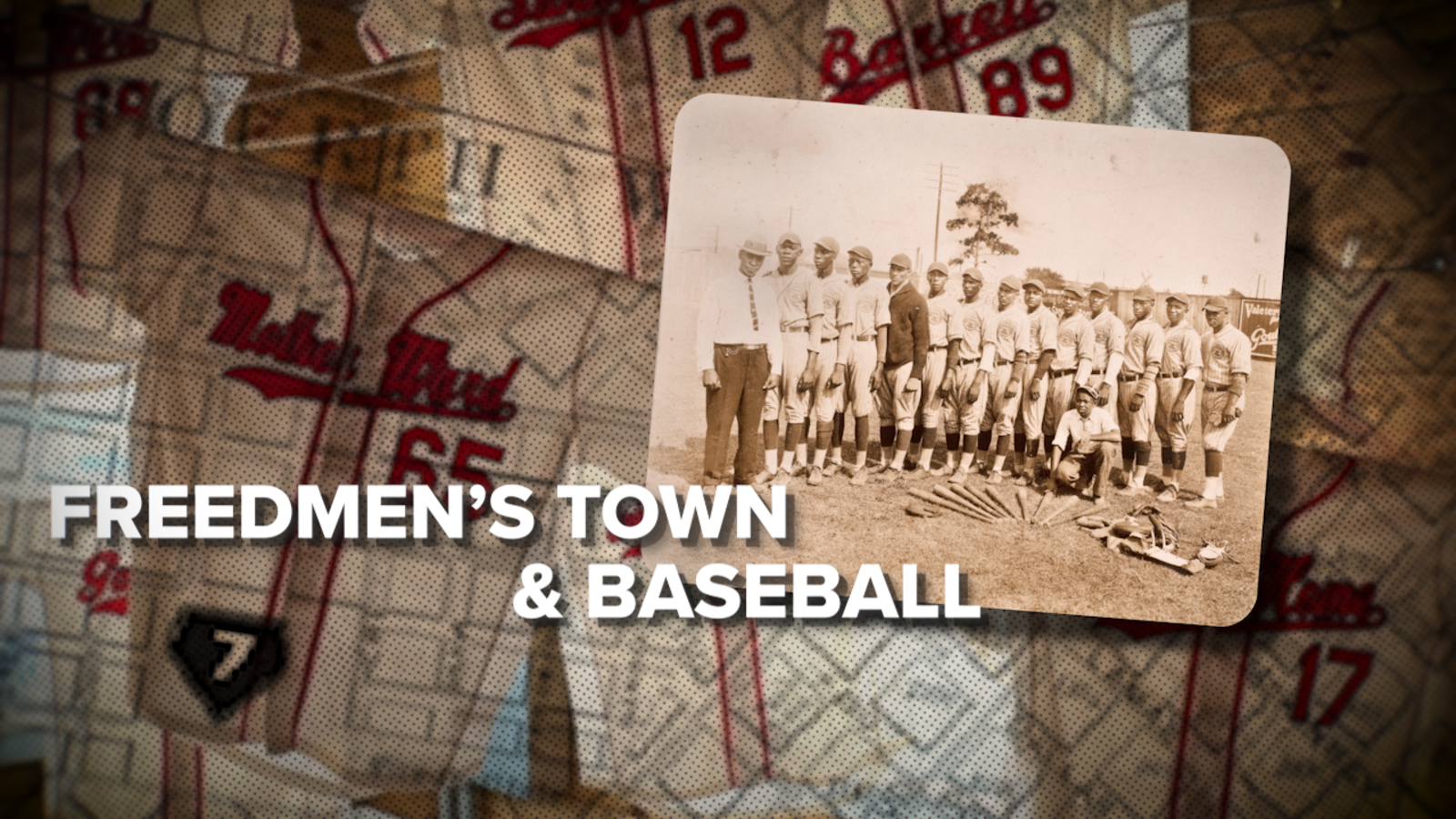
The Freedmen’s Town area of Fourth Ward is known for its iconic brick-paved streets, the Gregory School and institutions like Antioch Missionary Baptist Church. But a man now featured on the Major League Baseball website has a claim to fame there, too.
Hit play above to watch Part One of this two-part series on Houston baseball and Freedmen’s Town’s history
The Freedmen’s Town area of Fourth Ward is known for its iconic brick-paved streets, the Gregory School — now the African American Library at the Gregory School — and institutions like Antioch Missionary Baptist Church.
But a lesser-known Houstonian who was no less important also called Freedmen’s Town home — baseball player Leroy Grant.
He was without a doubt the first successful Black or white baseball player out of Houston to really reach national fame.
Mike Vance on first baseman Leroy Grant
“Home Run Grant”
According to research and Census records shared with ABC13, Grant was born in Freedmen’s Town on April 15, 1889.
“He would have lived on Saulnier Street, which is three blocks over, right across the street from the Jewish cemetery,” Blacklock-Sloan noted.
At the intersection of Saulnier and Wilson, no signs exist now of the house Grant would have shared with family, but the 1910 Census shows another connection.
“In 1910, Leroy Grant said he’s a professional baseball player, so that tells you right there he’s getting paid and very proud of it,” said author and baseball historian Mike Vance. “He’s really a fascinating guy in the time period that he transcends.”
We don’t want people to forget this important space.
Debra Blacklock-Sloan said of Freedmen’s Town
Recruited by powerhouse pitcher, manager, and fellow Texan Andrew “Rube” Foster, Grant left Houston in 1911 and would go on to play primarily in the Negro National League — first for Foster’s Chicago American Giants.
“The challenges that they face is part of the reason that Foster formed the Negro National League in 1920 in the first place. So, Leroy Grant was there. He’s learning to be a better baseball player,” Vance said.
“We have to realize the Negro League teams had the best non-white ballplayers, and that’s why the teams are so strong,” added Larry Lester, an author, historian, film and museum consultant.
Lester co-founded the Negro Leagues Baseball Museum in Kansas City, Missouri.
“Their roster was only 15 or 16 ballplayers, where white Major League teams had 25 players. So you had to be really good to play on a Black team,” Lester continued. “Everybody played. There was nobody sitting on the bench.”
“People try to downgrade it, saying, ‘Well, they were not equal.’ But my research has shown that the Negro League teams ordered their bats from the Louisville Slugger factory. They ordered their uniforms and their gloves from Wilson and Spalding. They played under the same rules. Bases are 90 feet apart. You know, 27 outs, nine men on each side. The only difference was the pigmentation of their skin,” Lester said.
Grant, meanwhile, was at times a highly-debated player.
“There are contemporaries of his that say he was the best Black first baseman of his era. Newspapers didn’t always like him,” Vance said, adding that the African American newspaper, “The Chicago Defender,” wasn’t always a fan. “Leroy was playing primarily in Chicago for most of his career. And the Defender sometimes praised him. And then they went through probably about a year where they just raked him over the coals and blamed him for losses, said he was a bad baserunner, and some of the later historians of baseball picked up on that.”
Vance explained that while Grant’s batting average was not the best, his defense was exceptional most of the time.
He even earned a nickname, albeit with a caveat.
“Today, we expect when somebody is branded as a home run hitter, you’re expecting a lot of them. He got the name “Home Run Grant” based on one home run that he hit in a game against, I think it was the University of Oregon. So not much of a power hitter by today’s standards, but a big guy by the standards of the day,” Vance said.
The fight for Freedmen’s Town
Grant was a big guy that sometimes got into big trouble.
The first baseman could be temperamental and moody, attributes that may have contributed to the tragic end of his life.
Before he left for Chicago, Grant stabbed a man on what is now West Dallas in Houston.
After he left Texas, he later spent time in jail after killing another man over a woman.
Still, Grant would go on to become the manager of a semi-pro team in Indiana, using skills he picked up playing prison baseball.
“Which was a big thing,” Vance said. “And unfortunately for him, it was in and out of jail for several years, and they finally committed him to what at the time they call the Indiana hospital for the criminally insane.”
“A little bit about medical quality at the time figures into this as well. They ultimately diagnosed him as paranoid schizophrenic. But in 1911 and 1915, at that time, none of those diagnoses were even available. Now there’s medication he could have been taking and probably dealing with all of that just fine,” Vance explained.
It’s unclear if that also explains his ballpark antics, which could have been seen as a good thing to some – if you weren’t on the receiving end.
“People compared his personality to Ty Cobbs,” Vance began. “(Grant) was known to pick up bats and chase other players. At the time, they thought, ‘Hey, here’s a fiery baseball player and the kind of guy you want on your team.’ But they definitely crossed the line a few times.”
Clearly, this diamond in the rough wasn’t afraid of a fight, even if costly.
But his hometown hasn’t been either.
As Blacklock-Sloan explained to ABC13, the original Freedmen’s Town settlement was along Buffalo Bayou on land that nobody wanted.
And yet pioneers, namely, John Henry “Jack” Yates and Rev. Ned Pullum, the latter an entrepreneur who established his own brickyard, shaped the community.
SEE ALSO: Exploring the life of Jack Yates: The true story of a Houston hero
Leaders grew institutions like churches, including Antioch and St. James United Methodist Church, into beacons helping those in need.
It is so important for us to continue telling our own stories… for so many people to know our history is America’s history.
Seba Suber, installation curator of BLACKBALL
But that land once considered too swampy and flood-prone started to become desirable to developers.
“Big business wants this. They’ve gone as far as they can go downtown so they want to move out. This is the heart of Houston,” one resident told former ABC13 anchor Melanie Lawson when she covered the future of the neighborhood in 1983.
Marvin Zindler covered another battle – the public housing complex Allen Parkway Village, which required destroying part of the historic area just to build it.
“In 1944, this 37-acre tract was dedicated as one of the first public housing projects in Houston. It was called San Felipe Courts and had 1,000 units. The project deteriorated,” Zindler reported during a series on the complex.
Initially opened to white residents only, Allen Parkway Village later became predominantly African American and tenants faced displacement again.
“We don’t want people to forget this important space,” Blacklock-Sloan said of Freedmen’s Town. “You know, we have six historic homes that tell (the) stories of those residents.”
Grant’s story is also featured in another part of the neighborhood through the Houston Freedmen’s Town Conservancy‘s exhibit, “BLACKBALL: Baseball, Barbecue & Blues.”
“Compared to some of his contemporaries that made the Hall of Fame, Leroy Grant is sort of a forgotten guy, but he was without a doubt the first successful Black or white baseball player out of Houston to really reach national fame,” Vance said.
The most important component
Decades before Jackie Robinson broke the color barrier in baseball, some of Texas’s stars shined big and bright on teams and in leagues of their own — even if it not by choice.
“Remember at the height of Negro League baseball, we were still in Jim Crow. Black folks could not be in the general society or mainstream society,” said Sharon Fletcher, Executive Director of the Houston Freedmen’s Town Conservancy.
Fletcher worked with Seba Suber, installation curator of the exhibit, and Dr. Layton Revel, founder of the Center for Negro League Baseball Research and Negro Southern League Museum, to explore the connection of baseball to Freedmen’s Town and how it created a way of life.
“Even in trying to come up with the idea of the name, I couldn’t just stick with baseball,” Suber explained. “I was like, ‘No, they were having picnics, and they were coming from church on Sunday. Smoking meat, and you know, having the blues,’ and so to me it was like more of a community gathering, and I wanted to tell that story and also highlight the legacy of Leroy Grant and the baseball history here.”
And what a history baseball has.
“In terms of the social and cultural aspects of Houston, Fourth Ward, Freedmen’s Town, baseball was the most important component,” Revel told ABC13. “From a financial perspective, baseball was the fourth leading economic business of that time.”
“The popularity of baseball, I think people lose sight of that because it was so much bigger than football on a national level and a local level,” Vance added. “And for a long time, the only professional team that Houston had were the Buffaloes or the Black Buffaloes. That was it. We didn’t get any other professional sport until 1960. So, we’re talking 100 years almost of nothing but that professional baseball team that was here.”
The Blackball exhibit not only honors baseball, but the origin sites of Black settlements and freedom colonies around the Houston area,” Suber said.
It includes artifacts and equipment, such as a hand-turned bottlebat produced around 1900-10 and a fielder’s glove from 1920, and installations to bring the story of the Bayou City’s baseball scene to life within two houses maintained by the Conservancy.
“It is so important for us to continue telling our own stories and reclaiming it and yelling it out very loud for so many people to know our history is America’s history,” Suber said.
The father of Black baseball
Part of the history in the houses is also dedicated to the earlier-mentioned Andrew “Rube” Foster, one of the best pitchers and managers of his time.
“Rube Foster, when he was playing, his big breakout in Texas was with a team in Waco, and that would have been one of the teams that the Houston teams were playing,” Vance explained.
“One of the best pitchers ever to play in the Negro Leagues before World War I,” Lester said. “He had this vision of starting his own team, which he did. And he competed against other independent Black teams before World War I. And he had this mission of one day establishing a league.”
That’s the beauty of it. We knew we were great. We knew that we could play.
Larry Lester on Negro Leagues teams
That would become the Negro National League, the first all-Black league to survive a full season.
Rube’s vision was to create something where you played for more than bragging rights.
According to the National Baseball Hall of Fame, Foster modeled this association of teams after Major League Baseball and flourished.
“He required contracts for the first time. He required constitutional laws to be written. He had bylaws,” Lester said. “His ability to formulate and have this business agenda was not common at the time.”
Foster is also one of the nine Black Texans who are in the National Baseball Hall of Fame and Museum.
Bill Foster, Ernie Banks, Hilton Smith, Biz Mackey, Andy Cooper, Willie Wells, Smokey Joe Williams, and Louis Santop round out the group of Hall of Famers with Rube Foster.
The beauty of stats
“That’s the beauty of it. We knew we were great. We knew that we could play,” Lester said.
And in 2024, Major League Baseball said it wanted to make sure everyone else knew that, too, when it officially added the statistics of more than 2,300 Negro Leagues players to its record books.
Now Leroy Grant‘s name and numbers are on MLB’s website.
The move also meant new Number Ones in some categories, and Lester’s research was key to making it happen.
The stats show that the baseball didn’t realize what color these ballplayers were. The stats are even across the board.
Before MLB ever came knocking, Lester compiled stats as a kid, combing Black newspapers.
“Over the course of 30 years, I was able to compile these stats,” Lester told ABC13. “I created a database, and I start inputting these stats and running different reports. There are roughly 200 different reports that can tell me what so-and-so did on this day. I can tell you what catcher caught the most no-hitters, what players hit for the cycle. You know, how many home runs Satchel Paige did not hit, or Josh Gibson did hit, how many stolen bases did Cool Papa Bell actually steal.”
Lester’s database includes the box scores of about 16,000 games.
“When I talked to Major League Baseball officials, I made sure I let them know that the Negro Leagues were a product of institutional racism,” Lester said. “And so this is your responsibility to accept these stats. The stats show that the baseball didn’t realize what color these ballplayers were. The stats are even across the board.”
And not competing on a level-playing field never stopped innovation.
“When you look at Black baseball you see things happening there that later evolved into Major League Baseball,” Lester explained. “One of the first promotions by Black teams was Ladies’ Day, and that was the cut down on profanity by men in the ballpark and drunkenness, so the women got in for free.”
In 1930, Lester added, the Negro Leagues teams introduced night baseball to America, five years before they put lights up in Cincinnati’s Crosley Field.
“In 1927, they put numbers on the back of their jerseys,” Lester continued. “This was the year before the New York Yankees and the Cleveland Indians put numbers in the back on their jerseys. The Negro Leagues were innovative in their style of play.”
Every great ballplayer of the time came through there, Satchel Paige, Babe Ruth, all of those players and every Hall of Famer you can name on down.
Mike Vance on the talent that graced West End Park
West End Park
Before that, baseball was already booming in Houston.
America’s pastime found a home at West End Park – one of the city’s first professional ball parks. It opened in 1905, a home run for a segregated sports community eager to see the Black and white teams who played there.
“There are stories about when West End park opened that very explicitly talk about the people that tried to watch the games for free. And they would bring their horse or wagon and park it along the outfield walls,” Vance said. “Every great ballplayer of the time came through there, Satchel Paige, Babe Ruth, all of those players and every Hall of Famer you can name on down.”
I’m hoping that people are encouraged and inspired to be able to collect their stories
Sharon Fletcher, Houston Freedmen’s Town Conservancy
Gameday also formed community.
“If you can imagine that on the day that Blacks were going to the game, those games were crowded. And so it was a good way to fellowship and commune with everybody that day,” explained Blacklock-Sloan. “Because the only other place Blacks could go would be Emancipation Park.”
Today an historical marker stands in front of a substation where parts of West End Park used to be.
“And some of the pictures, you can place it because you can see the steeple at Antioch Baptist Church,” Vance pointed out.
But as progress continued over the years, the Pierce Elevated cut off that bridge to baseball.
“The infield, home plate, the box office is all literally underneath the Pierce Elevated, so it’s gone,” Vance said. “The outfield is where the substation is. So that’s where the marker had to go, and we put it along what would have been the third baseline left field.”
West End Park wasn’t just for baseball.
Vance said it ended up being sold to Houston ISD and becoming the home of the district’s athletics until they built a new stadium in 1942 on the University of Houston campus.
The park’s early days saw track and field action, along with circuses, wrestling matches, and high school and football games, the historical marker database notes.
“Sometimes we think history is for somebody else and not for our own families,” Fletcher said. “And who knows? Your grandfather, your great grandfather could have also been a Houston Black Buffalo, right? They could have played for the Black Buffaloes or played for the Negro Leagues. So I’m hoping that people are encouraged and inspired to be able to collect their stories and be able tell their stories from this exhibition.”
The Houston Freedmen’s Town Conservancy’s exhibit “BLACKBALL: Baseball, Barbecue & Blues” is open through June 30. You can also learn more about Freedmen’s Town through the Freedmen’s Town Museums and landmarks on Andrews Street.
Follow Brittaney Wilmore on Twitter and Instagram.
Copyright © 2026 KTRK-TV. All Rights Reserved.