
Many of the families at Clifford Davis Elementary are new to the United States. Some parents don’t speak English. Some children spent time in refugee camps.
But principal Tamara Dugan says one thing is clear when those families walk into the southeast Fort Worth school.
“They’re willing to learn,” Dugan said. “It’s just a matter of us providing.”
That challenge — helping students learn to read who are also navigating a new language — is one reason Clifford Davis partnered with the nonprofit Catch Up & Read this year.
The work comes as Clifford Davis — and the district — face significant academic challenges. Texas Education Commissioner Mike Morath will soon replace FWISD’s leadership after years of poor academic performance.
In the most recent academic accountability ratings released by the Texas Education Agency, Clifford Davis earned an F with a score of 59. That was the school’s fourth consecutive failing grade.
Reading has been a major challenge.
Only 20% of third graders met grade level in reading on the STAAR tests, according to state data. Across all grades, 15% of students met reading standards.
The Dallas-based nonprofit provides after-school tutoring for early elementary students while also training teachers in evidence-based reading instruction they can use in classrooms, said Carol Goglia, president and CEO of Catch Up & Read.
“We focus on students, teachers, family and community with the end goal of competent and capable readers,” Goglia said.
At Clifford Davis, seven teachers participate in the program, including one lead teacher. They provide small-group tutoring while receiving coaching and professional development themselves.
The program serves first- through third-grade students. Educators use assessments to identify which reading skills children need the most help with — whether that is recognizing letter sounds, blending words or improving fluency and comprehension.
The model — which centers around the science of reading — is designed not only to help students improve their reading but to build teachers’ skills so their strategies extend into regular classroom instruction, Goglia said.
“Teachers deliver the program,” Goglia said. “So when they learn these practices, they’re able to use them with all of their students.”
During a campus visit March 10, the educators were helping students build their vocabulary.
In one lesson, third-grade teacher Alexandria Martinez read a story aloud about a lonely book and asked how that character might feel. Students turned to partners to discuss their answers before sharing their ideas with the class.
The activity helps them learn new words while also strengthening oral language skills, the educators said.
“Read-aloud is crucial,” Ayanna Jackson, the organization’s director of programs, explained following the lesson. “When you’re reading aloud, you’re building language comprehension and helping students hear how the book is supposed to sound.”
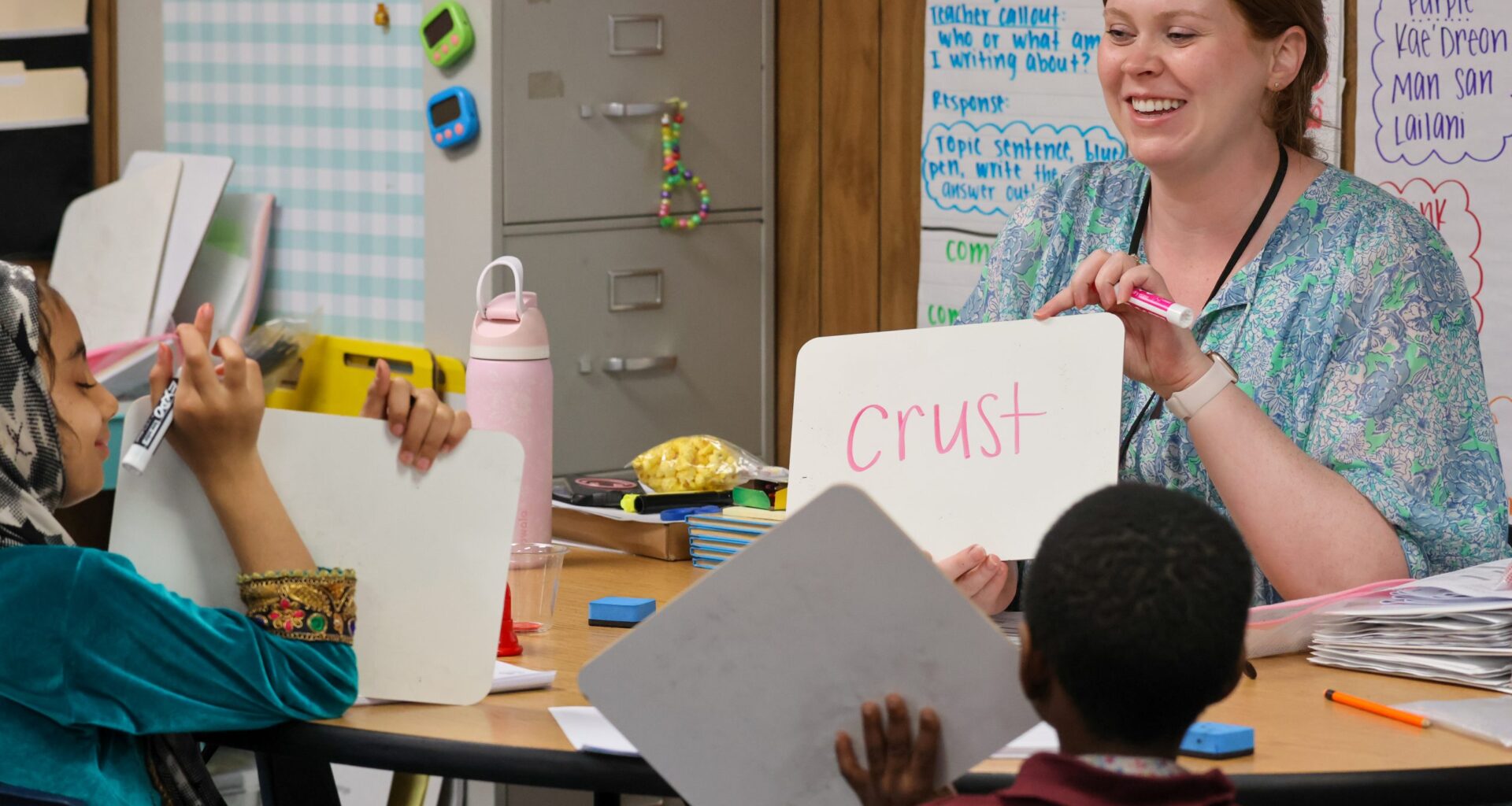
In another session, students practiced phonemic awareness — breaking words into individual sounds — before writing them on whiteboards. Jackson provided feedback to teachers in real time, helping them adjust the lesson based on what students needed.
The teachers receive feedback using a framework the program calls “two stars and a wish” — in which two strengths are detailed and one suggestion for improvement is given.
That combination of student support and teacher training is one of the program’s biggest strengths, Dugan said.
“Our teachers are using what they’re learning in Catch Up & Read in the classroom,” Dugan said. “For me, that’s the biggest bang for the buck.”
Clifford Davis leaders strategically selected second- and third-grade students to participate in the program this year. Some third graders, Dugan said, needed additional phonics instruction after experiencing disruptions in earlier grades.
The school serves families from many countries, with some students arriving to the United States with limited formal schooling, Dugan said. Those circumstances make early literacy instruction especially important.
“If they don’t get this phonics instruction systemically with that science of reading, then they’re even further behind than they already are,” the principal said.
Family engagement sessions help parents understand how reading instruction works and how they can support their children at home.
During one recent parent session, educators walked families through the five pillars of reading — phonemic awareness, phonics, fluency, vocabulary and comprehension — and demonstrated simple activities parents can practice with their children.
Even with language barriers, Dugan said many parents are eager to participate.
Catch Up & Read currently works with 27 elementary schools across North Texas, training more than 150 teachers and supporting more than 3,000 students in early grades. Goglia said the organization hopes to expand its work across Fort Worth ISD if the Clifford Davis program continues to show results.
“We know how important reading is not only for children personally but for their trajectory and for our whole community,” Goglia said.
Clifford Davis leaders will track student benchmark assessments and other internal measures to evaluate whether the program is improving reading outcomes.
But Dugan said she is already optimistic about the impact. She wants to see Catch Up & Read operating throughout Fort Worth ISD.
“It’s a good program,” she said. “I think it’s going to help the kids.”
Matthew Sgroi is an education reporter for the Fort Worth Report. Contact him at matthew.sgroi@fortworthreport.orgor @matthewsgroi1.
At the Fort Worth Report, news decisions are made independently of our board members and financial supporters. Read more about our editorial independence policy here.
This <a target=”_blank” href=”https://fortworthreport.org/2026/03/15/immigrant-refugee-children-catch-up-on-english-reading-skills-at-fwisds-clifford-davis/”>article</a> first appeared on <a target=”_blank” href=”https://fortworthreport.org”>Fort Worth Report</a> and is republished here under a <a target=”_blank” href=”https://creativecommons.org/licenses/by-nd/4.0/”>Creative Commons Attribution-NoDerivatives 4.0 International License</a>.<img src=”https://i0.wp.com/fortworthreport.org/wp-content/uploads/2021/04/cropped-favicon.png?resize=150%2C150&quality=80&ssl=1″ style=”width:1em;height:1em;margin-left:10px;”>
<img id=”republication-tracker-tool-source” src=”https://fortworthreport.org/?republication-pixel=true&post=445915&ga4=2820184429″ style=”width:1px;height:1px;”><script> PARSELY = { autotrack: false, onload: function() { PARSELY.beacon.trackPageView({ url: “https://fortworthreport.org/2026/03/15/immigrant-refugee-children-catch-up-on-english-reading-skills-at-fwisds-clifford-davis/”, urlref: window.location.href }); } } </script> <script id=”parsely-cfg” src=”//cdn.parsely.com/keys/fortworthreport.org/p.js”></script>