
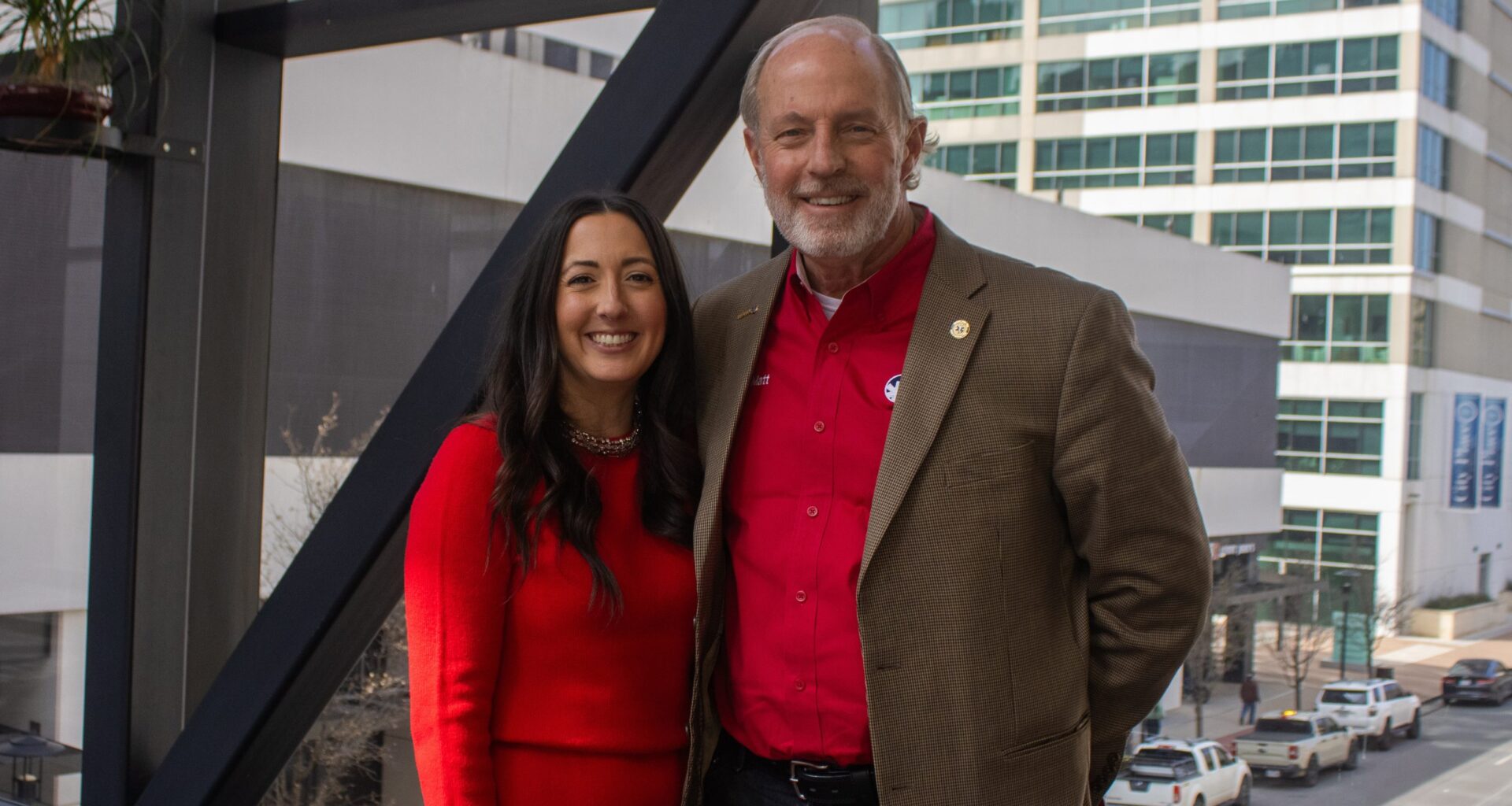
Speak with any heart health expert, they will likely point to King County, Washington, as the template for success.
For decades, the area has been a positive outlier nationwide for cardiac arrest survival rates. King County reached an all-time high in 2013 with 62% of cardiac arrest sufferers surviving the attack. The stats have stayed close to that number since, and locals in the region give credit to more people learning about the chain of survival: CPR, calling 911 and defibrillators.
Most of the country sits below a 10% survival rate for attacks that occur outside of a hospital setting. From Matt Zavadsky’s perspective, that national average “sucks.”
“We’ve invested so much time, energy, effort and money to improve cardiac arrest survival, but we really haven’t been able to move the needle,” said the vice president of PWW Advisory Group, a national consulting company for EMS and mobile health care organizations. “We need to figure out what’s the next thing we’re going to do that will really make an impact.”
The American Heart Association is looking to double that national survival rate. To that end, the nonprofit created the Nation of Lifesavers initiative in 2023, to train and equip regular bystanders with the tools needed to save a life.
Part of the initiative looked to pilot regional committees to bring local leaders into rooms to find solutions tailored to those communities. Tarrant County was one of three areas selected — with the others being Corpus Christi and the state of Colorado.
The simple task of this committee? To provide better training, education and funding to improve bystander reactions to sudden cardiac events.
“We know it can be done because there’s other communities that have much better outcomes than us,” said Jenny Eyer, vice president of community impact for the American Heart Association. “And it’s a lot easier to get them implemented if you have a group of people saying to do this rather than just the American Heart Association.”
That emphasis on educating the public may seem simple, but a bystander’s role is crucial prior to the arrival of medical professionals. Only 41% of patients nationwide receive bystander care, according to the Cardiac Arrest Registry to Enhance Survival.
And every minute that passes before CPR is performed, a person’s chances of surviving a cardiac arrest drop by 10%, according to the American Red Cross.
“We can’t always prevent a cardiac event from happening, so CPR is truly a pillar of our work,” Eyer said.
Since starting the committee in September 2024, the American Heart Association estimates 127,528 people in Tarrant County have become CPR-certified, partly because of efforts from committee members.
Who sits on the Tarrant County Nation of Lifesavers Committee?
Leaders from these organizations are members of the pilot program:
Baylor Scott & White The Heart Hospital.
Fort Worth Independent School District.
Fort Worth Police Department.
Deloitte.
HCA Healthcare.
Hurst‑Euless‑Bedford Independent School District.
MedStar.
Medical City Alliance.
PWW Advisory Group.
Reinhausen.
Many organizations in the pilot program take active steps toward change within their circles.
Most recently, Fort Worth Police announced their intention to equip 150 patrol cars with automated external defibrillators, or AEDs. The goal is for all 450 police department vehicles to have AEDs, public information officer Cynthia Wood said.
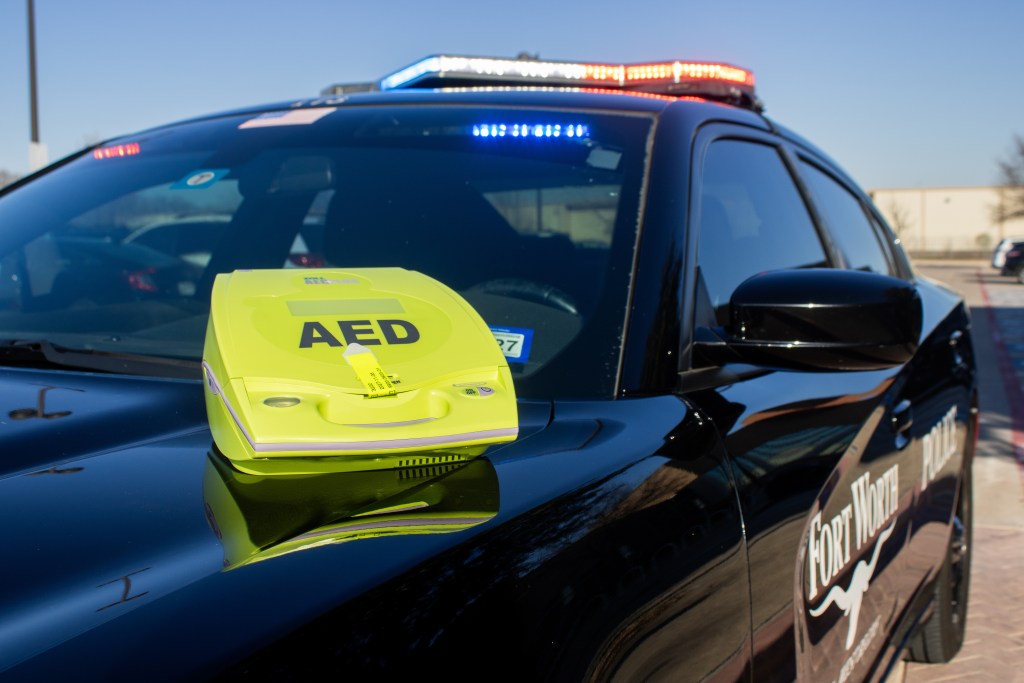 Automated external defibrillators will soon be installed in 150 Fort Worth Police Department vehicles. Photo taken Feb. 23, 2026. (Ismael M. Belkoura | Fort Worth Report)
Along with being valuable for the department — four police officers had AEDs used on them in sudden cardiac events over the last ten years — the defibrillators allow officers to provide care if they are first at the scene.
“It’s a success story — if they can help us, we can help the community as well,” Wood said.
The Texas Education Agency requires students in grades 7-12 to receive CPR instruction at least once. But the requirement, which is vaguely worded, didn’t provide students the training necessary for the skill to be applicable in a real-life situation, said Joe Harrington, superintendent of the Hurst‑Euless‑Bedford Independent School District, which aspires to better train students under the framework required by the state.
In some districts, the lax requirement led to only one video being shown to students within those six years. But HEB district leadership decided to go in another direction, increasing the number of its CPR kits from six to 66 and making sure that all eligible students received training on CPR dummies.
The school district also extended CPR training to fifth and sixth graders, Harrington said.
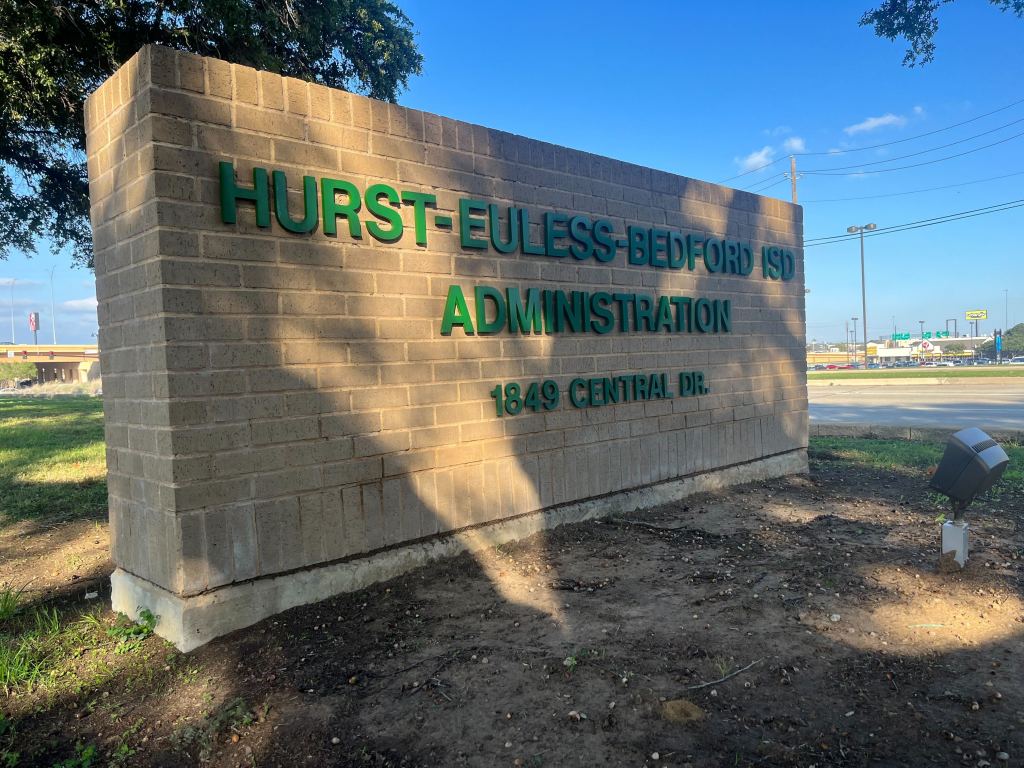 A sign outside the Hurst-Euless-Bedford ISD Administration Building at 1849 Central Drive in Bedford. (Matthew Sgroi | Fort Worth Report)
“Our goal eventually is that every kid is on the mannequin every year from fifth grade on,” he added. “We really feel that if we can do that level of muscle memory, then we’re going to create a society where it is second nature.”
These efforts led HEB ISD to receive the “District of Lifesavers” designation from the American Heart Association in 2024.
The work being facilitated by the committee isn’t exclusive to their members.
HEB ISD’s revamping of its CPR curriculum was noticed by other school districts. Harrington mentioned Carroll ISD as one of several that followed their template.
And outside the pilot program, other organizations are looking to work at improving bystander training.
Zavadsky, vice president of the Tarrant County Nation of Lifesavers Committee, said there are current plans to host a CPR bystander training at Dallas Fort Worth International Airport. They are also looking to promote bystander notifications to cell phones to alert folks who installed the application that others nearby are in need.
From his perspective, the only way that a nation of lifesavers can be created is by linking forces in Tarrant County to better improve that 10% rate.
“We would love to have more community input, because the more people involved, the bigger the difference you’ll get,” Zavadsky said.
Ismael M. Belkoura is the health reporter for the Fort Worth Report. His position is supported by a grant from Texas Health Resources. Contact him at ismael.belkoura@fortworthreport.org.
At the Fort Worth Report, news decisions are made independently of our board members and financial supporters. Read more about our editorial independence policy here.
This <a target=”_blank” href=”https://fortworthreport.org/2026/03/15/tarrant-county-looks-to-be-a-nationwide-leader-in-cardiac-arrest-survival/”>article</a> first appeared on <a target=”_blank” href=”https://fortworthreport.org”>Fort Worth Report</a> and is republished here under a <a target=”_blank” href=”https://creativecommons.org/licenses/by-nd/4.0/”>Creative Commons Attribution-NoDerivatives 4.0 International License</a>.<img src=”https://i0.wp.com/fortworthreport.org/wp-content/uploads/2021/04/cropped-favicon.png?resize=150%2C150&quality=80&ssl=1″ style=”width:1em;height:1em;margin-left:10px;”>
<img id=”republication-tracker-tool-source” src=”https://fortworthreport.org/?republication-pixel=true&post=446058&ga4=2820184429″ style=”width:1px;height:1px;”><script> PARSELY = { autotrack: false, onload: function() { PARSELY.beacon.trackPageView({ url: “https://fortworthreport.org/2026/03/15/tarrant-county-looks-to-be-a-nationwide-leader-in-cardiac-arrest-survival/”, urlref: window.location.href }); } } </script> <script id=”parsely-cfg” src=”//cdn.parsely.com/keys/fortworthreport.org/p.js”></script>