

Is Houston still an affordable place to live?
Houston is often touted as one of the most affordable cities in America, but with a limited housing supply, higher mortgage rates, zoning policies hitting the nation, and other pressures mounting, it’s hard not to wonder whether Houston—the fourth-largest city in the country—is still a budget-friendly place to live.
Not for long. According to the Kinder Institute for Urban Research, Houston’s affordability is “at risk” and strained by compounding factors, including flooding and rising insurance costs tied to the region’s climate vulnerabilities. To understand how these pressures are reshaping the city, it’s helpful to step back and examine Houston’s recent population and housing trends.
Harris County has surpassed 5 million residents, with much of its growth attributable to migration from outside Texas. Still, parts of Houston are experiencing population loss as suburban growth accelerates and Houston residents move out of the city. From 2018 to 2023, Alief experienced the largest population decline among Houston neighborhoods—roughly 10,000 residents. Sharpstown, Northside/Northline, Brays Oaks, and Pasadena (the second-largest city entirely in Harris County) each lost around 5,000 residents during the same period.
This shift can feel deceptive, particularly in the Inner Loop east of I-45, where new apartment complexes and townhouses seem to sprout up every day. The phenomenon has a name: central city stagnation. Steve Sherman, lead researcher on the Kinder Institute’s 2025 report, says areas like East Downtown illustrate “a common gentrification narrative.” “You see all this shiny new stuff coming up, but it doesn’t necessarily mean there are more people living there,” he says. “There may be more households, but there won’t be more people.”
These newer developments usually have units with up to two bedrooms, which means the households are smaller and typically don’t consist of families; that’s why more homes don’t always equal more people. Meanwhile, Sherman notes that most of the population growth is happening west of I-45. As the report shows, nearly every neighborhood in this area has added residents.
In addition, area residents are increasingly relocating to nearby counties, including Montgomery, Fort Bend, and Liberty. Within Harris County, some of the fastest growth is occurring in northwest areas like Cypress South, which saw a roughly 50 percent increase in population over the same five-year period, bringing its total to nearly 29,000 residents. Its surge was driven in part by large-scale developments such as Bridgeland. Katy and Klein also saw noticeable gains.
Separate data from the Houston Association of Realtors (HAR) reinforces the trend. In its recent Houston Housing Market Wrapped report, HAR identified the top zip codes for home sales in 2025 as 77493 (Katy), 77433 (Cypress), 77447 (Hockley), 77441 (Fulshear), and 77354 (Magnolia).
It becomes clear that, in some ways, Houston’s hottest neighborhoods aren’t in the city at all—they’re in the suburbs.
Sherman notes that residents leaving southwest Harris County or southwest Houston often cite school and housing quality issues as key factors in their decision. Development also plays a role. “There are certain places that are disproportionately…accounting for new housing growth,” says Sherman—particularly in the county’s northwest region. “And [the] thing is, developers wouldn’t be building those homes if there weren’t people wanting to move out there.”
Affordability gaps are prevalent in Houston and Harris County.
The divide between renters and homeowners further complicates Houston’s affordability story. Long considered a renter city, Houston saw a surge in homeownership during a post-COVID buying boom. From 2022 to 2023, Harris County and Houston each lost around 20,000 renter households, while their percentage of owner-occupied homes ticked up by about 1.5 points. Sherman cautions that such percentages might not continue to increase across the board. “There’s only so many owner-occupied homes or homes for sale out there, and so as stuff cleared out in that kind of post-COVID buying spree, my informed hypothesis is that those numbers are going to kind of start to resume their historical trend of declining,” he says.
Affordability gaps—the difference between what a median household income can afford to pay on a home and the actual median price of a home—are also widening in the city and county. “Home price should be between two and three times what your yearly income is,” Sherman says. In Harris County in 2024, the median home price of $325,000 was more than four times the median household income of $74,425. Sherman estimates that a household would need to earn approximately $120,000 to purchase a home in the county, and even more within Houston city limits, where the median home price ($345,000) is higher than that of Harris County. But in suburban counties with higher median household incomes ($100,000 in Montgomery County, for example) and median home prices similar to Harris County’s, the gap is a lot smaller, making it more affordable for people to purchase homes.
Affordability gaps are often further exacerbated for people of color, with Black and Hispanic communities struggling most with affordability. According to the Kinder study, rapid increases in land values can increase the risk of displacement. Data from 2018 to 2023 show that the median value of a parcel of land in Harris County increased by 56 percent, but several neighborhoods with majority-Black or Hispanic/Latino populations saw prices quadruple, leading to greater financial pressures, particularly as land values correspond to higher property taxes that many cannot afford.
Across Houston and Harris County, the Kinder study finds that about half of renters are also cost-burdened, defined as spending more than 30 percent of their income on rent. About a quarter are severely cost-burdened, devoting more than half of their income, mainly because wage gains have largely been erased by inflation.
The study goes beyond what people can afford. It also aims to highlight the link between Houston’s affordability and the effects of climate change. The institute’s findings show that air quality continues to be an issue for Houston as a whole, but specifically for nonwhite residents, and that many residents in flood-prone areas and communities with higher land surface temperatures are living in poverty.
Natural disasters and weather-related events—such as Hurricane Harvey, the derecho, and Winter Storm Uri—create an additional layer of costs and vulnerability for homeowners. According to the study, the average insurance policy for Houston homes, which often excludes flood coverage, was $3,325 in 2023, 43 percent higher than in 2015.
So, is housing still affordable in Houston? Compared to cities like New York or Los Angeles, yes—on paper. But as Sherman points out, the more pressing question is whether Houston incomes align with rising housing costs. Increasingly, they do not. And for many residents, the solution has been clear: move outward. —Sofia Gonzalez
The 10 Hottest Communities in the Houston Area
From HAR’s January 2026 report, based on fourth-quarter 2025 home sales compared to the year before.
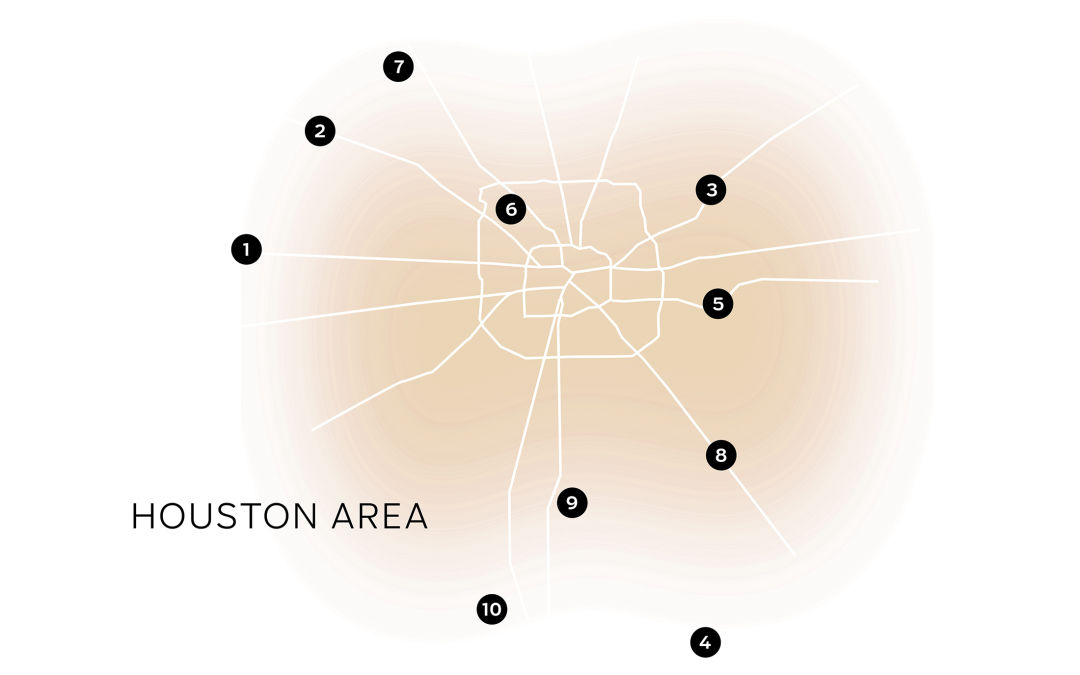
1. Brookshire
Just off I-10 in Waller County, this small city is seeing fresh subdivisions and retail follow close behind, appealing to residents who want more space and a quieter pace without losing connections to Katy and the metro area.
2. Waller
Straddling Harris and Waller Counties, this small city on the metro’s northwest fringe is pulling in buyers with lower home prices and a steady stream of suburban development.
3. Crosby Area
This historic, family-oriented zone in northeast Harris County keeps its small-town charm while offering easy access to Houston’s eastern suburbs and Lake Houston recreation.
4. Galveston–West End
On the quieter side of Galveston, the West End trades tourist crowds for open shoreline, vacation rentals, birding, and slower beach days, making it popular with buyers who want coastal living without the constant bustle.
5. Baytown
Formed in 1948 by merging three cities, Baytown is an energy-driven coastal hub known for its refineries, historic ferry, nature preserves, diverse housing options, and access to Galveston Bay.
6. 1960/Cypress
This area around FM 1960 features a mix of established neighborhoods and newer developments, offering everyday convenience and some of the more affordable home prices in northwest Houston.
7. Magnolia/1488 West
West of Magnolia’s town center, Magnolia/1488 West offers a rural retreat known for its wooded landscapes, abundant wildlife, spacious properties, and quiet country living within reach of Houston.
8. Friendswood
Between Houston and Galveston, this thriving suburb is known for strong schools, plentiful parks, and a variety of retail destinations, all within a close-knit community with easy access to both city life and the coast.
9. Manvel/Iowa Colony
These fast-growing Brazoria County communities are known for affordable home prices, strong schools, expanding developments, and proximity to the city’s job centers and outdoor recreation.
10. West of the Brazos
Near Lake Jackson, Angleton, and the Gulf, West of the Brazos is known for its larger lots, custom homes, and easy access to fishing, boating, and backyard space. —Brittany Britto Garley