
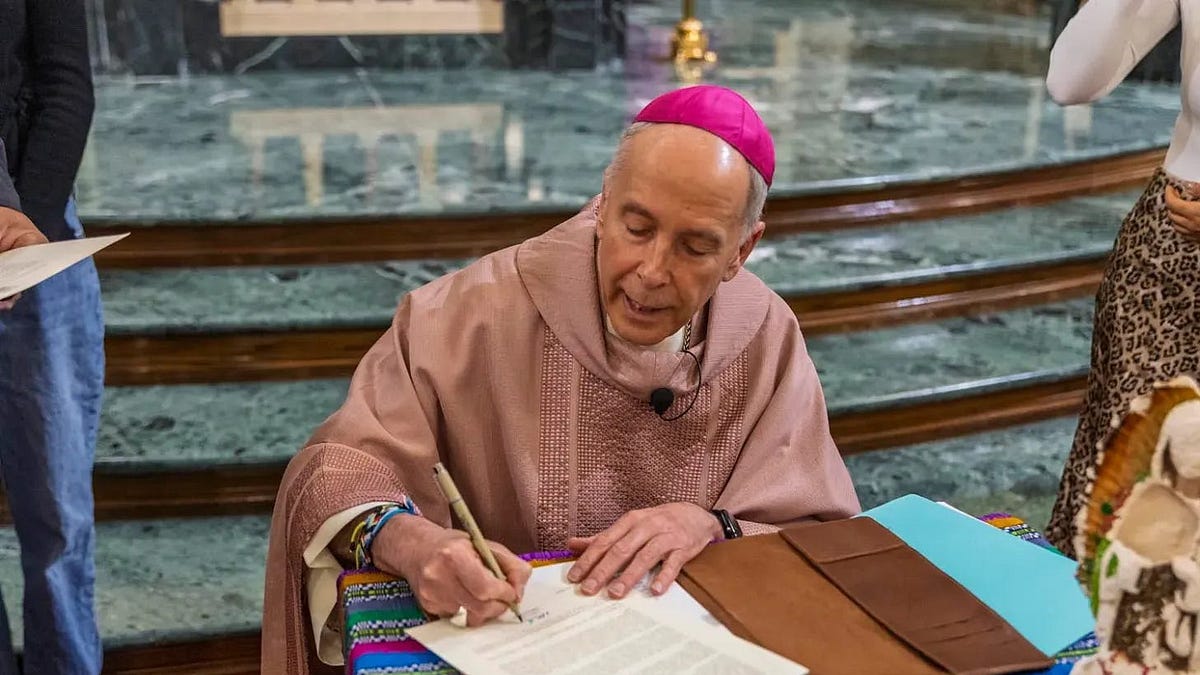

 El Paso Bishop Mark J. Seitz (left) signs his pastoral letter at St. Patrick Cathedral in El Paso on Sunday. Pope Leo XIV greets Bishop Seitz during an October 8 meeting at the Vatican between the pontiff and U.S. immigration advocates. Little more than a month later, the U.S. bishops’ conference issued a rare pastoral message condemning the Trump administration’s “indiscriminate mass deportation” of immigrants as an affront to “God-given human dignity.” (Photos: Fernando Ceniceros, Diocese of El Paso/Hope Border Institute)
This story has been updated.
By Gary Gately
El Paso Bishop Mark J. Seitz on Sunday denounced the Trump administration’s campaign of mass detention and mass deportation of immigrants as “a grave moral evil, one which must be opposed, with prayer, peaceful action and acts of solidarity with those affected.”
Bishop Seitz, a vocal advocate for immigrants for decades, delivered his sharp criticism of the policies in a pastoral letter, which he signed at St. Patrick Cathedral in El Paso and directed to be read Sunday at all Masses in the El Paso Diocese’s 55 parishes.
“To those of you affected by hatred and discrimination and afraid of what comes next, know that the Church stands with you,” Seitz wrote in the pastoral letter. “As your Bishop, I carry your pain daily in my heart and in my prayers. I stand with you.”
Pope Leo XIV employed those very words — “I stand with you.” — when speaking to Seitz and other members of a U.S. delegation of immigration advocates at the Vatican in early October. At the meeting, the first U.S.-born pontiff told the delegation that he hoped the U.S. bishops would become “stronger in their own voice” on immigration issues. Little more than a month later, the U.S. Conference of Catholic Bishops approved a rare pastoral message in a near-unanimous vote condemning the Trump administration’s “indiscriminate mass deportation” of immigrants as an affront to “God-given human dignity.”
In his new pastoral letter, the 71-year-old Seitz wrote: “Our Holy Father, Pope Leo XIV, told me personally to stand in solidarity with suffering migrant families and not to remain silent. I will do everything I can to uphold the God-given dignity of every person in our borderlands community.”
While acknowledging what he portrayed as the overdue need for “significant immigration reforms,” Seitz said in his message: “It is an injustice to make families, children and the vulnerable pay the price of our inaction…. I must make clear, the current national campaign of mass detention and deportations is a grave moral evil, one which must be opposed, with prayer, peaceful action and acts of solidarity with those affected.”
Seitz urged immigration enforcement officers to follow “the moral requirements of the Gospel at this moment with integrity and honesty,” adding: “No one has to obey an immoral order…. When we take off our masks and encounter each other as neighbors, we can reclaim our common dignity.”
“Our Holy Father, Pope Leo XIV, told me personally to stand in solidarity with suffering migrant families and not to remain silent.” — El Paso Bishop Mark J. Seitz, in his new pastoral letter
Directly addressing immigrants in the Texas border city, Seitz wrote: “In recent months, I have heard your fears, sufferings and worries about deportation. I have heard the stories about families being separated and of members being taken away from our community.”
Mass deportations, Seitz said in the letter, do not make communities safer but instead, separate families, divide neighbors and threaten the economic well-being of targeted communities.
He also lamented the deaths of three people since December at Camp East Montana, the ICE detention center at El Paso-based Fort Bliss, including that of Geraldo Lunas Campos. The 55-year-old Cuban immigrant’s January 3 death has been ruled a homicide, prompting calls for the immediate closure of the nation’s largest ICE detention facility, holding an average of about 3,000 detainees.
Human rights, civil rights and immigration organizations have documented horrific conditions at the detention center. In December, Human Rights Watch called for the closure of Camp East Montana, citing widespread beatings and sexual abuse by officers against detained immigrants; beatings and coercive threats to attempt to compel deportation to “third countries” other than immigrants’ home countries; medical neglect; hunger and insufficient food; and denial of meaningful access to counsel, among numerous other rights violations.
The Department of Homeland Security (DHS) had not responded to requests for comment on Seitz’s pastoral letter as of Wednesday morning.
Read the full text of Bishop Mark J. Seitz’s new pastoral letter.
Dylan Corbett, executive director of the El Paso-based Hope Border Institute, a Catholic organization that advocates for immigrants, praised Bishop Seitz’s pastoral letter.
“This is an important message because it categorically calls out mass deportations as a grave evil, one which, as the bishop says, must be opposed with acts of solidarity, peaceful protest and work to shape a more just system,” Corbett said in an email to The Catholic Observer.
Corbett — who along with Seitz, led the delegation of U.S. immigrant advocates who visited with Pope Leo at the Vatican in October — said it proved fitting that the bishop issued his pastoral letter after a breakfast meeting with immigrants, including some who had been detained at Camp East Montana. Other immigrants who have been deported participated in the meeting remotely.
“For Bishop Seitz,” Corbett said, “this isn’t a political issue…. It’s a letter grounded in an experience of encounter, and a strong sign of solidarity with all fearing the immigrant enforcement machine right now in our country.”
Corbett noted the that the letter’s “strong denunciation of the immigrant detention system” came after 11 deaths in ICE custody this year alone — and 32 last year, the highest in more than two decades.
“This is an important message because it categorically calls out mass deportations as a grave evil, one which, as the bishop says, must be opposed with acts of solidarity, peaceful protest and work to shape a more just system.” — Dylan Corbett, executive director, Hope Border Institute
At the October Vatican meeting, the delegation shared with Pope Leo more than 100 letters and a video featuring testimonies from immigrants in the U.S. The testimonies documented the level of fear and anxiety among many immigrants worried that they or the undocumented family members with whom they live could be deported to countries they had fled because of violence, poverty, hunger and persecution.
The testimonies brought tears to Pope Leo’s eyes, said Corbett, who hours after the meeting posted on X: “Today, with @BishopSeitz and members of the immigrant community, @HopeBorder met Pope Leo and gave him messages and a video from those fearing Trump’s mass deportations. ‘The church cannot stay silent before injustice. You stand with me. And I stand with you’, the pope said.”
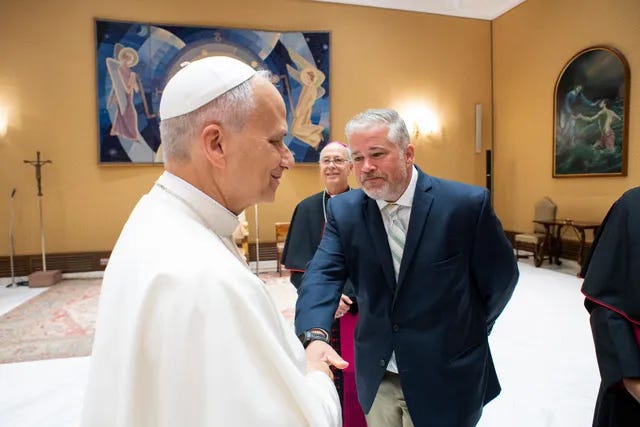 Dylan Corbett, executive director of the El Paso-based Hope Border Institute, greets Pope Leo XIV during an October 8 Vatican meeting between the pontiff and a delegation of U.S. immigration advocates. El Paso Bishop Mark J. Seitz (center, background) and Corbett led the delegation. (Photo: Hope Border Institute)
Seitz’s pastoral letter marks his third since Pope Francis appointed him El Paso Bishop in May 2013, less than three months after being elected the first Latin American pontiff.
The bishop’s letter follows months of mounting criticism over the Trump administration’s immigration crackdown from Leo, the U.S. bishops, priests, religious sisters, lay Catholics, immigration advocates and civil and human rights groups.
Seitz wrote his last pastoral letter before Sunday’s in the aftermath of a 2019 mass shooting at an El Paso Walmart in which the gunman drove 700 miles specifically to target Hispanics — and opened fire inside the store with a high-powered, semiautomatic rifle, killing 23 people and wounding 22 others in one of the deadliest mass shootings in U.S. history. The shooter expressed alarm about a “Hispanic invasion of Texas” in a lengthy manifesto in which he repeatedly referred to the “great replacement theory” — a racist conspiracy that claims white people are being replaced by non-whites, including immigrants, and by lower birth rates among whites than others.
“This mystery of evil also includes the base belief that some of us are more important, deserving and worthy than others,” Seitz wrote. “It includes the ugly conviction that this country and its history and opportunities and resources, as well as our economic and political life, belong more properly to ‘white’ people than to people of color. This is a perverse way of thinking that divides people based on heritage and tone of skin into ‘us’ and ‘them’, ‘worthy’ and ‘unworthy,’ paving the way to dehumanization.”
In his first pastoral letter, in 2017, Seitz referred to America’s “broken system of immigration” as a “wound on this border community,” adding: “It is a scandal to the Body of Christ in El Paso. As Christians, our mission is to announce the Kingdom in the midst of a world which often goes astray and needs to be encouraged, given hope and strengthened on the way. As God’s people here on the border, we are called to transform this desert, making refreshing pools of the burning sands of injustice and quenching the thirst of the oppressed.”
Trump, who made immigration a keystone of his campaign, won the Catholic vote in November 2024 by a larger margin than any presidential candidate in more than a half-century, in a nation where about 3 in 10 Catholics are immigrants and another 14% children of immigrants, a majority of people targeted for immigration detention or deportation are Catholics, and nearly 1 in 5 Catholics are vulnerable to deportation or live with someone who is.
The Trump administration has largely dropped “mass deportations” from its social media messaging in recent weeks as multiple polls show a significant majority of Americans believe that U.S. immigration enforcement has gone too far.
Immigration advocates welcomed what they called the long-overdue ouster of embattled Homeland Security Secretary Kristi Noem, but some expressed skepticism that the Trump administration will ease its aggressive mass deportation campaign and often-violent immigration enforcement tactics.
Trump announced on social media on March 5 that he had nominated to replace the 54-year-old Noem Senator Markwayne Mullin, an Oklahoma Republican and close ally of Trump’s who has vocally supported his administration’s brutal immigration enforcement tactics.
“The Trump administration overplayed its hand with the harsh immigration enforcement tactics on display in places like Chicago, Los Angeles and Minneapolis, and now public support for immigration reform and humane policies is growing,” Corbett said. “Although the departure of Secretary Noem is undoubtedly a result of this changing public opinion, as long as the administration remains committed to mass detention and mass deportations, little will change for ordinary communities and immigrant families across the country….
“Behind every policy, there is a human life impacted. Until we see a meaningful pivot in the administration’s approach, the deep moral, policy and constitutional challenges on the issue of immigration will undoubtedly continue.”
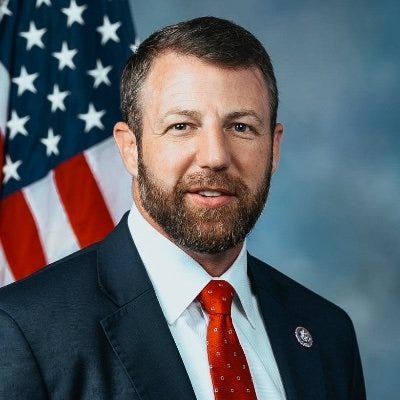 U.S. Senator Markwayne Mullin, an Oklahoma Republican, has been nominated by President Donald J. Trump to replace ousted Homeland Security Secretary Kristi Noem. (Photo: X)
DHS has shown no indication that it plans to scale back its plans to spend $38.3 billion to acquire warehouses across the country and convert them into immigration detention centers, more than doubling detainee capacity to over 150,000.
Noem’s firing came after she faced two days of intense grilling during congressional hearings, at which she refused lawmakers’ repeated demands that she apologize — and retract — her statements accusing U.S. citizens Renee Good and Alex Pretti of “domestic terrorism” after their January fatal shootings by immigration agents in Minneapolis.
Lawmakers also sharply questioned Noem about a $220 million taxpayer-funded DHS ad campaign, which included a $143 million contract to Safe America Media, and about reports of her affair with aide Corey Lewandowski, who has close ties to a Safe America subcontractor, The Strategy Group. That firm is led by CEO Benjamin Yoh, the husband of Tricia McLaughlin, who until mid-February had been DHS’s assistant secretary for public affairs since the beginning of Trump’s second term.
The departure of the brash McLaughlin, a Catholic, came during scrutiny of the contract and just days after revelations that DHS had not reported for nearly a year an ICE agent’s killing of U.S. citizen Ruben Ray Martinez as he celebrated his 23rd birthday at the popular spring break destination South Padre Island, Texas. DHS had said in the immediate aftermath of Martinez’s March 15, 2025, killing that the agent fired “defensive shots” at him after he “intentionally ran over” another agent.
Newsweek, which first reported on Martinez’s killing on February 20, has since obtained officers’ body-cam video footage contradicting the DHS account. The video shows an ICE Homeland Security Investigations (HSI) agent firing three shots through Martinez’s driver-side window as he attempted to drive off. Martinez is shown steering away from another agent brandishing a gun near the front right side of the car, but it’s unclear whether the car brushed that agent.
In his rambling, record-long State of the Union address on February 24, Trump never uttered the names of Renee Good or Alex Pretti, the 37-year-olds whose deaths were captured on multiple viral videos that contradicted the administration’s accounts of their killings, leading to nationwide outrage. Nor did Trump mention widespread criticism over not only undocumented immigrants but also nonviolent, unarmed U.S. citizens, being dragged from cars and homes, tackled, tased, beaten, put in dangerous chokeholds, pepper-sprayed and tear-gassed. And the president did not bring up deplorable conditions and deaths in immigration detention centers; rampant racial profiling; unjustified use of force; unlawful arrests and denial of due process rights; or plans to transform warehouses across the country into mass detention centers for tens of thousands more immigrants.
Related: