
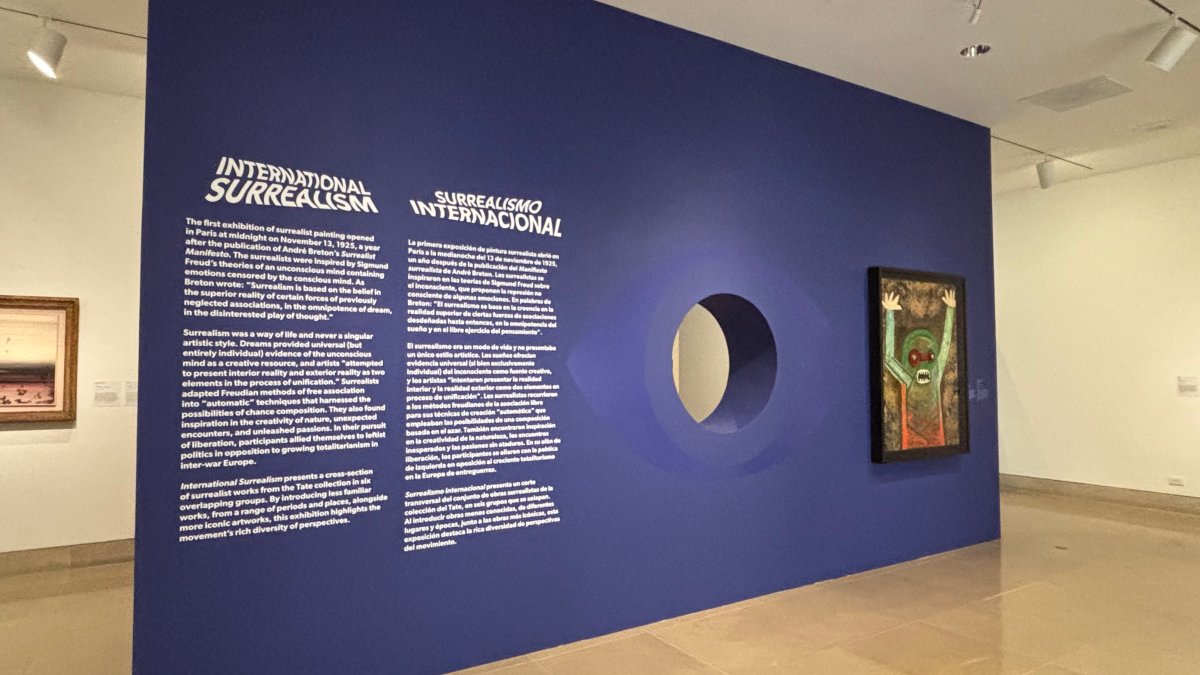
Exactly 100 years after first exhibition of surrealist art, the Dallas Museum of Art highlights the story of the art movement through its most iconic artists in International Surrealism, now on view through March 22.
The exhibition includes more than 100 works by international artists as curated by Matthew Gale, the former Senior Curator at Large, Tate Modern. The Dallas presentation is curated by Sue Canterbury, the Dallas Museum of Art’s Pauline Gill Sullivan Curator of American Art.
“Surrealism wasn’t just a movement or a singular artistic style, it was a way of life,’ Canterbury said. “This exhibition offers our viewers a glimpse into this revolution of the mind and the evocative, fantastical and often unsettling images that surrealism produced.”
Inspired by Sigmund Freud’s theories of an unconscious mind containing emotions censored by the conscious mind and his methods of free association, these artists investigate dreams, desire, nature, and politics with different techniques and mediums.
TateTate
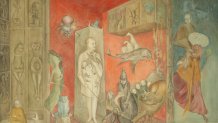
Leonora Carrington, Transference, 1963, Tate, presented by Tate Americas Foundation, purchased with assistance from the Latin American Acquisitions Committee 2017, accessioned 2021. © 2025 Estate of Leonora Carrington / Artists Rights Society (ARS), New York.
In Transference, Leonora Carrington explores her relationship with her psychoanalyst.
“She talked about the idea of transference, where we transfer our certain emotions and things onto the other person, which happens. And so, this whole thing is about that sort of transference or that transformation from one step or another. She’s tapping into all these wonderful sort of mythological things that she had encountered in Mexico,” Canterbury said.
In Paul Delvaux’s Sleeping Venus, a Renaissance-style image of a reclining female nude is surrounded by figures representing death and fear. The turmoil in Delvaux’s life inspired this surrealist version of a classic.
“He basically later shared that he painted this while Brussels was under bombardment during World War II. And for him it was almost like a prayer for peace, but he said it just was a really very terrifying time, so he brought these two together,” Canterbury said.
Sex is a common theme among surrealists.
“The surrealists basically were trying to change those social norms about sex, gender, identity, all sorts of things and they were trying to challenge all these concepts. And it generally took a mode where it was really about, for men, the fetishization of the woman. And so, as the movement moved on and more women came in, those sort of ideas were starting to be challenged,” Canterbury said.
Hans Bellmer first made a realistic doll as a reflection of his obsession with his cousin. In this exhibition, his 1936 version of The Doll is less realist, but still disturbing.
“He would have sort of a basic structure, but then he would add other anatomical parts, or modified anatomic parts. So, are you looking at the bottom or the top of the torso? It looks like she has two bones on the backside,” Canterbury said. “This sort of fetishization was something that really annoyed the surrealist women.”
Not far from The Doll is Leonor Fini’s Untitled (Praying Mantis), a reference to the female insect who devours her male partner after mating.
“It sort of balances out this sort of fetishization that is going on in this particular wall,” Canterbury said.
TateTate
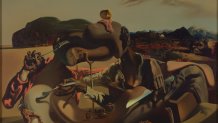
Salvador Dalí, Autumnal Cannibalism, 1936, Tate, purchased 1975. © 2025 Salvador Dalí, Fundació Gala Salvador Dalí, Artists Rights Society.
One of the most well-known surrealists, Salvador Dalí, is represented in this exhibition by his reaction to politics. His Autumnal Cannibalism is a response to the brutality of civil war.
“If you come look closely, yes, there are some of the melting features. You can think of the melting clocks in some of his other paintings. But this painting actually is about his experience in the Spanish Civil War. He basically saw his fellow countrymen fighting with each other. They were cannibalizing each other. They were cannibalizing Spanish culture by attacking each other. They’re digging their forks into each other, and scooping out, and stabbing each other, and eating one another,” Canterbury said.
Surrealists used their traditional professional training to try new things, consider different perspectives and in turn, they inspired future generations of artists around the world to express their surreal existence.
“You need to know the rules so you can break them. And they already knew the rules, and they were ready to break them,” Canterbury said.
Learn more: Dallas Museum of Art