
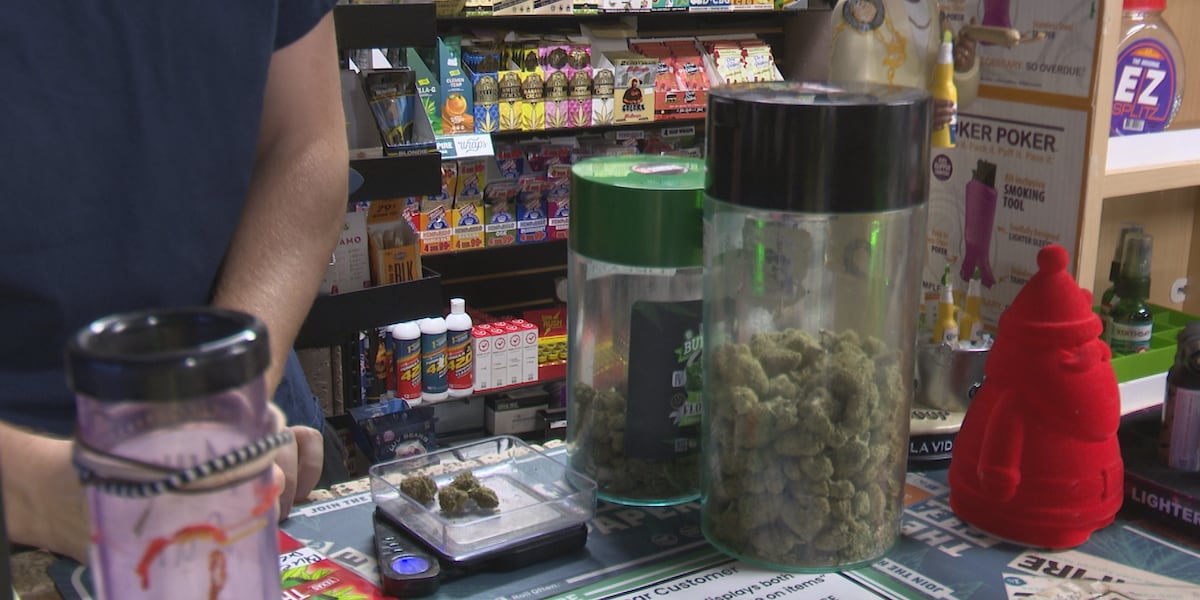
BRYAN, Texas (KBTX) – New hemp regulations taking effect March 31 will pull most smokable cannabis products from Texas store shelves — the latest development in a years-long legislative battle over tetrahydrocannabinol, commonly referred to as THC, in the state.
What’s changing March 31
The new rules adopt a “total THC” calculation that includes THCA — a compound that converts to Delta 9 THC when heated. Delta 9 is the primary psychoactive ingredient in cannabis. By factoring in THCA, most smokable hemp products will no longer meet the legal threshold to be sold in Texas.
Edibles will remain legal but must be sold in child-resistant and resealable packaging.
The regulations also significantly raise annual fees for hemp businesses:
Current FeeNew FeeRetailers$150 per location$5,000 per yearManufacturers$250 per year$10,000 per year
The March 31 deadline is the result of a lengthy and complicated legislative process.
During the 2025 regular session, the Texas Legislature passed Senate Bill 3, which would have banned THC products outright. Gov. Greg Abbott vetoed it at the last minute, citing a similar Arkansas law that had been tied up in court for two years. Abbott called lawmakers back to Austin, pushing for regulation rather than an outright ban.
Lawmakers tried again in the first special session with Senate Bill 5, which passed the Senate but stalled in the House. It returned as Senate Bill 6 in the second special session and hit the same roadblock.
Before the broader regulations were settled, House Bill 2024 took effect Sept. 1, 2025, banning the sale of vapes containing cannabinoids like THC, as well as nicotine products manufactured in China.
The push to restrict THC products drew strong opinions on both sides.
Supporters of a full ban argued the hemp industry was exploiting legal loopholes. Kaufman County District Attorney Erleigh Wiley testified before the Senate State Affairs Committee, saying lawmakers were dealing with “a drug industry that is preying on young people.” Chambers County Sheriff Brian Hawthorne said, “Under the false label of hemp, we have allowed illegal marijuana and THC products to infiltrate our state.”
On the other side, advocates argued that access to hemp-derived THC products provides an affordable alternative for people who rely on them for medical reasons. Romana Harding, a Navy veteran, founder of Texas Veterans for Medical Cannabis and constituent of Brazos County Sen. Charles Schwertner, testified before the committee about her personal experience.
“This was a deep, moral injury that led me to alcoholism and other hard drugs. Alcohol has killed two of my brothers and both of my biological parents,” Harding told lawmakers. “In their name, I have switched to cannabis to save my life.”
Harding noted that under the state’s Compassionate Use Program, legal cannabis products can cost around $575 a month, compared to roughly $90 for comparable products currently sold on store shelves.
Abbott also signed legislation expanding the Compassionate Use Program, making those with chronic pain, Crohn’s disease and people in hospice care newly eligible.
Defense attorneys raised concerns about legal clarity, arguing that vague regulations contributed to wrongful arrests and prosecutions.
What remains legalEdibles, with new child-resistant and resealable packaging requirementsHemp products containing CBD or CBG, which do not produce an intoxicating effectProducts with less than 0.3% Delta 9 THC under the existing standard
Copyright 2026 KBTX. All rights reserved.