
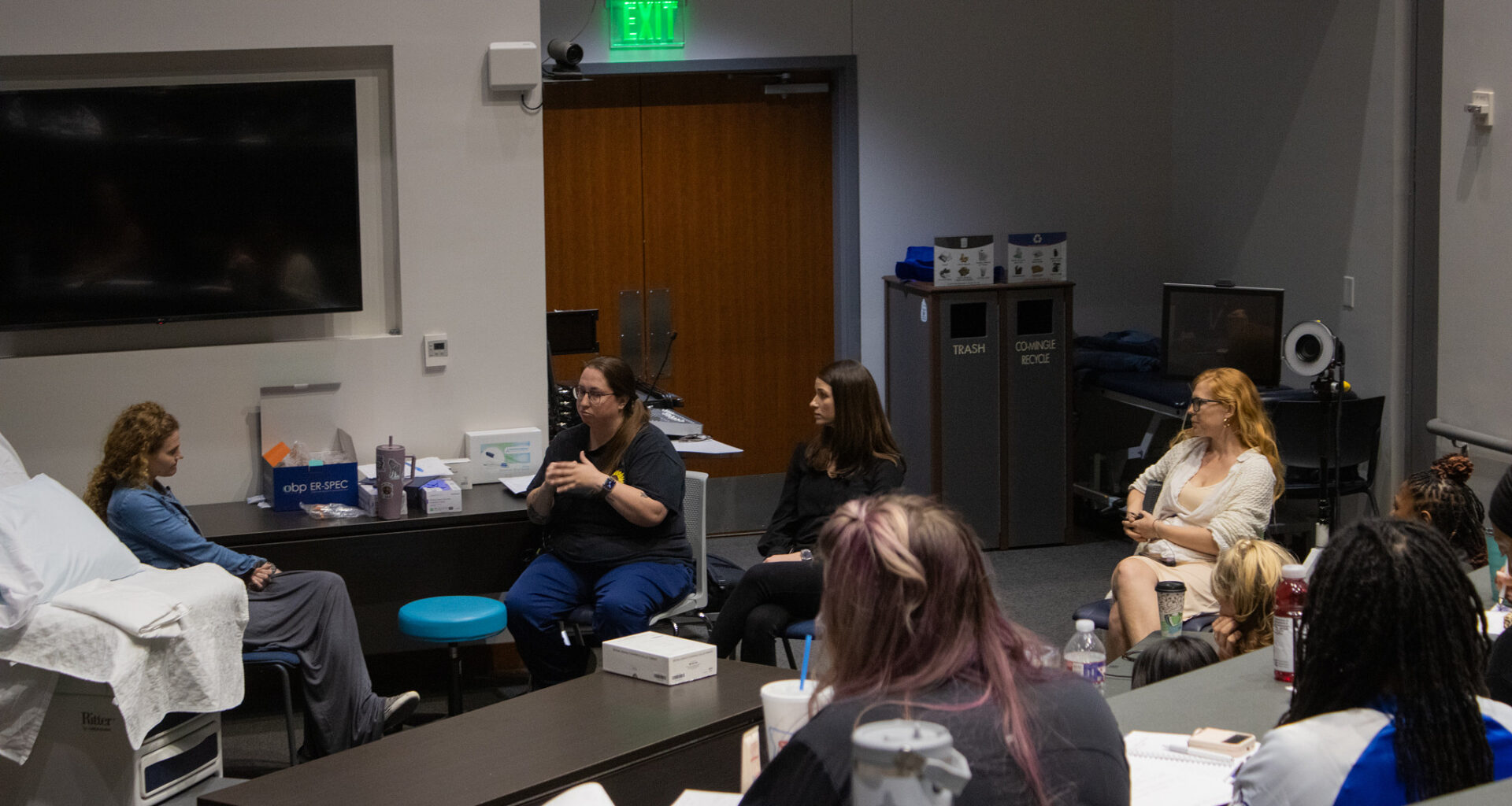
A woman sitting before a nurse and victim advocate quietly described graphic details of a sexual assault.
“I absolutely needed and desired to be heard.”
Those words were uttered by an actor portraying a domestic violence survivor during a demonstration at UNT Health Fort Worth. However, her outcry is an all-too-real feeling expressed to nurses in such traumatic situations.
Sexual Assault Nurse Examiners, or SANEs, are specialized health care workers who provide trauma-informed care and medical services to a victim of sexual assault.
Just over a third of Texas counties have SANE programs, illustrating a growing need to provide the certification necessary to better equip nurses to serve patients.
In order to streamline the pathway for nurses to receive the certification, UNT Health created the North Texas Area SANE Consortium. The program began in August to train nurses on how best to interact with victims while also properly securing evidence and testimony.
“We have set up infrastructure to really help support that pipeline,” said Nancy Downing, professor at the UNT Health College of Nursing and consortium project director.
The demonstration is an early part of the coursework. The 20 nurses participating watched the simulated examination play out as the SANEs demonstrated how to ensure a victim is medically treated while collecting evidence.
All the intricacies — ranging from how a patient might lead the conversation to the important timely decisions needed from the victim — were all on display in the simulation.
“They even were addressing the shame cycle — interrupting that and making sure you’re emphasizing that this is a safe space for the patient,” said Alita Whitaker, a nurse at UT Southwestern.
The demonstration came during the third week of classes for the consortium, allowing the nurses to visualize the various lessons.
And although not every situation will echo the training demonstration, consortium learners found it very useful.
“They’ve done a really good job informing us of what we need to do going in, but also reassuring us that we’re not going to have everything down to a T immediately,” Whitaker said.
A growing need — regionally and nationally
The North Texas Area SANE Consortium is the third Texas university-based effort funded by a $1.5 million grant from the Health Resources & Services Administration’s Advanced Nursing Education – SANE program.
Started in 2018, the federal fund sought to improve national rates of SANE certification. Only about 17%-20% of hospitals nationwide have such nurses on staff, according to the American Nurse Journal.
Texas A&M University Health Science Center and Texas A&M International University were the first schools in the state to receive the funding. UNT Health is the newest addition, leading the consortium alongside other local partners.
North Texas Area SANE Consortium members
UNT Health.
Tarrant County College Division of Nursing.
One Safe Place.
JPS Health Network.
North Texas Area Community Health Centers.
The Women’s Center of Tarrant County.
Classroom learning and clinic training are required for certification.
Several Tarrant County hospitals and rape crisis centers employ SANEs. While several offer the clinic training, few schools statewide provide the classroom education necessary. Even fewer provide the classroom coursework in person.
The consortium pathway is a game changer for the service, said Priscilla Kenyon, manager of Forensic Nursing Services at JPS.
“Not only have they mastered the ability to get students to sign up into the didactic training,” Kenyon said, “but in having these established clinical training sites, and us working collaboratively, we are able to shorten the amount of time it takes to get SANE-certified.”
What is the difference between SANEs and forensic nurses?
SANEs are a type of forensic nurse who are specifically trained to provide trauma-informed care and give medical examinations to sexual assault victims.
Forensic nurses provide trauma-informed care and medical examinations to victims of violence, including sexual assault, domestic assault, strangulation and general abuse.
The benefit is not isolated to hospitals.
SANE certification isn’t required to complete sexual assault exams but has become an industry gold standard, Downing said. Patients who see a forensic nurse are more likely to engage with the legal investigation of the crime committed against them, Kenyon added.
Currently, 550 nurses in Texas have the certification, compared to less than 400 in 2019.
“We have a waiting list of 100-people long for our 60-plus available learner positions,” Downing said. “We’re hoping to get more resources to meet the demand.”
Part of UNT Health’s work includes helping a North Texas hospital to create its SANE program, Downing added. And university officials announced last week a no-cost, micro-credential in forensic nursing for SANEs who want additional education in supporting victims of violence.
Meanwhile, the consortium created an online network of SANE coordinators to converse with each other and provide ongoing support.
Why give a training demonstration?
Simulating an exam is not a required part of the certification.
But the instruction is invaluable, said Barbara Gilchrist, a Fort Worth-based nurse for over a decade, especially considering the actors mirror what a forensic nurse examination would look like.
“What we have here is people that are dedicated to this practice, who are teaching us how to take care of people while they’re taking care of us,” Gilchrist said.
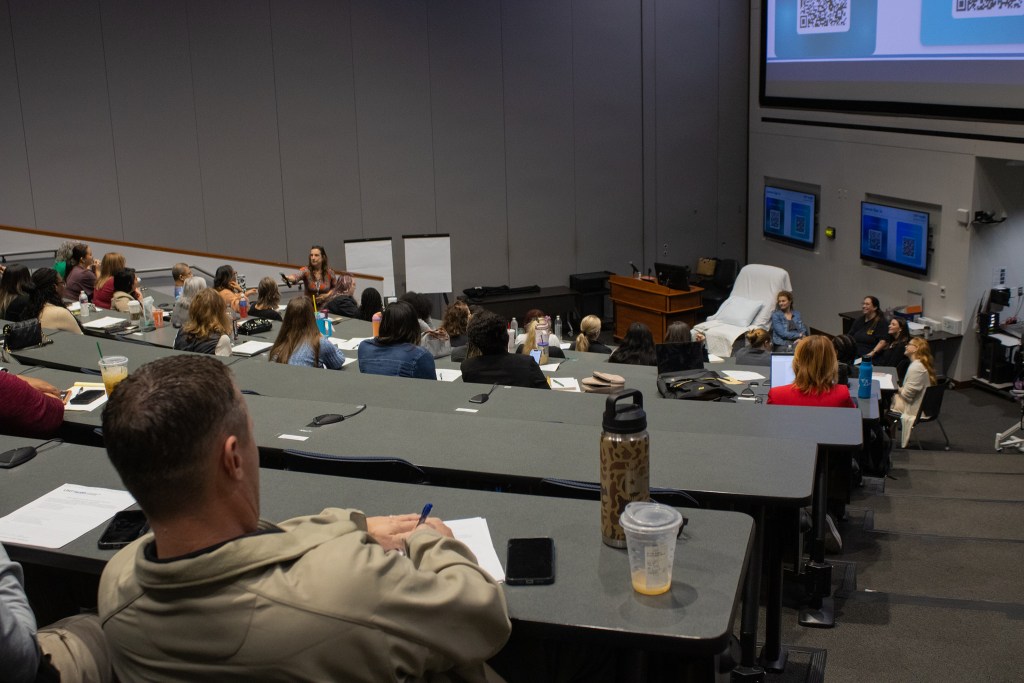 Nurse learners and community partners watch the simulated forensic nurse examination at UNT Health Fort Worth on March 3, 2026. (Ismael M. Belkoura | Fort Worth Report)
Several online courses provided by institutions nationwide offer nurses the opportunity to get the classroom education necessary.
But the in-person system provides an alternative, said Jenny Black, director of forensic nursing at UNT Health.
“Being able to provide all of these components in person just makes for a very rich learning environment,” she said.
Ismael M. Belkoura is the health reporter for the Fort Worth Report. His position is supported by a grant from Texas Health Resources. Contact him at ismael.belkoura@fortworthreport.org.
At the Fort Worth Report, news decisions are made independently of our board members and financial supporters. Read more about our editorial independence policy here.
This <a target=”_blank” href=”https://fortworthreport.org/2026/03/16/sexual-assault-nurse-education-streamlined-through-unt-health-education-pathway/”>article</a> first appeared on <a target=”_blank” href=”https://fortworthreport.org”>Fort Worth Report</a> and is republished here under a <a target=”_blank” href=”https://creativecommons.org/licenses/by-nd/4.0/”>Creative Commons Attribution-NoDerivatives 4.0 International License</a>.<img src=”https://i0.wp.com/fortworthreport.org/wp-content/uploads/2021/04/cropped-favicon.png?resize=150%2C150&quality=80&ssl=1″ style=”width:1em;height:1em;margin-left:10px;”>
<img id=”republication-tracker-tool-source” src=”https://fortworthreport.org/?republication-pixel=true&post=450033&ga4=2820184429″ style=”width:1px;height:1px;”><script> PARSELY = { autotrack: false, onload: function() { PARSELY.beacon.trackPageView({ url: “https://fortworthreport.org/2026/03/16/sexual-assault-nurse-education-streamlined-through-unt-health-education-pathway/”, urlref: window.location.href }); } } </script> <script id=”parsely-cfg” src=”//cdn.parsely.com/keys/fortworthreport.org/p.js”></script>