
Applications for families hoping to use public funds to pay for private school during the 2026-2027 academic year will remain open until 11:59. They are available on the state website for Education Freedom Accounts, controlled by the Texas Comptroller’s office. The application period started on February 4, and demand is high.
The program — known as Education Savings Accounts, or ESAs — allows families to use state funds to help pay for private school tuition, tutoring, and other education-related expenses.
An update on Monday from acting Comptroller Kelly Hancock said more than 200,000 applications have already been filed for students hoping to participate. Under the program, families can receive about $10,474 per student each year, with significant increases for students with disabilities that could exceed $30,000.
The program is funded at around $1 billion in the first year, enough to serve only about 1.5% of Texas students. The gap between interest and availability is expected to create intense competition for spots.
Who is applying
Data released by the state offers a clearer picture of the families applying for the program — and where students are coming from.
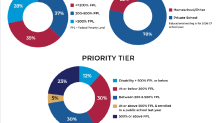
According to a state fact sheet, applicants span a wide range of income levels:
35% come from families at or below 200% of the federal poverty level
37% fall between 200% and 500% of the federal poverty level
28% come from families earning more than 500% of the federal poverty level
The data also shows that most applicants are not currently in public schools.
About 78% of applicants plan to attend a private school
About 22% are in homeschool or other settings
The state also groups applicants into priority tiers, with:
12% qualifying as students with disabilities in lower-income households
About 30% at or below 200% of the federal poverty level
Another 30% in the middle-income ranges
North Texas applications:
State data shows thousands of applications are coming from North Texas school districts, including some of the largest in the region.
Among the highest totals:
Dallas ISD: more than 6,700 applications
Fort Worth ISD: about 3,700 applications
Plano ISD: about 3,600 applications
Frisco ISD: more than 2,100 applications
Arlington ISD: about 2,000 applications
Garland ISD: about 2,000 applications
Northwest ISD: about 2,000 applications
Lewisville ISD: about 2,000 applications
Other North Texas districts also reported significant numbers, including:
Denton ISD: about 1,600 applications
McKinney ISD: about 1,300 applications
Mesquite ISD: more than 700 applications
Grand Prairie ISD: about 500 applications
The data reflects broad interest across both urban and suburban districts in North Texas.
Participating schools
The state has also been building out a network of approved education providers as the program launches. More than 2,200 private schools have opted in to accept voucher students, according to a state website.
A significant number of those participating schools are located in North Texas, giving families in the region multiple options if they are selected for funding. The site lists more than 650 schools in the Dallas-Fort Worth region.
How the selection process works
State rules prioritize certain students, even though any eligible family can apply.
Applications will be given priority in the following order:
Students with disabilities, particularly from lower-income households
Families with lower incomes at or below 200% of the federal poverty level.
Families between 200-500% of the federal poverty level.
Families at or above 500% of the federal poverty level.
What happens next
The state says applications are not first-come, first-served; instead, all submissions will be reviewed after the deadline at 11:59 p.m. Tuesday. After the application window closes, the state will begin reviewing submissions and awarding funds based on its priority system and available budget. The state says any sibling of a student selected for the program will also automatically be admitted.
Decisions on who receives funding are expected later this spring, with funds distributed ahead of the next school year.
Confusion over students with disabilities & additional funding
Due to limited funding, not every applicant will receive a voucher, and those not selected may be placed on a waitlist.
State officials say students with disabilities are prioritized in the voucher program, but families should understand how services may differ outside the public school system.
According to the state’s program website, private schools are not subject to the same federal and state requirements as public school districts when it comes to providing special education services.
That includes protections under the Individuals with Disabilities Education Act (IDEA), which guarantees certain services and supports for students in public schools.
The state directs families to review their rights under federal and Texas law before enrolling, noting that services available in a private school setting may not match those provided in a public school or charter school.
Additional guidance from the Texas Council for Developmental Disabilities highlights several key differences families should consider:
Students do not keep their IEP if they leave the public school system
Private schools are not required to accept students with disabilities
Private schools are not required to provide the same services listed in an IEP
There was also confusion about the program rules to qualify for additional funding for special education services. Legal documentation proving a child received a special education evaluation from a public school can take months. The Comptroller’s office has since added a form that a physician or other qualified professional can complete in place of the full assessment and IEP.
State guidance also clarifies that while students with disabilities may qualify for up to $30,000, that amount is not guaranteed and is based on the level of services the student would have received in public school.
In some cases, qualifying for the higher funding level requires documentation tied to a student’s special education status in public school, such as an Individualized Education Program.