
Jim Duncan, a retired city planner, has written more than 600 short histories of Austin businesses. We introduced him and this series, “Jim Duncan’s Austin,” on July 6. This week, we adapt four of his histories of Mexican restaurants. — Michael Barnes

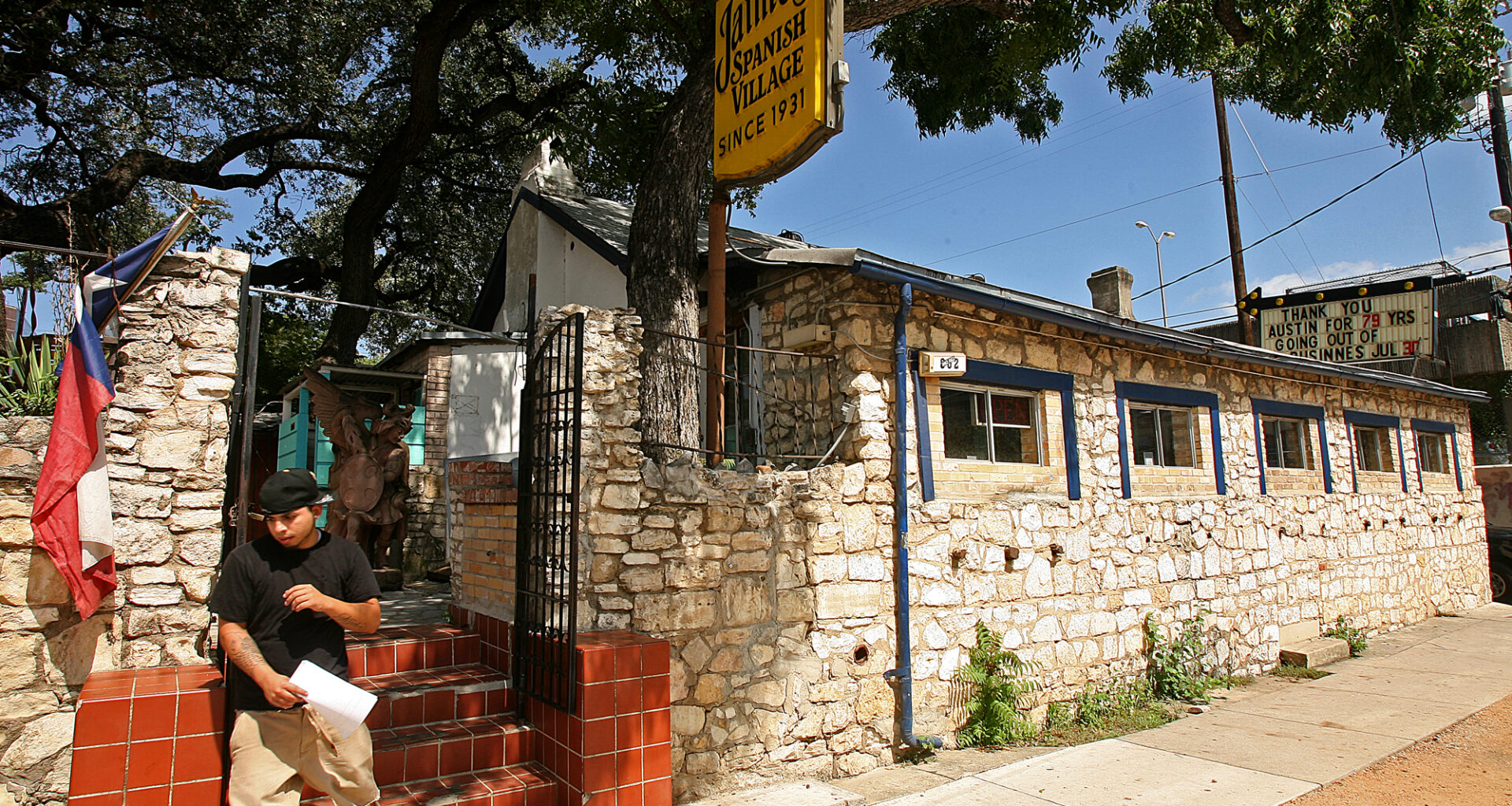
1938: Spanish Village / Pelons Tex Mex
Restaurants, starting with Spanish Village, have been serving Tex-Mex at Red River and East Seventh streets since 1938.
Alberto Martinez/Austin American-Statesman
Before it became the oldest café in Austin to have continuously served Mexican food, the six-room stone structure at 802 Red River St. functioned as a residence for more than two decades. Located near the Capitol and the University of Texas, the restaurant was especially popular with politicos and students.
Article continues below this ad
Built in 1915 by Joseph Curry, the structure was converted to a restaurant in 1938 by Jay W. Caldwell. It has since had three more owners: Alexander Alanis “Lupe” Abieta from the mid-1950s to 1979, Jaime M. Tames and Charlie Tames from 1980 to 2011, and Douglas Walter Guller and Tasha Miller since.
For more than 70 years, the restaurant was known by variations of “Spanish Village.” In 2012, it was rebranded “Pelons” in honor of owner Guller (“Pelons” is Spanish for “bald one”). Abieta died in 1983, Caldwell in 1990 and Jaime Tames in 2007.
Today, Spanish Village and Pelon’s salsas and queso are sold online and at Whole Foods, Central Market and Royal Blue Grocery.
1952: Matt’s El Rancho
Matt’s El Rancho on Wednesday September 1, 2021.
Jay Janner / American-Statesman, Austin American-Statesman
Matt Gonzales and Janie Gayton Martinez opened El Rancho in 1952 at East First Street (Cesar Chavez) and San Jacinto Street with $75 cash and a $300 loan.
Article continues below this ad
In the beginning, Gonzales worked the front of the 10-seat café and Martinez ran the kitchen. They had no employees. Gonzales’ dad, Delfino, had immigrated to Austin from Monterrey, Nuevo León, and made tortillas and tamales for a living. Matt had gotten his first taste of entrepreneurship at the age of six, peddling tamales near the Capitol.
El Rancho’s first menu featured only blue-plate specials, such as chicken-fried steak. It was Martinez’s occasional enchilada special, however, that garnered the most attention, and it wasn’t long before Mexican food took over the menu.
In 1986, Gonzales sold the downtown property to the developer of the Four Seasons Hotel Austin for $5 million and relocated El Rancho to five acres at 2613 South Lamar Blvd.
Article continues below this ad
El Rancho now seats more than 600 diners and has the highest alcohol sales of any restaurant in Austin, thanks to margaritas. Of its current $20 million in annual revenue, one-third is alcohol-derived.
Matt’s is still family-owned and operated by Gonzales’ daughters, Gloria, Cecilia and Cathy, and his daughter-in-law, Estella. His son, Matt Jr., moved to Dallas and became a well-known restaurateur, celebrity chef and author. The elder Gonzales died in 2003, Matt Jr. in 2009 and Martinez in 2013.
1958: Tamale House
A gently flowing fountain is the focal point of the lush courtyard of Tamale House East.
Austin 360
From a tiny walk-up window at West First Street and Congress Avenue, Moses Steve Vasquez and his wife, Carmen, sold tamales to hungry downtown Austinites for over two decades.
Article continues below this ad
Governor Mark White said, “Tamale House an institution, and Moses was the master. Best tamales in Austin. Enjoyed them for years. Wish I had six right now.”
Carmen Vasquez called it “just a shack. When it rained, customers waiting in line got wet. I felt so sorry for them.”
Moses had bought the property in 1969 for $80,000, with $4,000 down, and he earned money playing with a Spanish and Calypso band. Before that, he rented.
Their five children all helped. Then came the real estate boom of the 1980s, and Lincoln Properties offered them $1.6 million for their “shack” to build a high-rise office building, which was at the time the highest ever per-square-foot real estate sale in Austin.
Article continues below this ad
They accepted and used the money to open four new Tamale Houses in South Austin (2218 College St.), the UT campus (2825 Guadalupe St.), Delwood (5003 Airport Blvd.) and East Austin (1707 East Sixth St).
In 2001, the Austin Chronicle awarded Tamale House “Best reason to wake up before 3 p.m. (when they close).”
Carmen died in 2001 and Moses in 2014.
1973: Rosie’s Tamale House
The combination plate No. 1’s beef taco at Rosie’s Tamale House.
Amber Novak/For American-Statesman
For more than 50 years, Rosie’s Tamale House has been a primary source of Tex-Mex food in far west Travis County. It all began when Joe Estanislas Arriaga and his wife, Mary Rose, opened Rosie’s in 1972 in an old vacant gas station at the corner of Texas 71 and FM 620. Eventually, the restaurant became a family affair involving their daughter and five sons.
Article continues below this ad
In 1984, they lost their lease and moved farther west to 13436 Texas 71.
From day one, Rosie’s has been a popular stopover for those heading to Lake Travis and the Hill Country. A review by RoadFood described it as “a rough-and-tumble roadside eat-place that sells excellent Mexican food at rock bottom prices.”
Rosie’s has had its share of celebrity customers, including Darrell Royal and George Strait. They also have a Willie’s Plate named after their Spicewood neighbor.
Unfortunately, the Arriagas were not able to transfer their success in the boonies to the big city. During the 1980s economic downturn, they opened a second café in Lincoln Village on North Interstate 35. It lasted only five years.
Article continues below this ad
In 1993, they tried again at 13776 Research Blvd. It closed in 1997. Joe died the same year.
Rosie’s advice to the budding entrepreneur is: “Go slow, start little and grow.”
Three recent articles in this series
Before Uber and craft cocktails, Austin had Roy’s Taxi, the Cloak Room
Article continues below this ad
Peter Pan Mini-Golf, Hofheintz-Reissing Compound, Robinson-Rosner Building
A taste of Austin’s oldest bakeries, including Joe’s and Mrs. Johnson’s
Please send tips and questions to mbarnes@statesman.com.
Article continues below this ad