
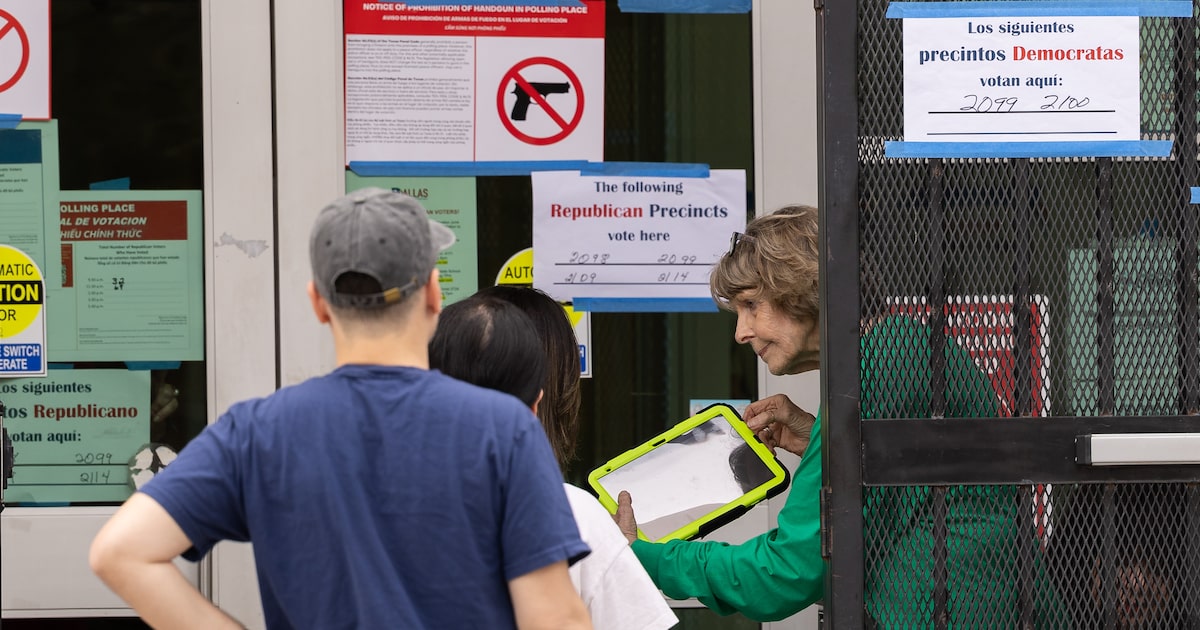
After a primary day marked by mass confusion and voters turned away at polls, Dallas County’s elections chief is trying to scrap the precinct system pushed by Republicans and return to countywide voting for the May 26 runoff.
Elections Administrator Paul Adams said Tuesday that restoring vote-anywhere access would prevent a repeat of March 3. But Texas law requires both parties to agree to the countywide system for election day during a primary, leaving the fix dependent on GOP leaders whose decision to revert to precincts triggered widespread disruptions and backlash.
Party Chair Allen West did not return calls and text messages this week asking if he would agree to the change for the runoff’s election day to allow voters to cast a ballot at any location regardless of their address.
Adams said he pitched returning to countywide voting to both parties last week in response to the chaos on March 3. While the Democratic Party is eager for a return to the universal system, West, according to Adams, was entertaining the idea as long as the runoff remains a non-joint election. That means Republican voters would use separate workers and equipment at locations shared with Democrats like they did for the primary.
Breaking News
“Returning to countywide voting is important for our voters, and whatever I can do to help make that happen, I’m going to do that,” Adams told The Dallas Morning News.
Countywide voting remained in place during the primary’s 10-day early voting period, and would again for the runoff’s early voting, because county officials control that period under the election code.
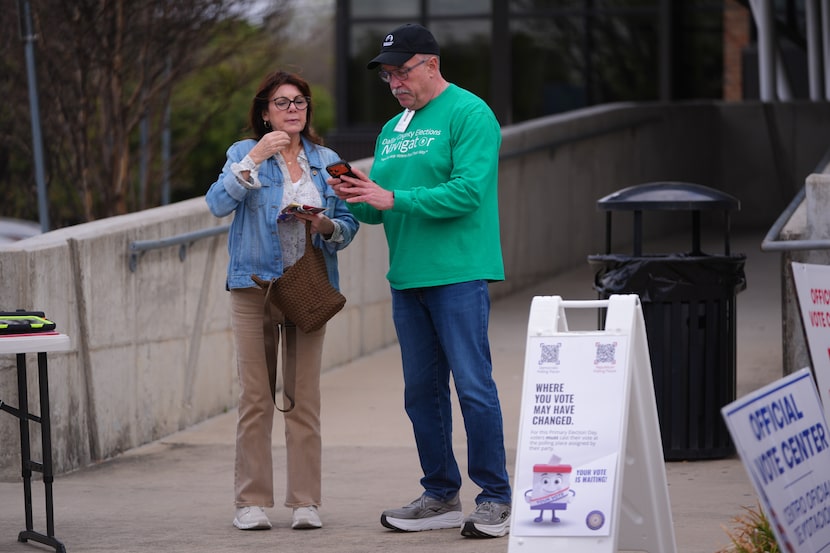
Dallas County election navigator Edwin Hightower Jr. (right) helps a voter who arrived at the wrong polling station find her correct voting location in Dallas, Tuesday, March 3, 2026. (AP Photo/LM Otero)
LM Otero / AP
How it changed
More than 200 Republican precinct chairs voted last year to break from a jointly administered March 3 primary with Democrats and use precincts on election day. West called it an effort to reduce fraudulent activity, although research shows voter fraud is exceedingly rare in the U.S.
The GOP’s decision resulted in members of both parties showing up to what had been universal voting sites since 2019 and being rerouted to their assigned neighborhood precincts. Voters of both parties complained about the lack of privacy the separate primary created during the early voting and election day period.
During a discussion on the issue Tuesday, members of the Commissioners Court said they did what they could to warn voters of the switch through $1 million spent on digital and social media ads and direct mailers. The county also trained and stationed navigators at the busiest polling sites to direct lost voters to their correct precincts, but commissioners advocated for a return to countywide voting.
“The parties have to come together and we cannot afford to make these mistakes just for the sake of voter fraud and all kinds of issues that do not really exist,” Commissioner Elba Garcia said.
Democratic Party Chair Kardal Coleman said he is fighting for a return to countywide voting and a joint election for the runoff.
The non-joint setup with voters of both parties using separate workers and equipment at shared locations put enormous strain on the election’s department, Adams said. In some cases Democrats had to wait in line for one of their party’s machines to be freed up while those reserved for Republicans sat empty due to the rules of the separate primary.
Coleman said Republicans should not be congratulated for “taking a half step” toward doing the right thing for the public.
“We should not limit access to voting for the electorate, and we should not take up archaic practices in order to disenfranchise voters,” Coleman told The News. “Voters have had enough of that” and “they will speak against that whether they are Democrats or Republicans.”
Adams said there is no way to confirm how many voters were redirected to other polling sites on March 3, or how many gave up in frustration. However, navigators sent 12,674 text messages to redirected voters that shared a map of their correct precinct, giving a hint of the scope.
Commissioners praised Adams for his handling of a scenario he didn’t choose. He began the job Oct. 1 after leading elections in Lorain County, Ohio, which is one-sixth the size of Dallas County.
Voter frustration
But some voters found blame to go around.
Community activist Tamara Pleasant noted how voting machines failed in some polling places, causing lines and wait times. She said not all voters saw the county’s outreach warning them of the changes about precinct voting.
“If we have no right in our life, we have a right to vote because people died, were hung, were beaten to have this right to vote, my ancestors,” Pleasant told commissioners. “People that I know did not understand why the integrity was gone, the disruption happened, the suppression was massive and we thought we had allies in you all.”
Adams confirmed there was a series of failures of voting machines and said the age of the equipment played a role. The Commissioners Court paid $25 million in 2019 to purchase its voting equipment from the vendor Election Systems & Software. Commissioners acknowledged the machines were approaching the end of their useful life and the county will have to look toward replacement soon.
“There’s nothing else before this court that’s any more important than this equipment and the confidence in this equipment and whatever it takes, we’ve got to do it,” Commissioner John Wiley Price said.
Runoff resetElections chief wants countywide voting back in the May 26 runoff after primary confusion.Precinct-only system turned away hundreds of voters March 3.Change requires GOP approval, Democrats already on board.Voters were rerouted, separate systems slowed lines.Officials don’t know how many gave up voting.