
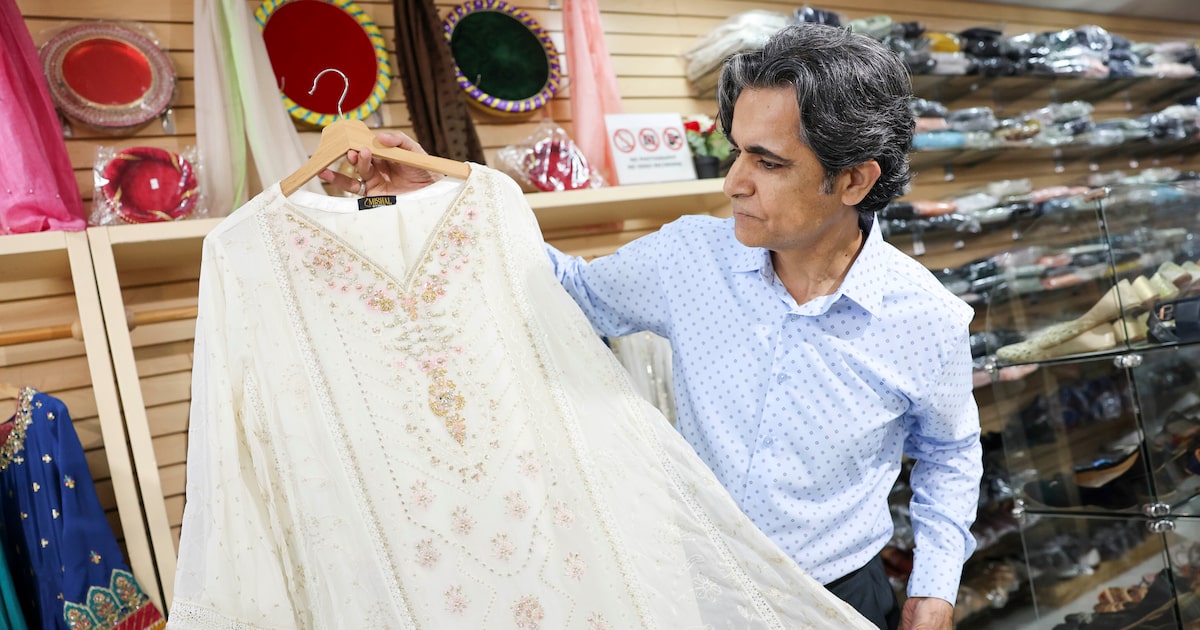
Abid Malik, owner of Mishal Studio in Plano, greets customers at his Pakistani clothing boutique with the familiarity of family.
Amid rows brimming with embroidered and beaded garments, he helped solo customers and families alike Tuesday to find traditional pieces for Eid al-Fitr, a holy day that marks the end of Ramadan.
For many Muslims, it’s a tradition to buy new clothes to wear for Eid al-Fitr, often referred to as Eid. The holiday this Friday is a time for family, renewal and celebration. For local businesses, it’s one of the busiest times of the year.
“We fast for 30 days,” Malik explained. “Then we celebrate.”
Breaking News
Related
Malik’s establishment sells traditional clothing for men, women and children, from dresses to dress coats, shoes to jewelry. Many of the garments, ranging from subdued hues of blue and white to rich purples and teals, feature hand-stitched embroidery.
While the store imports its goods from Pakistan and sells styles traditional to South Asia, Malik said his customers come from a variety of backgrounds, including from Middle Eastern and Western countries and traditions.
“I love doing it,” he said of running the store. “Playing with colors, dealing with people every day from all age groups, all different backgrounds, faiths.”
The days during Ramadan before Eid al-Fitr are his busiest, and he started procuring merchandise for the holy day as far back as July 2025. Ramadan is not at the same time every year and since Ramadan is during the spring season this year, pastel shades of purple, green, blue and yellow are in style.
Malik showcased formal dresses for women, shalwar kameez, both short and long, many in chiffon fabric. For men, Mishal carries kurta pajamas, a knee-length tunic outfit, along with embellished waistcoats to elevate the look.
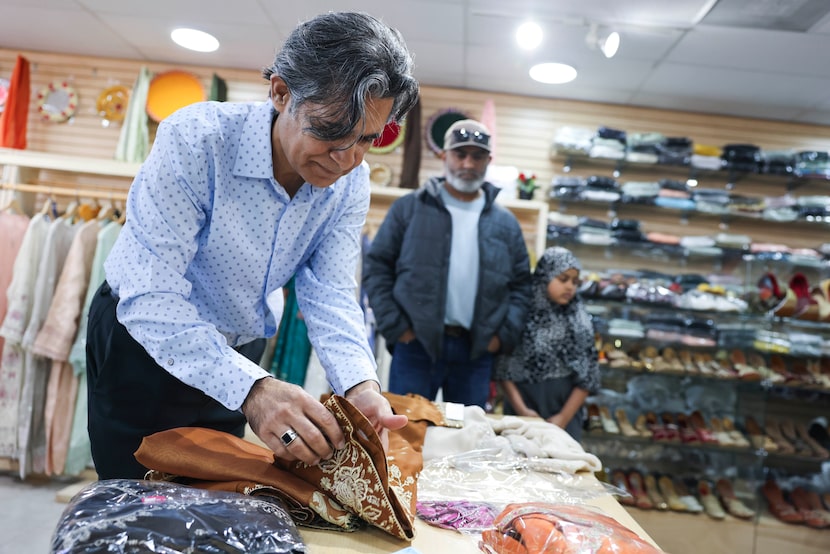
Mishal Studio owner Abid Malik packs a dress for Arif Shareef (back) ahead of Eid al-Fitr, on Tuesday, March 17, 2026 in Plano.
Shafkat Anowar / Staff Photographer
A recent trend for Eid in recent years is for families with children to coordinate their outfits.
Arif Shareef of Sachse, 42, brought his family, along with his four children, all under the age of 14, to Mishal Studio Tuesday to shop for new clothes for Eid.
“This is one of those places where the kids love wearing the stuff from here because it’s not sticky or itchy,” he said. Shareef and his wife also enjoy the variety of fabric and colors available.
For Eid, the family plans to wake early for morning prayer and go to the local mosque. Afterwards, they’ll have a gift ceremony for the children. In the afternoon, they will gather with about a dozen other families to celebrate with different meals with dishes from India and Pakistan.
Related
In their subdivision, Shareef will invite non-Muslim neighbors over as well.
“That’s also one of our critical parts of celebration,” he said.
As the South Asian population and Texas population has grown in the past decade, so has Malik’s business. Many immigrants who moved to the area 30 to 40 years ago are now seeing their children grow up and marry. Groomswear is a speciality for the boutique.
“People love staying in Texas,” Malik said.
A chance to go “all out”
There’s more to dressing up for Eid al-Fitr than just the attire. Outside Mishal Studio, University of Texas at Dallas students Huria Mehdi, 21, and Mariyah Syed, 20, run a pop-up henna business.
Henna, also called mehendi or mehndi, is a South Asian art form using temporary dye paste to create elaborate designs on hands and palms. It’s often applied for special occasions like weddings or holidays.
“Eid is a day that you can go all out,” Mehdi said.
Syed described Eid as a chance for a fresh start. It’s popular not only to buy new clothes but to clean the home, give gifts, take pictures and gather with family over meals.
For Muslim women, henna is another way to dress up for the holy day. Syed and Mehdi’s designs range from floral and botanical patterns, to fine lines and geometric designs. Syed and Mehdi also like to do henna for young children and families.
Last year, Mehdi was shopping at Mishal Studio when Malik learned she could do henna. He offered for her to sit outside the store ahead of Eid, where she and Syed will be most of this week.
The two met at the University of Texas at Dallas where they are premed students, and both learned henna by practicing on family. This is the holiday that they will set up at the Plano location.
What is Eid al-Fitr?
Eid al-Fitr, which means “the Festival of Breaking the Fast,” according to Harvard University’s Pluralism Project, is one of two major holy days in Islam, the other being Eid al-Adha, which marks the end of the Hajj, the pilgrimage to Mecca in Saudi Arabia.
The exact timing of Eid al-Fitr depends on the sighting of the moon, as the Muslim calendar follows a lunar calendar. Many masajid or mosques in North Texas are marking the first day of Eid with prayer services on the morning of March 20, with festivities continuing on throughout the weekend.