
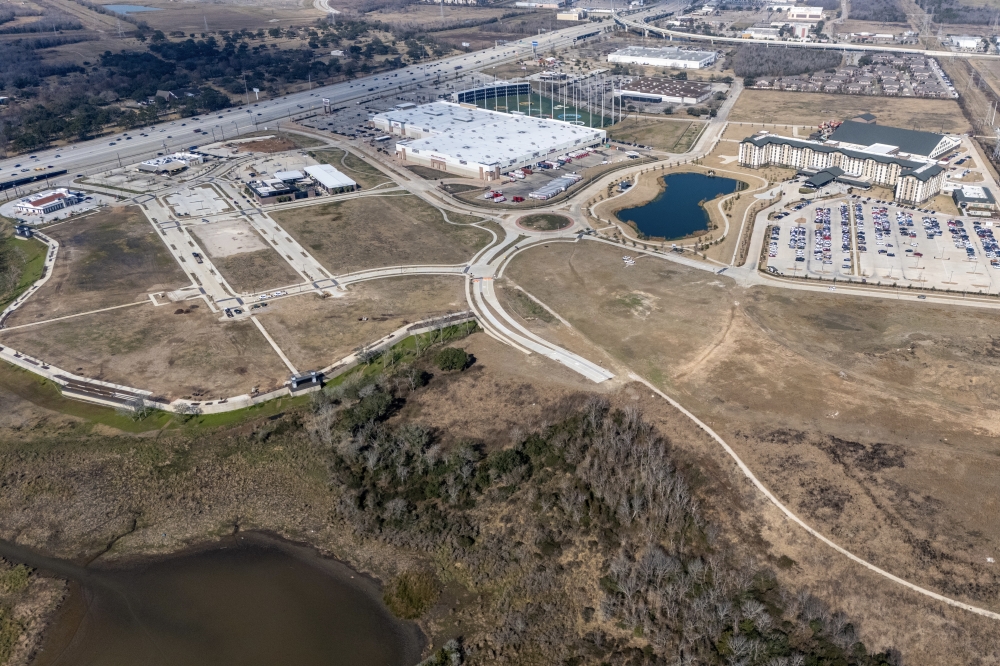
Driving south of I-45, visitors encounter development around Baybrook Mall, new hotels and increased retail along NASA Parkway, and early infrastructure work tied to the Flyway district, an 80-acre hub planned to combine entertainment, dining and hospitality uses.
The big picture
While the city is just under 7 square miles in size and has a population of 12,500, Webster sits along a “prime position” of the I-45 Gulf Freeway corridor, which encounters about 250,000 vehicles that travel daily, according to city documents.
With the city of Webster being about 80% commercial, strides have been made to support regional destination development, Webster Marketing and Tourism Specialist Katie Vela said.
“Webster’s approach evolved from a clear understanding of our commercial footprint and where we are positioned regionally,” Vela said. “We are a predominantly commercial city with limited undeveloped land, so being strategic about how and where we grow has always mattered.”
Just outside of Webster sits Baybrook Mall, NASA’s Johnson Space Center and Midline—a 1,600-acre master-planned development slated to start bringing 2,800 single-family homes this spring—right at the west border of the city, as previously reported by Community Impact.
“>
How we got here
 Measuring the impact
Despite having about one-tenth the population of League City, Webster’s sales tax allocations—the amount of taxable sales occurring within the city—have come close to matching League City each January since 2016.
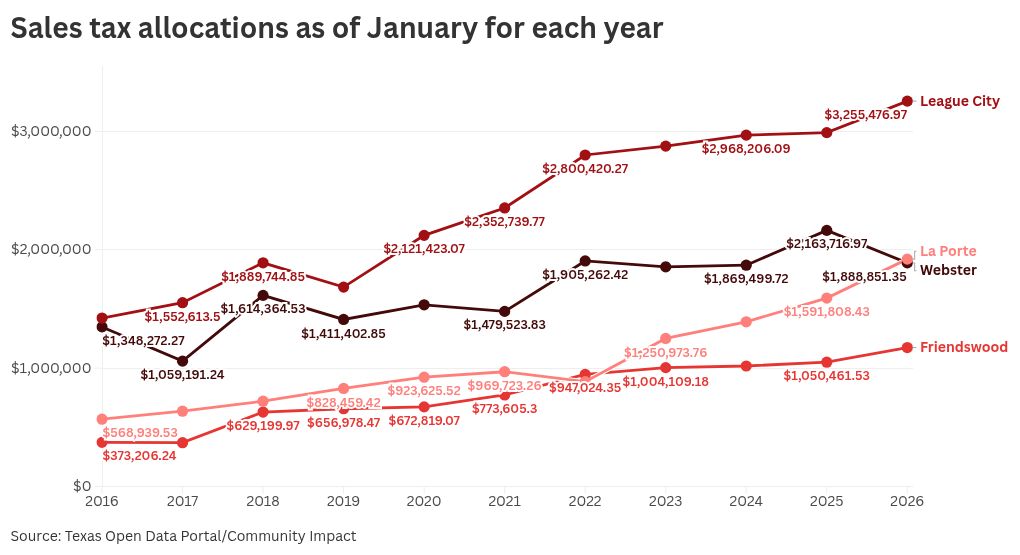 While Webster ranks higher in sales tax allocations, it has the smallest population compared to neighboring cities. Population figures are from the U.S. Census Bureau’s 2020 and 2024 American Community Survey five-year estimates, reflecting 2016 to 2020 and 2020 to 2024 data.
In comparison
League City typically avoids offering incentives by choice of its elected officials, Economic Development Director Scott Livingston said.
League City Mayor Nick Long added that “new development must pay for itself.”
“The taxpayers are not willing to subsidize private development,” he said. “The city will certainly consider economic development incentives, but the project must pay for itself and create a significant [return of investment] for the taxpayers.”
By contrast, Webster has used Chapter 380 agreements, otherwise known as financial incentive agreements, for Great Wolf Lodge, American Furniture Warehouse and Chicken N Pickle, according to city documents.
While Vela did not cite a specific incentive, she said the city’s “certainty and responsiveness” often set it apart.
What’s next
As development continues, major projects remain in the pipeline, including IKEA, Sprouts and the rest of Flyway, which has about nine parcels available, according to its website.
With Webster’s ongoing contributions to development in Houston’s Bay Area, Brian Freedman, president of the Bay Area Houston Economic Partnership, said the city will continue to be a “major player” in the regional economic development space.
“All the cities down here have their focus areas of what they want to develop, and how they want to see it developed,” he said. “Webster’s doing exactly that.”
Coming soon
Ale & Ivy
Opening early 2026335 Royal Tern Way, WebsterSlick City Action ParkOpening in April20750 Gulf Freeway, WebsterIKEAOpening in the summer19801 Gulf Freeway, WebsterHCA Houston Healthcare Clear Lake expansionExpanding by late 2026500 W. Medical Center Blvd., WebsterSprouts Farmers MarketOpening in 20271001 W. Bay Area Blvd., WebsterGauchos Do SulOpening TBD415 Royal Tern Way, WebsterSunset Amphitheater HoustonOpening TBD901 Royal Tern Way, Webster